
EVEREST GROUP Advances Under Bermuda Monetary Authority’s Group Supervision Framework
Everest Group, Ltd. navigates intensified regulatory landscape with strategic capital and portfolio actions while sustaining underwriting and investment performance.
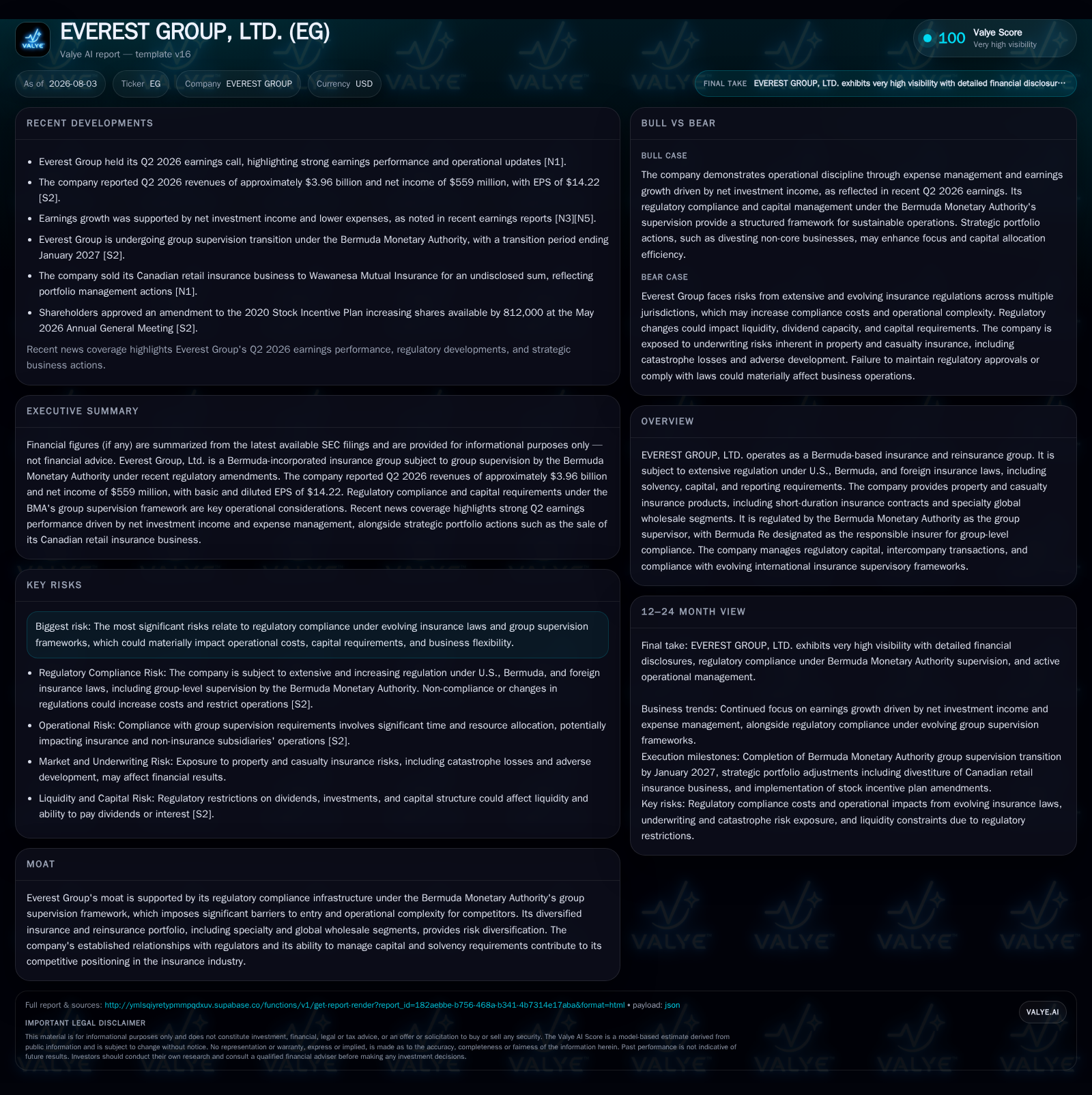
In its latest quarterly filing, Everest Group highlights the formal designation of the Bermuda Monetary Authority (BMA) as group supervisor, carrying significant implications for regulatory capital management and operational flexibility [S2]. The company continues to refine its portfolio through notable transactions, including a pending sale of its Canadian retail insurance operations, aiming to optimize risk diversification and capital deployment [S22]. Amid an evolving international supervisory framework, Everest maintains focus on underwriting discipline in specialty and global wholesale segments while leveraging investment income to support overall profitability. Regulatory compliance costs and constraints on dividend distributions are emerging as key operational considerations [S19].
Recent Operating Update
Everest Group's most recent quarterly report dated August 3, 2026, discloses important developments in regulatory oversight with the Bermuda Monetary Authority (BMA) formally assuming the role of group supervisor effective January 7, 2026 [S2]. This marks a critical regulatory transition where Everest must comply with enhanced group-wide supervision standards that encompass solvency, capital adequacy, and intercompany transaction transparency across its insurance subsidiaries. The BMA designated Bermuda Re as the "designated insurer" responsible for group-level compliance during a twelve-month transition period ending January 2027. Discussions on how this impacts Everest’s capital management strategy are ongoing but represent a structural shift increasing operational complexity.
Concurrently, Everest announced an agreement to sell its Canadian retail insurance operation via Everest Insurance Company of Canada for CAD 410 million subject to regulatory approvals [S22]. This strategic divestiture aligns with managing regulatory capital burden by shedding non-core retail exposure to focus resources on their specialty global wholesale insurance segments. The transaction includes reinsurance arrangements transferring liabilities pre-closing back into Everest’s reinsurance entities to contain risk within the group structure.
Market reception has noted Everest's Q2 earnings performance beating estimates due primarily to lower expenses and favorable net investment income contributions reflecting disciplined underwriting combined with stable asset returns [N1], [N3]. However, management highlights ongoing challenges from increased regulatory restrictions on dividends from operating subsidiaries and limits on investment categories imposed by varied U.S., Bermuda, and foreign insurance laws which may constrain liquidity flexibility or acquisition opportunities [S19].
Business Model Analysis
As a Bermuda-based insurer/reinsurer operating under stringent multi-jurisdictional regulations including those from U.S. states and European regimes, Everest's business model centers on underwriting short-duration property & casualty insurance contracts alongside specialized global wholesale products tailored for complex risk profiles. Revenues stem from premiums collected primarily from commercial policyholders globally, with reinsurance arrangements utilized both as risk ceding mechanisms and intra-group capital management tools.
Premium streams are supplemented by investment income generated from the substantial pool of reserves held in bonds and other investment-grade securities characteristic of insurers seeking capital preservation amid low-yield environments [N9]. Key operating metrics include gross written premiums as volume drivers; net earned premiums reflecting actual risk exposure; combined ratio encompassing loss ratios plus expense ratios; underwriting income as an indicator of core profitability; return on equity (ROE); and reserves adequacy signaling claim settlement preparedness.
Everest's ability to navigate increasingly complex group supervision mandates while preserving underwriting discipline is central to sustaining margins. The company must manage statutory surplus levels prudently under BMA rules which cap dividends distributable from subsidiaries potentially conflicting with shareholder return expectations. Intercompany transactions triggering "extraordinary" event reviews demand meticulous governance controls further layering cost structures.
Industry Structure and Competitive Position
Everest occupies a niche within the wider Bermuda-based specialty reinsurance sector alongside peers like Arch Capital Group Ltd. and RenaissanceRe Holdings Ltd., which also balance diversified portfolios encompassing property & casualty specialties facing volatile catastrophe exposures. Their adherence to Bermuda Monetary Authority regulations places them in a high-barrier-to-entry ecosystem shaped by technical licensing requirements, solvency pressures, disclosure demands, and capital management disciplines uncommon outside such international hubs.
The group's portfolio diversification acts as a natural hedge against cyclical shocks impacting primary insurers or individual lines. However, competition remains intense in pricing models especially for catastrophe-exposed coverage amid abundant alternative capital sources entering reinsurance markets globally. Further pressures arise from evolving accounting standards influencing reserve assessment methodologies impacting reported earnings volatility.
Technological innovation in underwriting analytics represents an industry-wide growth lever but requires continual capital investment where scale is advantageous. Regulatory opacity during transitional enforcement phases such as currently experienced by Everest adds uncertainty compared with less regulated peers outside Bermuda jurisdictions.
Growth Drivers
Looking ahead, growth opportunities for Everest are anchored in:
- Expanding demand for specialty global wholesale insurance products driven by increasing complexity in commercial risks worldwide.
- Geographic diversification into emerging markets showing rising commercial insurance penetration encouraged by conducive regulatory evolutions.
- Leveraging underwriting innovation through enhanced data analytics improving risk selection accuracy which could favorably influence loss ratios.
- Strategic acquisitions freeing up capital from divestitures like the Canadian retail operation enabling reinvestment in higher-margin specialty domains.
- Benefiting from incremental clarity around IAIG-compliant group supervision frameworks providing stable cross-border regulatory environments fostering longer-term planning.
- Addressing macro trends such as climate change effects which heighten demand for catastrophe-related reinsurance coverages thus potentially elevating premium bases.
Risks and Watchpoints
Despite these positives, Everest faces notable risks:
- Regulatory compliance remains the foremost operational challenge amid continuous law changes across key jurisdictions including U.S., Bermuda, and Europe enforcing group-wide capital controls [S19].
- Dividend distribution constraints may impede shareholder value realization particularly if operational cash flow tightens unexpectedly.
- Underwriting risk persists if adverse loss development occurs beyond actuarial estimates especially given exposure to catastrophe events in specialty lines.
- Investment portfolio market volatility could undermine net investment income critical to offset underwriting cycles.
- Potential disruption stemming from intercompany transaction scrutiny or licensing failures could impair business continuity or trigger sanctions.
- Heightened competition may pressure pricing reducing combined ratios adversely impacting consistent profitability.
- Transitional uncertainties related to full implementation details of BMA’s group supervision regime could reveal unforeseen operational costs or restrictions during the one-year adjustment window ending January 2027.
What To Watch Next
Key forthcoming milestones include:
- Completion status of the Canadian retail insurance sale including receipt of antitrust clearance from Canadian authorities marking tangible progress on portfolio optimization [S22].
- Updates on formal defined requirements set by BMA post-transition discussions clarifying adjustments required in capital models or governance structures demonstrating operational adaptability [S2].
- Quarterly operating results highlighting trends in underwriting income reflecting loss ratio fluctuations amid environmental or macroeconomic influences.
- Changes in net investment income trajectory given interest rate environments influencing overall profitability robustness [N9].
- Potential announcements regarding dividend policy revisions correlating with statutory surplus standings providing insight into shareholder return strategies under tightening regulations.
Financial Profile Discussion
Liquidity appears sufficient though dividend restrictions imposed by insurance regulation create a distinct dynamic between statutory surplus maintenance versus distributable earnings capacity often seen among specialty reinsurers regulated under Bermuda Monetary Authority frameworks. Sustaining ROE within sector peer ranges depends heavily on efficient combined ratio control alongside maximizing yield from invested assets given modest interest rate outlooks prevailing globally at present.
In summary, financial resilience hinges on adeptly balancing compliance costs imposed by evolving international group supervision mandates while maintaining underwriting discipline and capturing market-driven premium growth opportunities in specialty segments where Everest holds established expertise.
Disclaimer: This is research-only, informational analysis and not investment advice. It may include AI-generated interpretation and general industry context. Always verify important details using primary sources.

Comments