
Essential Utilities’ Growth Path and Regulatory Challenges Ahead of American Water Merger
Essential Utilities reports stable water and gas service revenues while navigating capital intensity and merger regulatory hurdles.
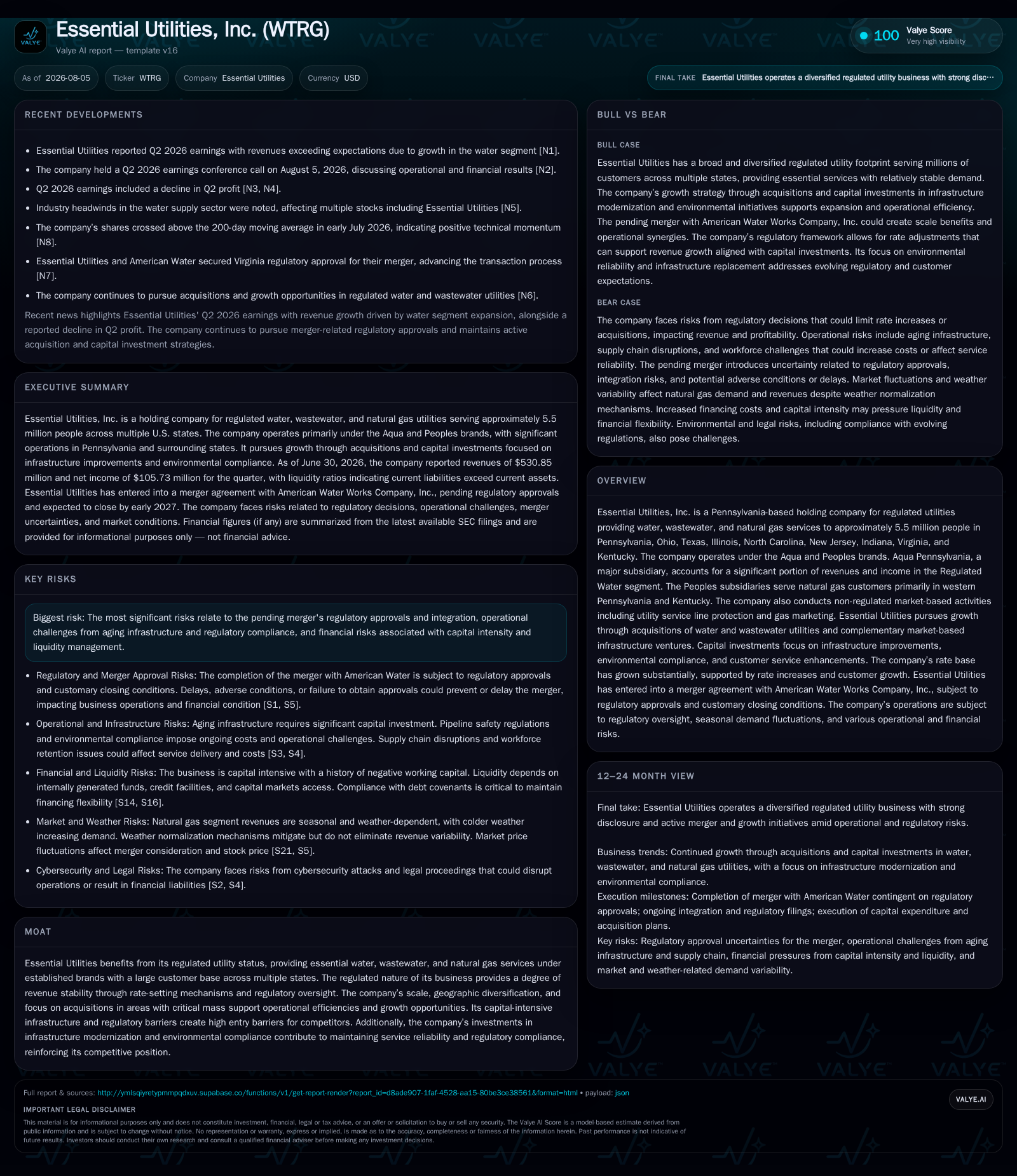
Essential Utilities maintains a broad regulated utility footprint providing water, wastewater, and natural gas services across multiple U.S. states, primarily under Aqua and Peoples brands. The company’s near-term outlook is shaped by its pending merger with American Water, significant capital investments in aging infrastructure, and regulatory timing on rate cases to recover costs amid inflationary pressures. Non-regulated activities remain a small but complementary contributor to earnings. Financially, Essential carries substantial debt aligned with its capital-intensive operations but retains access to liquidity through internally generated funds and credit facilities. Monitoring will focus on merger approvals, infrastructure spend efficiency, and rate case outcomes.
Recent Operating Update
Essential Utilities reported its financial results for Q2 2026 on August 5th, reflecting steady performance across its regulated water, wastewater, and natural gas segments [S2], [S3], [N1], [N3]. Revenue strength was primarily driven by growth in the Regulated Water segment led by Aqua Pennsylvania's sizeable customer footprint. Despite inflationary pressures increasing operating costs particularly in production of water and wastewater services, the company’s timely pursuit of rate cases has been critical to mitigating regulatory lag effects on revenue collection [S1]. However, essential to near-term growth is resolution of pending regulatory approvals related to its merger with American Water Works Company, Inc., currently targeted for closing by Q1 2027 contingent upon clearance from antitrust bodies and state public utility commissions without burdensome conditions [S1].
The company reaffirmed its strategy of disciplined infrastructure investment focused on modernization and environmental compliance—this entails substantial capital expenditures (CapEx) directed at upgrading old water treatment facilities, pipelines, and natural gas distribution networks that underpin service reliability across multiple states including Pennsylvania, Ohio, Texas, Illinois, North Carolina, New Jersey, Indiana, Virginia, and Kentucky [S1], [S11]. Concurrently, Essential continues acquiring smaller municipal systems within existing states or adjacent territories to bolster scale benefits in regulated rate bases.
Business Model Analysis
Essential Utilities operates a dual-segment regulated business: a dominant Regulated Water segment generating over half the company’s operating revenues chiefly via Aqua Pennsylvania’s service to roughly half of its total customer base; and a Regulated Natural Gas segment operating principally under Peoples subsidiaries which serve around 747,000 customers concentrated mainly in western Pennsylvania with portions in Kentucky [S1]. The business model hinges on delivering essential utility services subject to extensive public utility commission oversight regulating rates charged based on established regulatory rate bases.
Revenue arises predominantly from volumetric consumption fees collected from residential, commercial, industrial customers who pay based on usage approved by regulators following periodic rate cases [S1]. The company's ability to earn allowed returns on invested capital depends heavily on the timing and sufficiency of such rate case approvals to offset increasing costs including inflation-linked O&M expenses and CapEx requirements. While non-regulated activities such as utility service line protection programs offer incremental revenue streams outside traditional ratemaking frameworks, they account for a limited proportion of total earnings but fit strategically as value-added customer offerings complementing core utilities
The company's acquisition-driven growth approach focuses on expanding regulated customer connections within core states where it has critical mass enabling economies of scale through shared O&M expenses while enhancing geographic diversification—a competitive economic moat supported by high barriers related to infrastructure capital requirements and environmental regulations restricting new entrants.
Industry Structure and Competitive Position
Essential Utilities sits within a highly regulated oligopolistic framework of U.S. regional utility holding companies that provide essential services requiring heavy capital investment. Its principal peers include American Water Works Company (pending merger partner), California Water Service Group, and other regional multi-state utilities combining regulated water and natural gas operations.
The company’s strategic advantage derives from its scale—serving an aggregate population exceeding five million people—and geographic spread across diverse jurisdictions with variable regulatory environments that temper localized risks. Deep-rooted relationships with state commissions facilitate navigating rate cases integral for recovering escalating costs due mostly to aging infrastructure replacement mandates and stricter environmental compliance requirements like PFAS contaminant mitigation.
However, just as peer companies face similar regulatory scrutiny risks regarding timeliness and adequacy of rate recovery mechanisms—which directly influence free cash flow profiles—Essential must maintain strong management capabilities to optimize capital allocation between maintenance versus expansion. Additionally, integration complexity post-merger creates potential transitional disruption if synergy targets prove challenging.
Growth Drivers
Key structural growth drivers include expanding customer connections through acquisitions targeting smaller municipal systems especially adjacent to existing service territories fostering operational leverage. Population growth trends and urban expansion in served states underpin a baseline rise in demand for reliable water supply and natural gas services.
Rate increases authorized by regulatory commissions tied closely to periodic rate cases remain the primary lever for adjusted top-line growth—these cases typically reflect cost pass-throughs linked to labor inflation, commodity prices for natural gas procurement, infrastructure renewal CapEx programs, and environmental compliance expenditures.
Technology-enabled efficiency improvements within operational processes such as advanced metering infrastructure deployment may reduce non-revenue losses or lower O&M costs incrementally over time. Market-based ventures including service line protection programs broaden customer engagement while introducing supplementary recurring fee streams beyond traditional commodity sales.
Environmental regulation tightening accelerates investment necessities especially for contaminant remediation like PFAS litigation-related obligations where recovery remains dependent on regulator-approved accounting treatment—this both ensures compliance resilience but also adds predictable capital outlays eligible for return through rates.
Risks and Watchpoints
The foremost risk centers on finalizing approval from various state commissions alongside federal antitrust clearance under the Hart-Scott-Rodino statute required to consummate the planned merger with American Water—the process remains subject to uncertainties including potential onerous conditions impairing projected synergies or delay realization timelines [S1]
Delays or inadequacies in securing timely regulatory rate relief expose the firm to compressions in margins due to rising input costs unable to be fully recovered promptly because of regulatory lag embedded in ratemaking paradigms. Increased customer conservation stemming from heightened awareness or improved efficiency could suppress volumetric consumption thereby pressuring revenue without commensurate cost reductions.
Infrastructure aging coupled with increasingly stringent environmental legislation necessitates continual high capital expenditure rates which amplify financing needs exposing Essential Utilities to debt sustainability risks particularly amid rising interest rates influencing borrowing costs at a time when the company had approximately $8.5 billion net debt as of mid-2026 with limited current liquidity cushion (current ratio ~0.78) typical for this sector but warranting monitoring regarding covenant adherence over time [F1]. Moreover, environmental liability exposure related to multi-district litigation around PFAS compounds introduces contingent litigation risks with an uncertain impact despite partial settlements already received.
Cybersecurity threats targeting operational technology platforms controlling critical infrastructure represent emergent risks given evolving threat vectors—any disruption could materially affect service continuity or invoke regulatory penalties.
What To Watch Next
Upcoming quarterly earnings releases will provide insight into how effectively Essential manages cost inflation vis-à-vis approved tariff adjustments as well as execution status on key infrastructure projects crucial for long-term rate base growth.
Regulatory docket developments during H2 2026 into early 2027 will be pivotal—specifically outcomes from state utility commission rulings determining allowed returns on equity (ROE) granted alongside CapEx recovery model refinements will frame visibility on margin trajectories.
Progress updates from the U.S. Federal Trade Commission or Department of Justice concerning antitrust review of the merger transaction can alter transaction timelines or terms affecting strategic planning.
Monitoring customer consumption trends amid broader economic conditions also matters since shifts toward conservation or disruptive technologies may structurally impact usage patterns over time.
Financial Profile Discussion
As of June 30, 2026, Essential Utilities holds $8.5 billion net debt against relatively constrained liquidity measured by a current ratio below one at approximately 0.78 — a balance sheet profile resonating with typical capital structures in capital-intensive regulated utilities [F1]. This leverage level underscores reliance on consistent cash flows from operations buttressed by periodic rate case approvals enabling recovery of invested capital plus reasonable returns mandated by regulators.
The company supplements internal cash generation with access to committed revolving credit facilities totaling over $400 million spread across its main operating subsidiaries alongside equity issuance programs evidenced historically through ATM sales providing additional funding flexibility when markets permit [S4]-[S7]. Maintaining investment-grade credit ratings hinged largely on successful delivery of timely compensatory rates reflecting inflationary pressures remains critical to lowering borrowing costs sustaining dividend payment continuity across decades-long track records.
While free cash flow volatility may occur transiently due to timing variations between CapEx outlays versus rate recoveries subject to regulatory lag phenomena typical industrywide, Essential’s financial discipline centered around balanced funding mix aligns well with its stated intent on sizable acquisition activity paired with organic infrastructure renewal commitments ensuring continued regulated asset base expansion supporting sustainable profitability growth over medium term horizons.
Disclaimer: This is research-only, informational analysis and not investment advice. It may include AI-generated interpretation and general industry context. Always verify important details using primary sources.

Comments