
Western Midstream Expands Delaware Basin Footprint with $1.67B Brazos Delaware Acquisition
The midstream operator's strategic acquisition and steady fee-based contracts enhance its asset scale and revenue visibility amid capital-intensive sector dynamics.
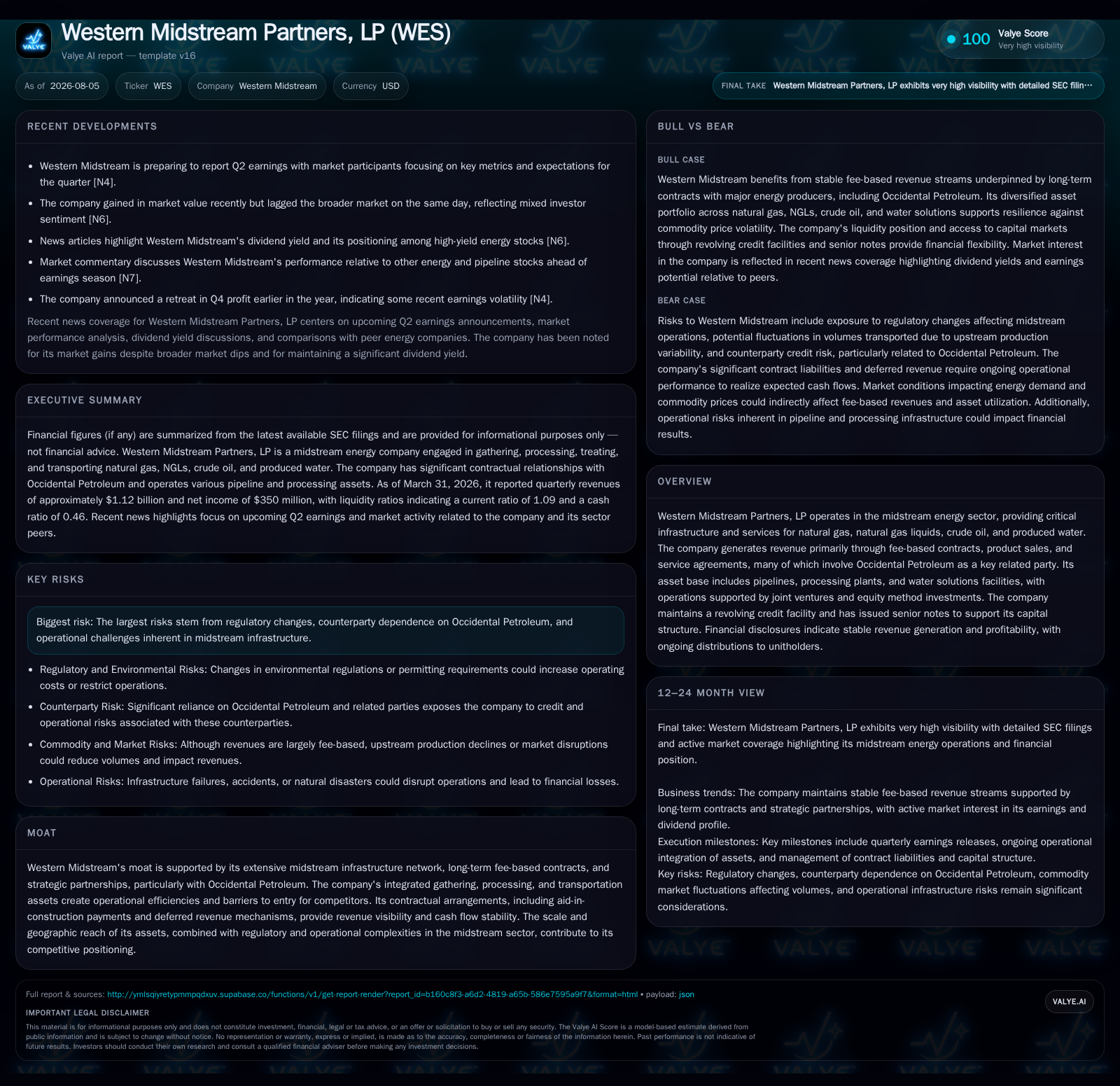
Western Midstream Partners, LP reinforced its position as a leading midstream energy infrastructure provider through the June 2026 acquisition of Brazos Delaware for approximately $1.67 billion, integrating significant gathering and processing capacity in the prolific Delaware Basin. The company’s revenue model hinges on long-term fee-based contracts, primarily serving Occidental Petroleum and other upstream producers, providing stable cash flow notwithstanding commodity price volatility. Operational metrics such as throughput volumes and capacity utilization remain key performance indicators, while capital expenditures have risen to support asset expansion. Key risks include counterparty concentration, regulatory changes, and inherent operational challenges. Financially, Western Midstream maintains a balanced capital structure supported by revolving credit facilities and senior notes, though leverage levels reflect ongoing investment activity.
Recent Operating Update: Strategic Footprint Expansion in the Delaware Basin
Western Midstream Partners, LP finalized the acquisition of Brazos Delaware II, LLC on June 11, 2026, for approximately $1.67 billion, comprising $820 million in cash funded by borrowings under its revolving credit facility (RCF) and commercial paper program, along with $852 million issued in common units [S2][S13]. This transaction notably expands Western Midstream’s gathering and processing operations within the prolific Delaware Basin – a key oil and gas play region – signaling a strategic move to capture incremental upstream production volumes through infrastructure scale enhancement.
This acquisition evidences Western Midstream’s disciplined capital deployment approach, balancing debt leverage with equity issuance to preserve financial flexibility [S2][S13]. Post-acquisition restructuring within its subsidiaries reflects integration efforts to consolidate control over Brazos Delaware’s assets through its operating subsidiary WES Operating
Business Model: Fee-Based Revenue Streams Rooted in Long-Term Contracts
Western Midstream operates as a master limited partnership that owns, operates, develops, and acquires midstream energy infrastructure serving natural gas, natural gas liquids (NGLs), crude oil, condensate, and produced water sectors. Its revenue generation predominantly derives from fee-based contracts encompassing gathering, treating, processing, transportation, storage services, plus product sales primarily under agreements involving Occidental Petroleum as a principal customer/related party [S1][S6][S13]
Key elements supporting revenue stability include minimum volume commitments embedded in take-or-pay agreements and aid-in-construction payments recognized over customer-benefit periods [S2][S1]. These contractual features mitigate commodity price exposure common in upstream operations by ensuring steady base fees independent of fluctuating throughput volumes or hydrocarbon pricing trends
Financial disclosures emphasize contract liabilities related to deferred revenue streams underpinning predictable cash flows [S2]. Additionally, Western Midstream manages operational throughput handling natural gas liquids (NGLs), raw hydrocarbons via pipelines and processing plants scaled across various basins including the Permian’s Delaware segment where recent expansions occurred [S13].
Industry Positioning: Integrated Infrastructure Amid Competitive Midstream Landscape
Western Midstream occupies an intermediate value-chain role bridging upstream exploration/production activities with downstream refining or export markets [S1][S13]. Its extensive asset network—comprising pipelines, processing plants like Chipeta Processing LLC (majority-owned), water management facilities via Aris Water Solutions acquisition (completed October 2025), plus equity stakes in joint ventures—offers critical service breadth leveraged for operational efficiencies
Within the broader midstream peer cohort including Enterprise Products Partners, Plains All American Pipeline, Enbridge Inc., Kinder Morgan, and Magellan Midstream Partners, Western Midstream is distinguished by its geographically targeted asset base anchored by a close relationship with Occidental Petroleum that drives substantial volume commitments securing foundation throughput revenues [S1]
Operational metrics such as throughput volumes (expressed in MMcf/d for gas or barrels per day for liquids), capacity utilization percentages indicative of asset load efficiency, and contract backlog/minimum take arrangements form essential KPIs monitored internally to assess performance against industry benchmarks [S1]
Growth Drivers: Organic Volume Growth Combined with Strategic Acquisitions
Growth initiatives stem from organic expansions reflecting increased upstream drilling activities in core basins necessitating additional gathering and processing capacity [S2][S13][S1]. Complementing organic trends are systematic acquisitions exemplified by the recent Brazos Delaware deal aimed at consolidating regional presence while broadening customer access beyond Occidental Petroleum constraints
Capital expenditures have correspondingly risen; capital spent reached approximately $506 million in the first half of 2026 versus $321 million over the same period in 2025 as Western invests both to maintain existing assets’ operability and complete growth projects [S11]. Leveraging operational synergies from integrated asset platforms supports expected margin improvements from economies of scale.
Water management services acquired through Aris Water Solutions align with rising produced water handling demands driven by intensified hydraulic fracturing activity—a key sector demand driver enhancing Western Midstream's full-service midstream offering scope beyond traditional hydrocarbons gathering [S1][S13].
Risks & Growth Constraints: Customer Concentration and Regulatory Environment
Counterparty risk emerges as a significant watchpoint given Occidental Petroleum's outsized contribution to revenues via fee-based contracts underpinned by minimum volume commitments. Any volatility or strategic shifts by Occidental could disproportionately impact Western Midstream's operational throughput and cash flow predictability [S1][S5]. This dependency necessitates continued diversification efforts alongside managing contract renewals effectively.
Regulatory compliance poses ongoing challenges amid tightening environmental policies targeting methane emissions reduction and water disposal standards affecting pipeline operation permits. Capital intensity coupled with execution risk in pipeline integrity maintenance heightens exposure to operational incidents potentially disrupting throughput volumes.
Market conditions also impose risk factors such as sustained low commodity prices impacting upstream drilling plans which feed volume levels into midstream infrastructure although Western's fee-based model partially cushions this effect.
What to Watch Next: Execution & Contractual Backlog Monitoring Critical
Upcoming milestones include integration success metrics post-Brazos Delaware transaction focusing on synergy realization without operational disruptions or capital cost overruns. Contract backlog evolution – via new fee agreements or extensions with customers including Occidental Petroleum – will provide insights into near-to-medium-term revenue visibility.
Operational KPIs such as quarterly reported throughput volumes across natural gas gathering systems and liquids processing plants will be pivotal metrics validating organic growth assumptions against regional production trajectories.
Capital expenditure pacing relative to depreciation expense trends will inform management efficiency in asset base expansion versus replacement capex while liquidity position updates post-deal financing rounds will indicate balance sheet resilience amid continued investment activity.
Financial Profile Discussion
At March 31, 2026, Western Midstream held approximately $647 million in cash and equivalents against current liabilities translated into a current ratio near 1.09 signaling adequate short-term liquidity [F1]. Total debt figures trace back fully only through 2018 at around $4.84 billion; however recent financing activity associated with acquisitions indicates elevated leverage levels albeit managed via staggered senior notes maturities extending into the mid-2030s ensuring manageable refinancing risk profiles [S8][S25][F1].
Net income growth supported by robust adjusted EBITDA correlates with steady distribution payments reflecting sustained distributable cash flow generation capability despite heavy capex cycles characteristic in expanding infrastructures like those taken on with the Brazos Delaware deal [F1][S11]. Interest expenses have risen corresponding to higher borrowings but remain within coverage thresholds typical for midstream peers maintaining investor confidence in fixed income instruments.
Commercial paper usage supplements revolving credit facility drawdowns to optimize short-term liquidity costs while preserving financial agility for opportunistic investments or working capital demands underscoring prudent balance sheet management practices central to long-term value creation goals outlined in company strategy disclosures [S5][S8]
This analysis integrates primary SEC filings through August 2026 with contextual industry knowledge customary for midstream operators reliant upon fee-based contracts backed by long-term upstream partner relationships. The strategic acquisition activity positions Western Midstream favorably within innovative service offerings yet underscores capitalization demands accompanied by counterparty exposure considerations inherent at this scale.
Disclaimer: This report is for informational purposes only; it does not constitute investment advice or research views regarding Western Midstream Partners' securities.
Disclaimer: This is research-only, informational analysis and not investment advice. It may include AI-generated interpretation and general industry context. Always verify important details using primary sources.

Comments