
Blue Owl Technology Finance Corp. Balances Growth and Conflict Mitigation in Tech-Focused BDC Operations
Latest quarterly results highlight Blue Owl's disciplined allocation amid complex affiliated investment dynamics.
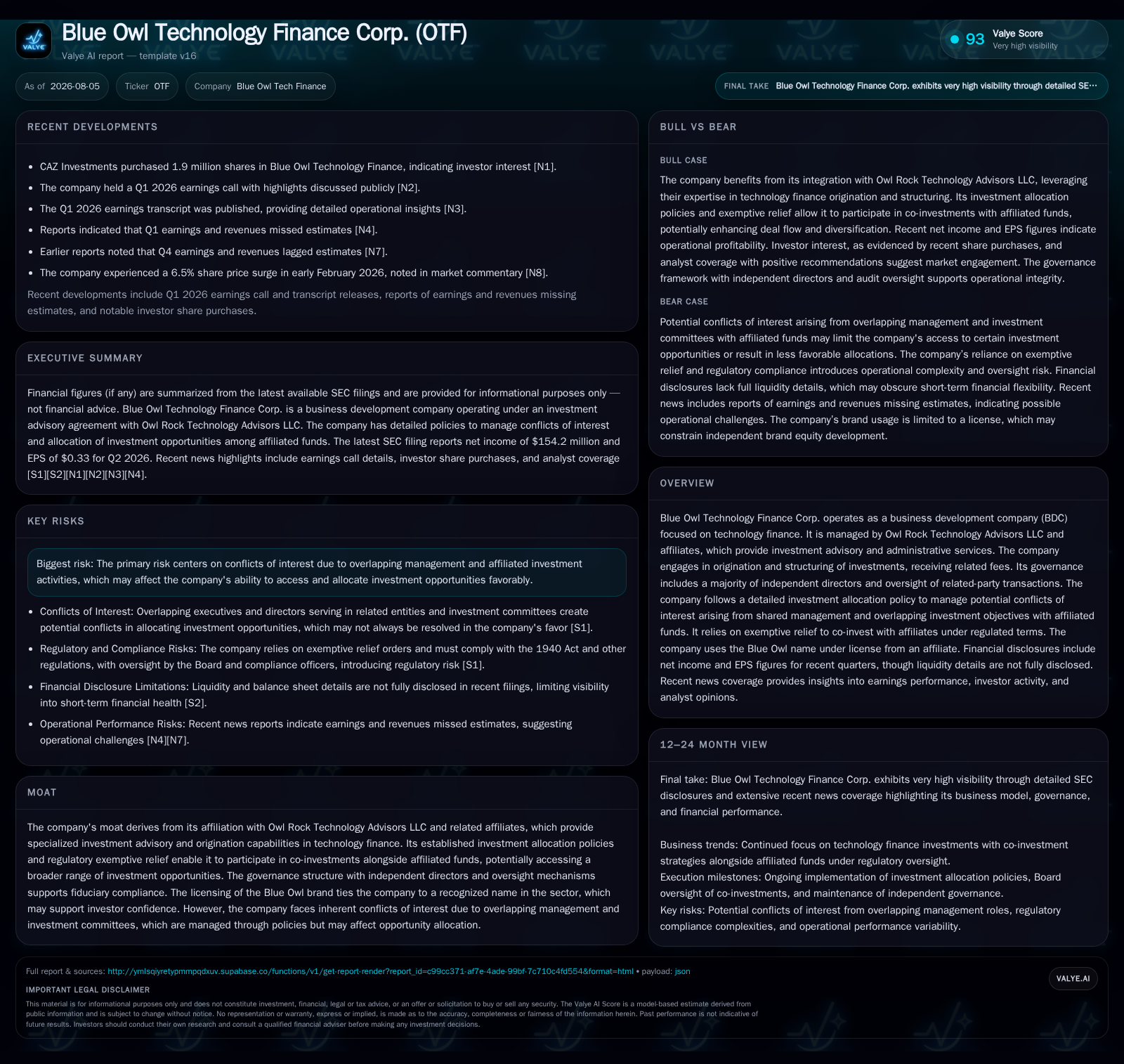
Blue Owl Technology Finance Corp. operates as a technology-focused Business Development Company (BDC) managed by affiliated advisers that navigate co-investment and conflict-of-interest risks through robust policies and exemptive relief. Its recent quarterly filings demonstrate continued fee income generation from origination and structuring activities, alongside stable net investment income, underpinning its focus on middle-market tech financing. However, inherent overlaps in management and investment committees pose ongoing challenges to opportunity allocation fairness in a competitive environment. Monitoring portfolio credit quality and leverage levels will be key to assessing durability.
Recent Operating Update
Blue Owl Technology Finance Corp.'s Q2 2026 disclosures reaffirm steady operational momentum within its niche as a technology finance business development company (BDC). The company maintains active origination and structuring activity through its affiliated advisers, translating into continued fee income streams alongside net investment income from its leveraged portfolio [S2][S3]. While detailed revenue breakdowns are limited in public filings, the filed 8-K confirms ongoing execution against its core investment strategy focused on providing debt and equity-like financing solutions to middle-market tech companies.
Notably, the company's second-quarter financial snapshot reports approximately $7.25 billion in total debt outstanding as of June 30, 2026—reflecting substantial leverage typical for BDC structures aiming to amplify yield profiles [F1][S2]. This leverage underscores the importance of effective portfolio credit risk management to safeguard earnings stability amid potentially volatile market conditions affecting underlying portfolio companies.
Business Model
Blue Owl Technology Finance Corp. operates with an externally managed structure under an investment advisory agreement with Owl Rock Technology Advisors LLC and affiliates. These entities are responsible for sourcing, underwriting, structuring, and administering investments primarily focused on the technology sector—a segment characterized by significant growth potential but also elevated risk due to rapid innovation cycles and capital intensity [S1].
Revenue primarily derives from two components: net investment income generated by interest or dividend returns on deployed capital into portfolio companies; and fee income from origination, arrangement, structuring, and ancillary services provided by affiliated advisers during deal execution. These fees serve both to compensate advisory efforts and supplement yield beyond pure investment return from assets held directly by the BDC [S1]. This dual stream offers some resilience against fluctuations in underlying asset performance but can be sensitive to overall deal flow volume.
A material aspect of Blue Owl's business is its reliance on co-investment arrangements facilitated through regulatory exemptive relief under the Investment Company Act of 1940. This statutory framework allows Blue Owl alongside affiliated funds managed by common advisers to participate concurrently in certain investments despite potential conflicts of interest—a notable complexity inherent in multi-client asset management platforms [S1].
Industry Structure and Competitive Position
Business Development Companies like Blue Owl fill a specialized intermediary role between public equity markets and private technology companies seeking growth capital beyond traditional bank lending limits. Their strategic value lies in delivering flexible capital solutions including structured debt or equity-related instruments tailored for innovative firms often excluded from mainstream financing.
Within this broader universe are peers such as Hercules Capital and Ares Capital Corporation which also emphasize technology or growth-sector lending but differ operationally—some operate more fully vertically integrated origination platforms while others rely heavily on external advisory relationships. Compared with these peers, Blue Owl's affiliation-based approach leverages expertise but introduces additional governance complexity.
Blue Owl's governance framework incorporates a majority independent board tasked with overseeing all related-party transactions arising from shared adviser relationships. The existence of a detailed investment allocation policy aims to uphold fairness when distributing limited co-investment opportunities among different affiliated funds competing for the same deals. While such policy frameworks are standard industry practice under BDC regulatory constraints, their practical application remains a key determinant of perceived fiduciary effectiveness [S1].
Growth Drivers
The primary tailwind supporting Blue Owl's growth trajectory is structural demand within the technology sector for non-bank financing as innovation cycles accelerate and middle-market firms outgrow traditional sources yet seek more flexible capital than public markets provide. This creates persistent deal flow that advisors like Owl Rock can harness through established relationship networks.
Additionally, licensing arrangements allow Blue Owl to capitalize on brand recognition within relevant institutional investor communities—an intangible asset supporting sustained capital raises. Regulatory provisions enabling co-investment not only diversify potential deal participation but also permit capturing incremental origination-related fees enhancing overall revenue mix [S1]
Further growth may be fostered by rising interest rate environments that increase yield spreads for lenders; however, countervailing risks linked to borrower credit stress demand careful credit discipline.
Risks and Watchpoints
Foremost among Blue Owl's risks is managing the inherent conflicts arising from overlapping management teams administering multiple affiliated funds targeting similar sectors with potentially competing mandates. While robust allocation policies are designed to ensure equitable treatment over time, any perceived imbalance could impair deal access or investor confidence.
Macroeconomic headwinds—including inflationary pressures impacting portfolio company cost structures or disruptions in capital markets reducing financing availability—pose additional challenges [S1]. Interest rate fluctuations affect both cost of debt funding for Blue Owl’s leveraged balance sheet and mark-to-market valuation sensitivity for debt instruments held.
Illiquidity remains a material concern given many portfolio investments reside in private middle-market companies without ready secondary markets limiting exit timing flexibility.
Given these vulnerabilities, tracking portfolio credit quality metrics such as non-performing loans or realized losses will be pivotal ongoing indicators.
What to Watch Next
Market participants should closely monitor forthcoming quarterly filings for signs of shifts in investment deployment velocity reflecting changing dealflow; changes in net asset value (NAV) per share indicating mark-to-market valuation adjustments; updates on fee income stability tied to origination efficacy; credit quality trends within portfolio holdings signaling risk accrual; as well as any proxy disclosures or board commentary related to conflicts oversight enhancements.
Additional insights may arise from public statements regarding any amendments or renewals related to their exemptive relief agreements governing co-investment activity.
Financial Profile Discussion
Blue Owl’s reported total debt near $7.25 billion at mid-2026 aligns with standard leverage profiles observed across publicly traded BDCs targeting enhanced yield through borrowed capital deployment [F1][S2]
Earnings per share (EPS) figures remain supported primarily through net investment income supplemented by fee revenues earned via affiliated adviser origination activities. The latter contributes importantly to cash-flow stability even during periods when fair value remeasurements of underlying portfolio assets introduce earnings volatility.
Close attention should be paid over subsequent quarters both to earnings sustainability as affected by portfolio credit risk evolution and any shifts in capital structure indicative of refinancing needs or deleveraging initiatives prompted by market conditions or strategic adjustments.
This analysis is based on publicly filed SEC documents dated through August 5, 2026 ([S1], [S2], [S3]) complemented by companyfacts financial data ([F1]) reflecting balance-sheet positions as reported. The report is intended for informational purposes only without constituting investment advice.
Disclaimer: This is research-only, informational analysis and not investment advice. It may include AI-generated interpretation and general industry context. Always verify important details using primary sources.

Comments