
Casella Waste Systems Strengthens Regional Footprint Amid Capital Intensity and Regulatory Challenges
Casella's latest quarter highlights operational resilience through pricing power and integration, balanced against debt leverage and environmental compliance risks.
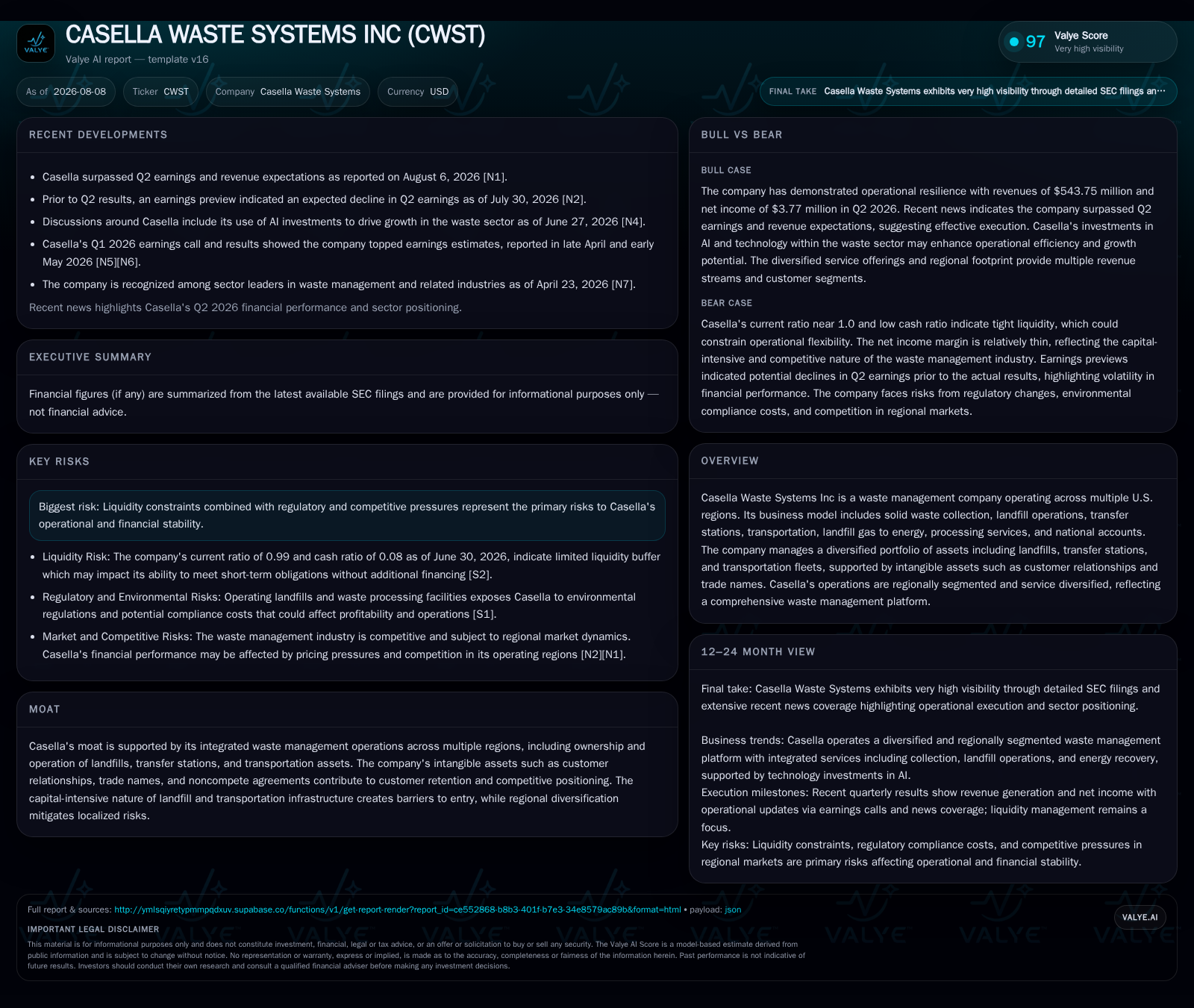
In its Q2 2026 filing, Casella Waste Systems maintained steady revenue contributions across collection, landfill, and processing segments while advancing geographic expansion with strategic acquisitions in West Virginia. The company emphasizes price increases and route optimization to offset cost inflation, navigating persistent regulatory scrutiny inherent in landfill operations. Capital-intensive infrastructure ownership underpins Casella’s integrated waste management platform, but leverage remains elevated requiring disciplined cash flow management. Growth prospects lean on sustainable waste solutions and acquisitions within a highly regulated, regionally fragmented sector.
Recent Operating Update
Casella Waste Systems reported its latest quarter ending June 30, 2026 in its Form 10-Q filed August 7, showing stable operational performance across its core service segments [S2]. The company detailed revenues by business line for the first half of 2026: collection services drove the bulk with about $574 million across its Eastern, Western, Mid-Atlantic, and Resource Solutions regions; landfill operations contributed nearly $47 million; transfer stations about $67 million; transportation services roughly $11 million; landfill gas-to-energy projects approximately $4.3 million; processing around $99 million; and National Accounts stood at just over $79 million [S2]. This breakdown signals that while traditional solid waste activities remain the backbone of revenue, energy recovery via landfill gas is becoming a meaningful adjunct.
The filing also disclosed a notable strategic acquisition closed January 1, 2026 — Mountain State Waste (RGL Inc.) — expanding Casella's service footprint into West Virginia [S1]. This deal complements the company's previous nine acquisitions in FY2025 that deepened market penetration especially in its Mid-Atlantic region. Such acquisitions align with Casella's stated objective of growth through both organic expansion and targeted M&A to consolidate regional holdings [S1].
Pricing trends from the previous annual report indicated collection fees increased by around 5% in calendar year 2025 compared to 2024, helping to mitigate fuel costs and inflationary pressures [S1]. The latest filings continue highlighting operational initiatives like route optimization technologies and automation aimed at reducing per-route operating costs while improving safety. These efficiency levers are critical given the labor- and fuel-intensive nature of collection operations.
Business Model Analysis
Casella Waste Systems operates an integrated waste management business model spanning multiple U.S. regions through a diversified asset base: landfills, transfer stations, transportation fleets, processing facilities, and energy recovery installations [S1], [S2]. Revenue primarily derives from fee-based contracts with residential customers — often secured by long-term arrangements supported by noncompete clauses — as well as commercial, industrial, institutional users, plus dedicated National Accounts segments [S2]. Pricing reflects per-ton or per-route fees that can adjust periodically to pass through cost inflation or based on contract renewals.
Owning physical infrastructure provides Casella capital leverage but demands ongoing capex for compliance upgrades, capacity expansions, and fleet maintenance [S2]. The company's intangible assets such as trade names and established customer relationships support high retention rates favorable for predictable earnings streams. Landfill gas-to-energy facilities monetize waste decomposition byproducts into electricity sold externally or used internally to offset power needs
Operational KPIs include volume of waste collected (tons), number of active routes optimized via automation tools to reduce fuel consumption and labor hours, average pricing per ton/route to capture inflation adjustments, landfill utilization rates constrained by permitting regulations, plus energy output (MWh) from gas projects. Monitoring customer retention and successful integration of acquired operations also shapes profitability.
Industry Structure & Competitive Position
The U.S. waste management industry is capital intensive with high barriers owing to heavy investments in environmental-compliant landfills and transport logistics. Key competitors consist of large integrated providers like Waste Management Inc., Republic Services Inc., and Waste Connections Inc., all with larger geographical footprints enabling greater scale economies. Against these scale giants, Casella positions itself as a strong regional operator leveraging dense local assets.
Regulatory scrutiny on landfill capacity permits coupled with community opposition often limits siting new facilities impacting long-term disposal options. Resource recovery through landfill gas-to-energy projects increasingly differentiates providers striving for sustainability goals mandated by corporate clients or government entities. Route optimization technology adoption is widespread to combat high transportation fuel costs accelerating industry-wide efficiency drives.
Casella’s recent acquisitions serve as strategic consolidation moves amidst a fragmented regional competitive landscape where smaller haulers serve niche markets. Their ability to integrate acquisitions profitably while upholding environmental standards shapes their competitive moat reinforced by capital-intensive infrastructure ownership.
Growth Drivers
Underlying demand growth stems from population increases driving higher municipal solid waste volumes alongside urbanization trends. Rising environmental regulations boost demand for compliant disposal services amplifying barriers for less-capitalized entrants.
Corporate sustainability initiatives encourage uptake of recycling and organic diversion services offered under Casella’s Resource Solutions segment increasing feedstock supply for processing activities [S1]. Technological advancements enabling better route efficiency reduce cost per ton collected creating margin expansion potential.
Casella’s acquisition strategy nurtures both geographic expansion into underserved states (e.g., Mountain State Waste in West Virginia) and densification in core markets strengthening pricing power due to consolidated market share [S1], [S2]. The growth of landfill gas-to-energy projects diversifies revenue beyond disposal tipping fees supporting more stable cash flows.
Risks & Constraints
Liquidity stands out as a watchpoint given roughly $1.33 billion total debt outstanding against $25.5 million cash reserves as of June 30, 2026 yielding a current ratio near unity (0.99) suggesting tight short-term liquidity conditions [F1], [S2]. Casella must carefully balance capital expenditures needed for regulatory compliance upgrades with debt servicing obligations amidst rising interest rates tied mostly to term loans maturing in late 2029.
Environmental regulations impose significant compliance costs; permit delays or denials restrict landfill expansions which can constrict capacity utilization ultimately pressuring margins. Fuel price volatility directly impacts transportation cost structures making ongoing route optimization essential yet only partially mitigating external shocks.
Competitive pressures from both large-scale national integrators able to leverage broader asset bases and smaller local haulers maintaining cost advantages in focused geographies persist. Customer contract renewals remain subject to pricing resistance particularly during inflationary slowdowns or economic downturns affecting commercial waste volumes.
Technological disruptions such as improved recycling sorting or emerging waste processing methods could require additional investments to stay relevant or face substitution risks over longer horizons.
What To Watch Next
Upcoming milestones involve assessing the operational integration success of the Mountain State Waste acquisition alongside any further tuck-in deals accentuating footprint growth [S1]. Investors should monitor updates on Capex deployment aimed at increasing landfill capacity or environmental upgrades crucial for future operating license renewals.
Tracking ongoing pricing programs' effectiveness amid evolving cost inflation will signal the company’s pricing power stability in a competitive landscape. Progress in route automation metrics such as cost per route mile or fuel savings will serve as tangible indicators of margin enhancement efforts.
Landfill gas-to-energy production volume growth offers insight into diversification results beyond traditional tipping fee revenues. Management commentary on regulatory developments including permit statuses or litigation outcomes could markedly affect disposal capacity visibility.
Liquidity management trends including covenant compliance under credit facilities bearing interest at floating rates tied to Term SOFR plus margin increments warrant attention given overall elevated net debt (~$1.3 billion) relative to operating cash flows [F1], [S2].
Financial Profile Discussion
As of June 30, 2026, Casella reported approximately $25.5 million in cash & equivalents against total debt nearing $1.33 billion resulting in net debt around $1.3 billion centralizing leverage concerns common within capital-intensive waste management firms [F1], [S2]. The company’s debt structure includes an $800 million Term Loan A facility due September 2029 bearing mid-5% interest plus an additional revolving credit facility drawn at about $185 million carrying similar cost rates [S2]. Interest coverage ratios must be watched since elevated financing expenses could constrain free cash flow allocation towards growth or dividends.
Historically highlighted operating margins around mid-single digits reflect industry typical returns pressured by ongoing compliance costs but partially offset by strategic pricing increases implemented recently [S1]. Return on invested capital depends heavily on effective asset utilization including landfill capacity deployment paired with successful scaling via acquisitions enhancing synergies.
Capital allocation priorities emphasize balancing acquisition-driven footprint densification with organic operational improvements including sustainability projects such as landfill gas-to-energy enhancements aligned with corporate ESG considerations outlined previously [S1]. Overall financial profile underscores a necessity for precision execution amidst leveraging structural growth opportunities within constrained regulatory frameworks.
Disclaimer: This analysis is based solely on publicly available filings from Casella Waste Systems Inc through August 7, 2026 combined with general industry knowledge pertinent to the waste management sector. It does not constitute investment advice regarding the securities of Casella Waste Systems or any other entity.
Disclaimer: This is research-only, informational analysis and not investment advice. It may include AI-generated interpretation and general industry context. Always verify important details using primary sources.

Comments