
Akamai Strengthens Edge and Security Leadership with AI-Enabled Cloud Growth Despite Macro and Competitive Pressures
Akamai’s Q2 2026 highlights sustained demand for cloud security and edge computing, balancing pricing pressure and geopolitical risks within an intensifying competitive landscape.
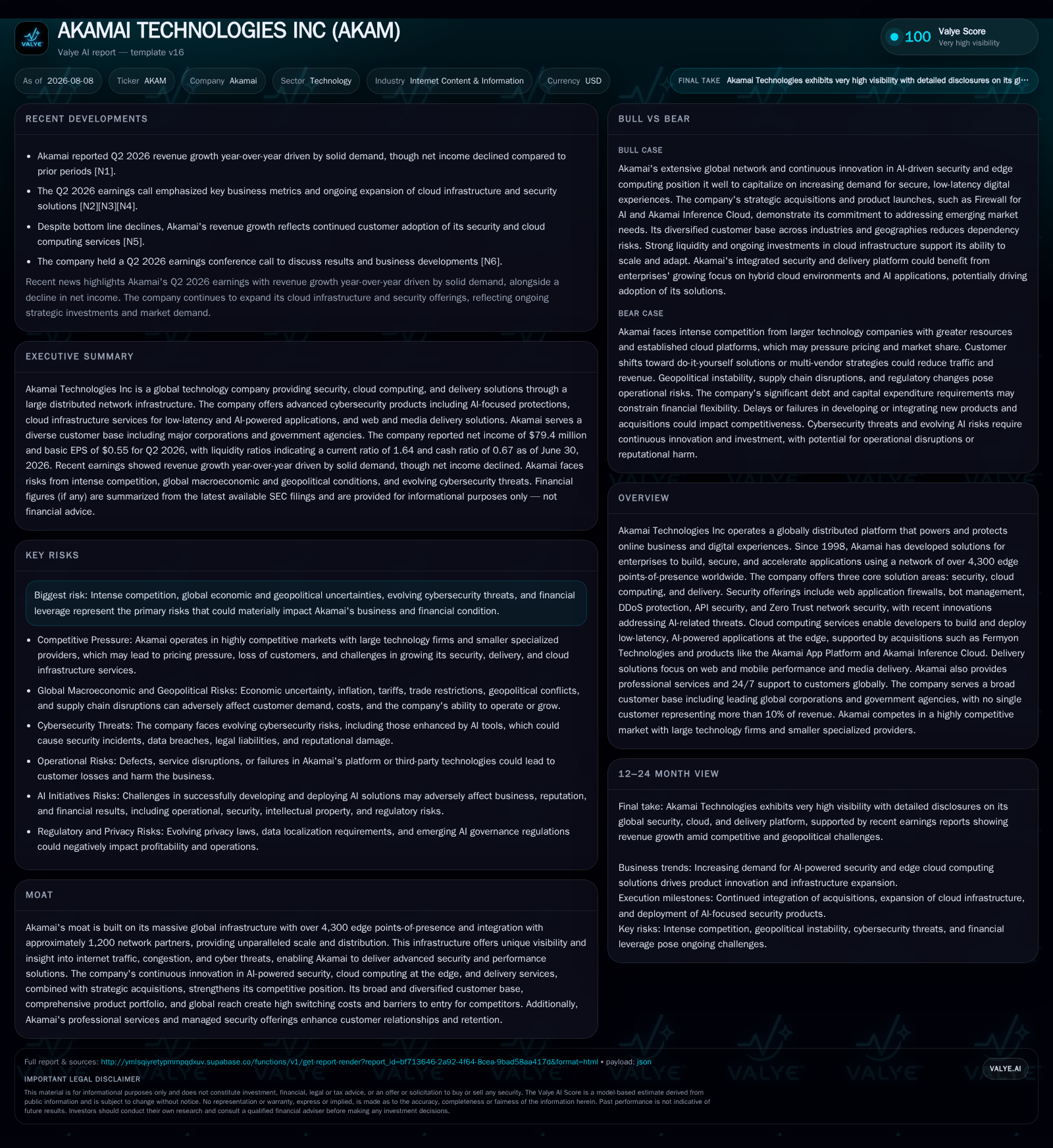
In its latest Q2 2026 report, Akamai Technologies demonstrated solid revenue growth driven by expanding security and cloud computing solutions that capitalize on AI-powered innovation and a massive global infrastructure. While delivery services continue to face pricing pressure and shifts toward do-it-yourself models, Akamai's extensive network of over 4,300 edge points-of-presence and integration with 1,200 network partners underpin its moat. Ongoing investments in cloud infrastructure and AI capabilities fuel growth but add capital intensity amid rising geopolitical and regulatory complexity. Akamai remains exposed to intense competition from hyperscalers and specialized security providers, with key near-term monitorables including recurring revenue trajectories, net retention trends, and margin impact from increased investments.
Recent Operating Update
Akamai Technologies' Q2 2026 results released August 6 confirmed continued top-line momentum fueled primarily by demand for its security solutions and expanding cloud computing offerings [S2][S3]. The company reported year-on-year revenue growth notwithstanding ongoing declines in traditional content delivery solutions due in part to pricing pressures and customer moves toward do-it-yourself traffic management strategies [S2]. This trend is consistent with industrywide shifts where large enterprises optimize or diversify content distribution away from turnkey CDN contracts.
Importantly, Akamai is leveraging its global edge computing footprint to enable next-generation AI-powered applications—through acquisitions like Fermyon Technologies—and has introduced new platforms such as the Akamai App Platform and Inference Cloud which offer developers low-latency compute close to end users [S1]. This strategic focus on AI-enabled edge infrastructure is designed to capture burgeoning demand for scalable real-time data processing while providing enhanced security protections against evolving threats shaped by AI adversaries.
Business Model Overview
Akamai operates a globally distributed platform delivering three core solution areas: security, cloud computing, and content delivery [S1]. Revenue generation is predominantly subscription-based complemented by usage fees tied to traffic volumes traversing its network. Customers mainly comprise enterprise clients across industries—ranging from technology firms like Adobe to government agencies—supported via direct sales teams as well as an extensive partner ecosystem including Microsoft Azure and Deutsche Telekom among others [S12].
The security segment leads revenue contributions through offerings such as web application firewalls (WAF), bot management systems, distributed denial-of-service (DDoS) protection, API security, DNS mitigation services, and zero trust network access controls. These are critical for enterprises managing hybrid multi-cloud environments amidst intensifying cyber threats. Cloud computing services provide a stack for developers building AI-powered apps deployed at the network edge—an area poised for structural growth given rising latency sensitivity.
Content delivery continues as a legacy segment affected by commoditization but remains relevant where optimized media streaming or high-performance web acceleration is required. Managed professional services bolster customer relationships by aiding deployment complexity reduction and ongoing solution refinement.
Industry Structure & Competitive Position
Operating within the Internet Infrastructure and Cloud Security Services industry segment positions Akamai among peers offering content delivery networks (CDNs), edge computing hardware/software platforms, cloud security stacks, and managed threat intelligence services. Its moat stems from an unparalleled scale: over 4,300 edge points-of-presence worldwide integrated with roughly 1,200 network partners grants unique real-time visibility into internet traffic patterns, threats, congestion points—as well as unmatched geographic proximity advantages relative to many competitors [S1]. This infrastructure breadth delivers competitive differentiation difficult for new entrants or hyperscale cloud providers to replicate quickly.
Key competitors include CDN-centric firms like Cloudflare—recognized for an integrated security-CDN platform—and Fastly focusing mainly on edge compute for content delivery optimization. Hyperscale public cloud giants Amazon Web Services (AWS) and Microsoft Azure also blur boundaries by extending their native edge security & compute services challenging incumbent vendors including Akamai in overlapping domains. In cybersecurity specialization, companies like Palo Alto Networks represent alternatives offering holistic threat prevention suites beyond perimeter CDN-focused architectures.
Pricing pressures arise partly because many large customers pursue multi-vendor sourcing or DIY solutions in parts of their stack—a dynamic that can depress average revenue per user (ARPU) metrics in the delivery segment [S1][S2]. However, Akamai’s focus on adaptive AI-driven security powered by extensive threat intelligence feeds positions it favorably versus generic offerings lacking deep internet-scale data.
Growth Drivers
Several secular trends underpin Akamai's growth outlook:
- Cloud + Edge Computing Adoption: As enterprises distribute compute closer to end users for performance-sensitive or regulatory-compliant workloads—including latency-critical AI inference—the demand for Akamai’s compute platforms grows structurally.
- AI-Powered Security Demand: The escalation of sophisticated cyberattacks leveraging AI necessitates advanced defenses that integrate generative AI for proactive threat detection. Akamai’s innovation pipeline targets these emerging use cases.
- Digital Content Consumption Expansion: Increasing video streaming, gaming ecosystems, e-commerce activity sustain baseline traffic requiring robust acceleration solutions despite pricing headwinds.
- Regulatory Compliance Requirements: Growing privacy law complexities elevate outsourcing of secure networking functions to specialists who can navigate cross-border data transfer restrictions efficiently.
- Outsourced Managed Security Services: Enterprises increasingly delegate cybersecurity operations augmenting contracted service revenues beyond software license fees.
These drivers translate operationally into KPIs such as annual recurring revenue (ARR) growth rate increments led by cloud/security bundles; net retention rate improvements reflecting upsell success; traffic volume scaling; plus steadily improving security event detection-to-mitigation ratios evidencing solution efficacy enhancements.
Risks & Watchpoints
Despite strengths, several risks could constrain Akamai’s trajectory:
- Persistent Pricing Pressure & Customer Optimizations: Delivery revenues remain under pressure due to competitive discounting and client DIY strategies possibly intensifying amid macroeconomic uncertainties [S1][S2].
- Competitive Intensity From Hyperscalers & Niche Vendors: Large cloud providers wield enormous purchasing power over capacity inputs such as servers or data centers which could challenge Akamai’s cost position especially in nascent edge compute markets.
- Geopolitical & Regulatory Headwinds: Increasing trade restrictions, export controls especially regarding China-related operations exposes supply chain disruption risk. Emerging EU regulations like the Artificial Intelligence Act impose compliance burdens on newly introduced AI services with potential financial penalties [S18].
- Capital Intensity & Leverage Constraints: Capital expenditures are rising markedly to expand cloud infrastructure capabilities raising cash burn concerns counterbalanced by healthy liquidity [F1][S5].
- Cybersecurity Threat Exposure: Despite internal controls residual risk from breaches or service disruptions could damage reputation or trigger fines [S11][S26].
- Technology & Integration Risks: Acquisitions aiming at enlarging the solution portfolio introduce integration challenges including managing legacy vulnerabilities or cultural assimilation [S21][S25].
What To Watch Next
Investors should monitor quarterly disclosures for concrete evidence of sustained ARR growth particularly in newer cloud/security product lines alongside commentary on net retention rates indicating successful upsell/usage expansion during renewals [N1][N3]. Updates on capex pacing versus margin impacts can illuminate tradeoffs between scale investments versus near-term profitability [S2][S5]. The progress of regulatory compliance initiatives around AI governance rules will be a further signal of operational resilience amid growing legal complexity [S18]. Competitive positioning cues may emerge through customer acquisition trends across hyperscaler versus mid-market segments along with any shifts in channel partnership effectiveness [S12]. Lastly potential material legal or regulatory events connected with geopolitical exposures warrant attention given existing contingent liabilities related to divested operations [S18].
Financial Profile Discussion
As of June 30, 2026, Akamai held $1.48 billion in cash and equivalents against current liabilities of approximately $2.84 billion yielding a manageable current ratio of about 1.64 suggesting reasonable short-term liquidity cushions despite increasing capital demands [F1][S2]. Capital expenditures have accelerated recently reflecting investments into cloud infrastructure expansion especially relevant for scaling the newly developed AI-focused edge platforms; while this exerts cash flow pressure it aligns with strategic imperatives aiming at durable competitive differentiation [S5]. Operating income remains positive though expected margin compression could persist as investment weighting grows.
This analysis is based solely on publicly available SEC filings alongside corroborated news reports up to August 2026. It aims to provide an informed industry perspective grounded in verified company disclosures without extending investment advice or speculative forecasts.
Disclaimer: This is research-only, informational analysis and not investment advice. It may include AI-generated interpretation and general industry context. Always verify important details using primary sources.

Comments