
POPULAR, INC.'s Portfolio Diversification and Regional Focus Shape Growth Amid Economic Challenges
POPULAR, INC. leverages its diversified banking and financial services in Puerto Rico and the U.S. mainland while managing concentration risks.
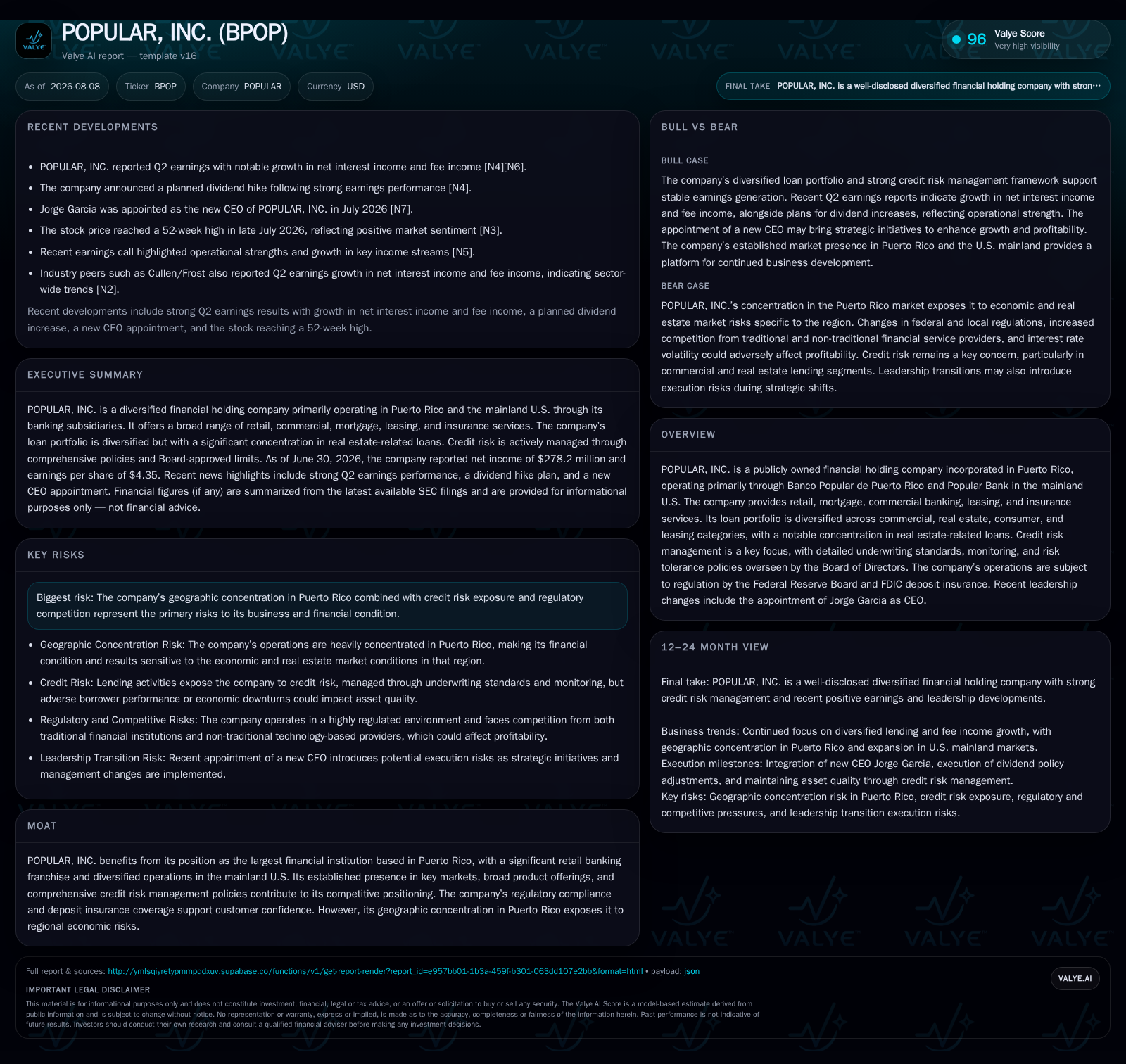
POPULAR, INC., the largest financial institution headquartered in Puerto Rico, reported steady operational performance in its latest quarter despite ongoing regional economic challenges. The company’s business model combines retail, commercial, mortgage banking, leasing, and insurance services across Puerto Rico and select U.S. mainland markets, generating revenue primarily through net interest income and fee-based activities. Its significant asset concentration in Puerto Rico exposes it to heightened credit and economic risks, mitigated by comprehensive credit risk management and regulatory oversight. New leadership under CEO Jorge Garcia aims to navigate evolving market conditions while capitalizing on growth opportunities through product diversification and deposit base expansion.
Recent Operating Update Reflects Sensitivity to Regional Conditions
In its latest 10-Q filing dated August 7, 2026, POPULAR, INC. underscored how its earnings are closely tied to general business and economic conditions within its service territories [S2]. Lending volumes, deposit activity, and fee income streams are influenced by variables such as consumer spending, business investment levels, interest rate fluctuations, competitive dynamics, and regulatory changes. This continuous monitoring allows management to adapt operations against prevailing market headwinds including volatility in capital markets and evolving customer preferences.
The filing reiterates POPULAR’s exposure to heightened regulatory scrutiny typical for federally supervised bank holding companies operating in multiple jurisdictions. Moreover, competitive pressures have intensified not only from traditional regional peers but also from fintech firms offering electronic banking solutions that potentially erode fee income bases. This external environment demands a balance between risk mitigation in lending practices and proactive revenue enhancement initiatives.
Business Model Anchored in Diverse Financial Services Across Core Markets
POPULAR operates primarily through two subsidiaries: Banco Popular de Puerto Rico (BPPR), which dominates Puerto Rico's banking sector with a broad retail footprint; and Popular Bank (PB) serving northeastern U.S. states including New York, New Jersey, and Florida [S1]. The company’s diversified product suite encapsulates retail banking (deposits/accounts), commercial banking (loans), mortgage lending tailored to both consumers and businesses, equipment leasing—including auto financing—and insurance brokerage operations.
Revenue generation predominantly hinges on net interest income derived from lending activity offset by funding costs associated with deposits—a critical metric closely aligned with the balance sheet’s loan-to-deposit composition. Complementing this is non-interest or fee income sourced from ancillary products such as brokerage fees, insurance commissions, leasing fees, and servicing revenues. Successful cross-selling of these services deepens client relationships while enhancing revenue stability beyond cyclical interest margins.
Credit risk management emerges as a fundamental feature of the business model given the concentrated real estate exposure embedded within the loan portfolio. POPULAR maintains disciplined underwriting standards overseen by its Board of Directors along with continuous portfolio monitoring practices designed to contain potential losses arising from borrower defaults or economic downturns [S1].
Industry Position Highlights Strengths and Geographic Vulnerabilities
However, geographical concentration—77% of assets situated within Puerto Rico as of December 2025—introduces systemic risk factors uncommon among peers with broader national footprints [S1]. The island’s prolonged economic malaise since the 2007 recession coupled with recent fiscal crises contributed historically to elevated delinquency rates and charge-offs impacting profitability. Though recent federal stimulus inflows have supported recovery momentum somewhat, ongoing dependence on government funding remains a vulnerability tied to political decisions outside the bank’s control.
Competitively within regional banking circles encompassing peers like Cullen/Frost Bankers or HomeTrust Bancshares—which enjoy more diversified state-level operations—POPULAR leans heavily on its dominance locally but lacks comparable geographic breadth. Additionally, fintech entrants increasingly pressure fee-based income lines by providing frictionless digital lending or payment alternatives challenging incumbent convenience.
Growth Drivers Focused on Portfolio Expansion and Product Diversification
Several factors underpin POPULAR's potential for volume expansion:
- Loan Growth: An emphasis on broadening commercial lending alongside residential mortgage originations aligned with recovering housing markets could drive sustainable asset accumulation. Equipment leasing markets also offer cyclical upside dependent on business investment trends.
- Deposit Growth: Retail deposit traction fueled by maintaining competitive pricing strategies combined with institutional online deposit programs supports low-cost funding crucial for net interest margin preservation.
- Fee Income Expansion: Diversifying revenue beyond lending via increasing insurance product penetration or leveraging broker-dealer subsidiaries helps mitigate margin compression risks inherent in intense interest rate competition.
- Operational Efficiencies: Upgrading systems for better cost control combined with technology investments enhances scalability enabling leaner expense ratios amid top-line fluctuations.
Furthermore, new CEO Jorge Garcia’s appointment announced July 23, 2026 reflects management’s intent to sustain growth momentum while addressing strategic imperatives around modernization and customer experience enhancements [N11]. His background may prove pivotal in steering adaptation toward digital innovation initiatives amid rising fintech competition.
Risks Demand Careful Monitoring Amid Structural Challenges
The firm grapples with multiple intrinsic risks:
- Geographic Concentration Risk: Heavy exposure to Puerto Rico’s economy magnifies susceptibility to adverse macroeconomic cycles affecting borrower creditworthiness and deposit stability [S1]. A regional downturn could ripple through loan performance metrics increasing provisions for credit losses.
- Interest Rate Volatility: Fluctuations impact net interest margins directly as loan repricing lags deposit adjustments; steep yield curve shifts could compress earnings absent effective hedging or pricing flexibility.
- Credit Quality: Segments reliant on real estate markets require vigilant underwriting vigilance; deterioration elevates non-performing loans ratio affecting profitability.
- Regulatory Compliance: Adherence costs are predictable yet escalating regulatory expectations create operational burdens that may constrain agility.
- Competitive Pressure: Fintech platforms threaten legacy fee income lines necessitating continued innovation investment.
- Liquidity Risk: Unexpected deposit outflows would require rapid asset repositioning challenging cash conversion capabilities under stress scenarios.
- Reputational Exposure: Maintaining trust is essential given customer-depositor relationships underpin balance-sheet stability.
What To Watch Next: Execution Milestones And Market Signals
Key areas for stakeholders’ focus include tracking quarter-over-quarter changes in:
- Loan loss provision levels relative to non-performing assets signaling evolving credit risk.
- Deposit growth rates indicating funding cost trajectory sustainability.
- Fee income contribution percentages highlighting diversification progress versus traditional net interest reliance.
- Efficiency ratio trends showing cost containment effectiveness amid revenue shifts.
- Regulatory developments influencing capital adequacy requirements potentially mandating capital buffers or strategy revisions.
Earnings announcements following the leadership transition will provide an early gauge of strategic execution capabilities under new CEO stewardship. Additionally, monitoring how the corporation adapts its product mix—particularly enhancing digital offerings—will signal responsiveness against rising fintech disruption trends.
Financial Profile Discussion
While no recent explicit debt or liquidity figures were provided for the current quarter [S2], the robust deposit franchise insured under FDIC regulations constitutes a stable funding source mitigating immediate liquidity concerns. Capital adequacy is actively managed given federal reserve oversight ensuring capitalization aligns with statutory requirements supporting ongoing operations amidst market uncertainties [S1].
Management’s disciplined approach toward provisioning maintains sound coverage ratios relative to total loans thereby safeguarding asset quality while preserving return metrics such as ROA or ROE within targeted ranges reported historically though exact current figures remain undisclosed for this quarter [F1/S2]. The announced dividend increase concurrent with recent earnings results evidences confidence in sustained cash flow generation capacity [N5]
This analysis is based exclusively on information drawn from mandated SEC filings as well as public news sources without speculative assumptions or forward-looking forecasts beyond stated company disclosures.
Disclaimer: This is research-only, informational analysis and not investment advice. It may include AI-generated interpretation and general industry context. Always verify important details using primary sources.

Comments