
Omada Health Advances Multi-Condition Virtual Care with Strong Customer Retention but Faces Profitability Challenges
Omada Health reported solid enrollment growth and multi-channel expansion in Q2 2026 while continuing to invest in clinical programs and technology integration, offset by ongoing operating losses.
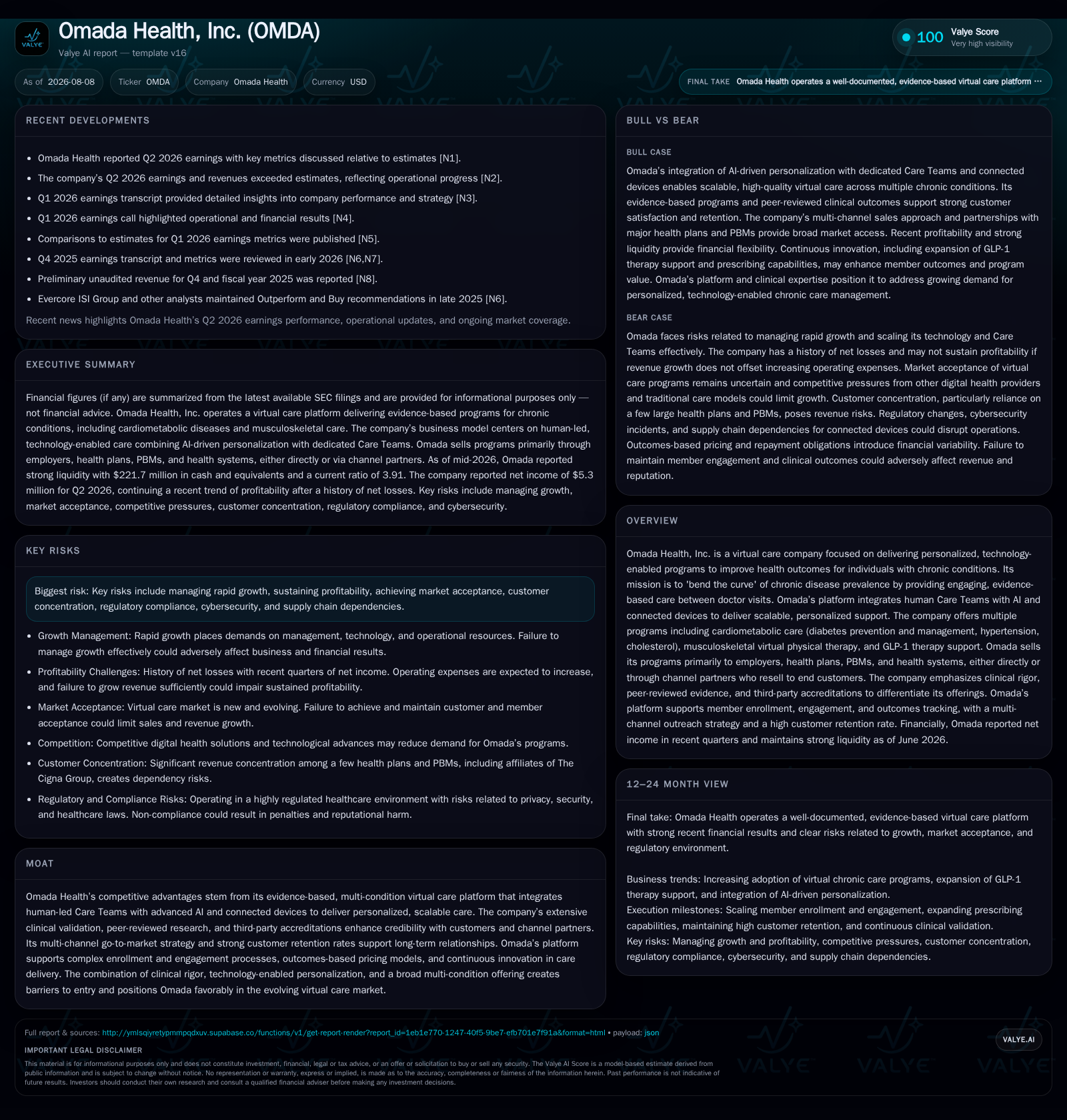
Omada Health's latest quarterly filing reveals sustained momentum in member enrollments and strong customer satisfaction across its technology-enabled virtual care platform focused on chronic disease management. Its evidence-based programs spanning cardiometabolic conditions, musculoskeletal therapy, and GLP-1 support reinforce differentiation through clinical rigor and AI-driven personalization. However, the company continues to navigate legacy net losses amid investments in scaling care teams and expanding go-to-market channels. Successful execution of outcomes-based contracts and enhanced member engagement metrics will be critical to reaching profitability. Regulatory compliance risks and competitive pressures remain material considerations.
Recent Operating Update
Omada Health’s second quarter 2026 filing [S2] confirms steady progress in its core business of delivering virtual care for chronic conditions using a technology-enabled platform that integrates human-led Care Teams with AI personalization. As of December 31, 2025 — the most recent enrollment date disclosed — Omada reported over 886,000 active members enrolled in one or more programs [S1], reflecting sustained demand across its product suite. The company continues to expand its reach by leveraging multiple go-to-market channels including direct contracts with employers, health plans, pharmacy benefit managers (PBMs), and health systems, as well as relationships with channel partners who resell Omada’s programs. This multi-channel distribution model enables flexible deployment tailored to customer preferences and ecosystem integrations [S17].
Financially, Omada maintains a strong liquidity position with cash and equivalents totaling approximately $222 million as of June 30, 2026 [F1]. The current ratio stood robustly at about 3.9x at quarter-end reflecting strong short-term asset coverage versus liabilities [F1]. The company acknowledges ongoing net losses stem largely from upfront costs associated with product development and broadening customer acquisition efforts [S2].
Business Model Overview
Omada Health operates as a digital therapeutics vendor within the broader virtual care industry focused on chronic disease management. It monetizes by contracting primarily on a B2B2C basis—selling subscription or outcomes-based virtual care programs to healthcare payers such as employers (self-insured), health insurance plans (both fully insured and self-insured), PBMs, and health systems who assume financial risk for patient populations [S17]. These customers cover program costs directly or via intermediaries.
The value proposition centers on providing evidence-based interventions that improve clinical outcomes—such as HbA1c reduction for diabetes prevention and management—while enabling cost savings below traditional in-person care models. Omada’s platform combines software tools (mobile app engagement, data analytics), connected devices (remote monitoring biometrics), AI-driven personalization of coaching protocols, and human Care Teams offering proactive outreach and behavioral support [S1]. This digital-human hybrid approach coined "Compassionate Intelligence" is designed to sustain high member engagement rates over extended periods [S1].
Sales cycles can be complex given the enterprise nature of customers but supported by Omada’s Customer Experience and Partner Management Teams who ensure onboarding success and ongoing account health [S17]. Contracts often incorporate outcomes-linked pricing elements that reward demonstrated clinical improvements or cost avoidance—a model gaining traction across healthcare payers focused on value-based care.
Industry Structure & Competitive Position
The digital health and virtual care market for chronic condition management is fragmented yet rapidly evolving due to rising prevalence of metabolic diseases and growing payer interest in telehealth solutions. Omada competes among virtual care platforms like Livongo Health (noting Livongo's focus primarily on diabetes management), telehealth providers like Teladoc Health which offer broader service scope including live physician consults, digital therapeutics firms developing condition-specific treatments (e.g., Virta Health targeting diabetes reversal), and device integrators (e.g., Omron Healthcare).
Omada’s moat derives from its clinically validated multi-condition platform—differentiated by third-party accreditations such as CDC recognition for its diabetes prevention program [S1]—and scalable integration with payer ecosystems through channel partnerships. Its ability to serve multiple comorbidities seamlessly through one partner is important given the high overlap among cardiovascular risk factors within populations.
Evidence-based content backed by peer-reviewed research positions Omada favorably against competitors relying heavily on narrower offerings or less formal validation. The company also emphasizes high customer retention rates exceeding 90% over three years [S17], signaling stickiness imperative for maximizing lifetime value in subscription or outcomes-linked models.
However, the sector is marked by intensifying competition from better-capitalized players pursuing similar virtual care strategies. Success depends critically on sustained member engagement metrics beyond initial enrollment—a historically difficult challenge across digital therapeutic deployments—as well as regulatory navigation specific to healthcare programs.
Growth Drivers
Several secular trends underlie Omada’s growth potential:
- Chronic Disease Burden: Rising incidence of diabetes, hypertension, obesity, cholesterol disorders increases demand for scalable remote management solutions.
- Cost Containment Needs: Employers and payers face mounting pressure to reduce expensive downstream complications via preventative virtual interventions.
- Technology Advancements: Integration of AI personalization algorithms with remote patient monitoring devices enhances engagement effectiveness at scale.
- Regulatory Support: Expanded reimbursement frameworks supporting telehealth services bolster payer willingness to adopt these programs.
- Multi-Condition Expansion: Broadening therapeutic area coverage captures cross-selling opportunities within existing accounts.
- Improved Digital Literacy: Growing smartphone penetration facilitates wider access among target populations.
These drivers are reflected operationally through metrics like rising active member enrollment counts tracked quarterly [S2] and strong member retention rates exceeding 50% engagement at years one and two on key cardiometabolic programs [S1], indicating durable usage patterns essential for realizing long-term outcomes.
Risks & Constraints
Key challenges facing Omada include:
- Profitability Pressure: Continued investments in sales/marketing infrastructure plus scaling specialized Care Teams contribute to ongoing net losses despite revenue growth [S2].
- Regulatory Complexity: Compliance with extensive federal/state healthcare laws (e.g., Anti-Kickback Statute, Stark Law) introduces legal risks that could result in penalties or operational constraints if mismanaged [S10][S15].
- Competitive Intensity: Larger incumbents with deeper pockets threaten market share gains; innovation pace must be maintained.
- Member Engagement Sustainability: Achieving consistently high usage beyond initial program months is necessary for demonstrating cost-effectiveness but remains a sector-wide challenge.
- Customer Concentration Risks: Reliance on certain large payers or channel partners could impair revenue diversity.
- Cybersecurity Vulnerabilities: Handling protected health information mandates robust data protection amid increasing cyber threats.
- Reimbursement Uncertainty: Outcomes-based contracts depend on measurable clinical/economic results; ambiguity hampers revenue predictability.
- Integration Challenges: Aligning with diverse healthcare system IT infrastructures requires adaptable technical architecture.
These risks underscore the operational complexity inherent in scaling personalized virtual care at population levels while navigating an evolving regulatory environment.[S12][S15]
What To Watch Next
Upcoming operating milestones valuable for assessing trajectory include:
- Quarterly updates on member retention rates at 12+ months post-enrollment across the full program suite.
- Expansion or renewal of outcomes-based payer contracts demonstrating confidence in clinical effectiveness.
- Progress reports on multi-channel penetration including growth via new reseller partnerships.
- Innovations around AI-driven personalization tools enhancing Care Team efficiency or member adherence.
- Any material changes in regulatory landscape affecting licensing or reimbursement terms.
- Indicators of narrowing operating losses signaling improved cost leverage as scale benefits accrue.
- New program launches or therapeutic area expansions broadening addressable market.
The company’s guidance disclosures combined with third-party accreditation developments will serve as important signals for commitment to quality standards influencing market acceptance [S2][S3]
Financial Profile Discussion
Omada’s financial posture through mid-2026 showcases prudent liquidity management: cash reserves stood at approximately $222 million at Q2-end June 30 [F1], providing a substantial runway to support product development and customer acquisition efforts. The current ratio stood robustly at about 3.9x at quarter-end reflecting strong short-term asset coverage versus liabilities [F1].
Despite healthy top-line progression depicted by increasing enrollments reported through late 2025 [S1][S2], Omada remains unprofitable; the company acknowledges ongoing net losses primarily attributable to upfront investments necessary for scalable delivery capacity building including salaried Care Teams along with sales/marketing spend targeting large enterprise account wins [S2]. Future profitability hinges upon improving average revenue per enrolled member through enhanced program completion rates while controlling per-member service delivery costs via technology augmentation.[S2]
Continued focus on sustaining above-industry-average customer retention (>90% three-year average) underpins recurring revenue visibility critical for valuation metrics common in SaaS-like healthcare platforms where lifetime value offsets sizable early CAC [S17]
This analysis synthesizes publicly filed SEC documents up to August 7, 2026. It reflects current operating data without investment advice or price forecasts.
Disclaimer: This is research-only, informational analysis and not investment advice. It may include AI-generated interpretation and general industry context. Always verify important details using primary sources.

Comments