
INFINITY NATURAL RESOURCES Advances Appalachian Basin Footprint Amid Capital Expansion and Tax Agreement Risks
The latest quarterly report highlights INR’s operational progress, capital structure evolution, and residual risk exposures in a volatile commodity environment.
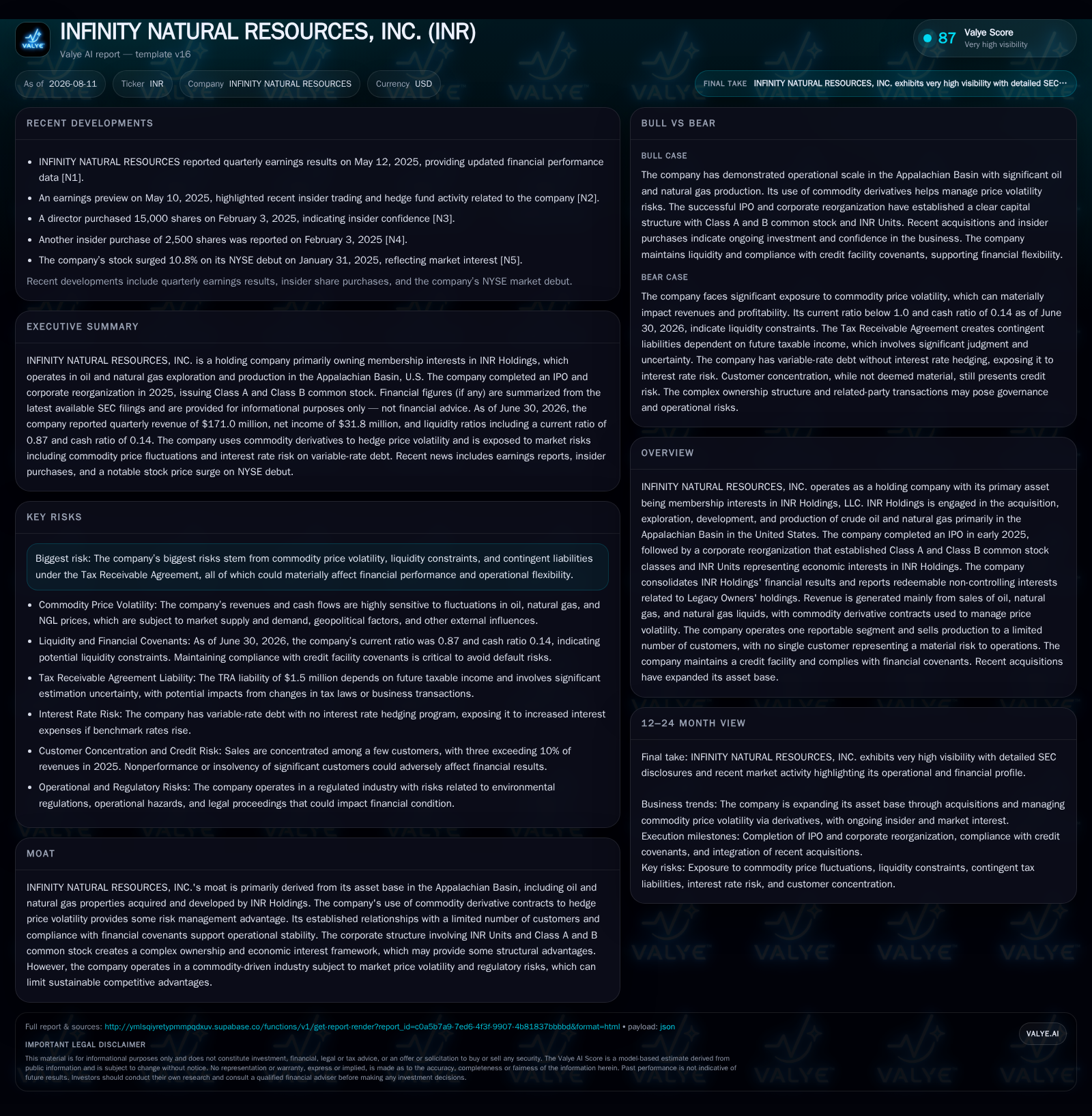
Infinity Natural Resources, Inc. (INR) reported operational updates for Q2 2026 that reflect ongoing production from its Appalachian Basin assets consolidated under INR Holdings. The company utilizes commodity derivative contracts extensively to hedge price volatility but faces counterparty credit and commodity price risks inherent in upstream E&P. INR recently completed sizable upstream and midstream acquisitions financed partly by preferred stock issuance and increased borrowing capacity. However, contingent liabilities related to a Tax Receivable Agreement (TRA) present material financial risk. Operationally, the company relies on a limited customer base typical of this sector but benefits from established market demand for its crude oil, natural gas, and NGLs production. Strong liquidity with minimal outstanding debt contrasts with a current ratio below one, which warrants monitoring as the company pursues growth investments.
Recent Operating Update: Q2 2026 Report Highlights
Infinity Natural Resources’ Q2 2026 filings report no outstanding borrowings on an $875 million credit facility, leaving the full capacity unused as of June 30, 2026 [S2]. While this suggests ample liquidity availability for operations or acquisitions, current assets stand at approximately $163 million against $187 million of current liabilities, producing a current ratio of 0.87 [F1]. This imbalance highlights working capital pressure possibly associated with ongoing investment activity or timing differences in payables and receivables.
Commodity price risk management remains central to INR’s upstream business as the company actively enters commodity derivative contracts to hedge sales exposure across crude oil, natural gas, and natural gas liquids (NGLs) [S1][S2][S19]. These derivatives are transacted exclusively with investment-grade counterparties who also participate in their Credit Agreement—an important mitigant against counterparty default risk [S1]. Nonetheless, exposure remains through unsecured receivables from a limited number of customers, with three customers accounting for more than 10% of revenues as of mid-2026 [S1][S2]. Despite this concentration, the fungibility of hydrocarbons in well-established markets limits meaningful losses from potential customer default.
Business Model: Asset Control via Holding Structure with Complex Equity Classes
INR operates chiefly through its managing-member position in INR Holdings LLC. The holding company consolidates all operational results while Legacy Owners retain significant ownership represented via INR Units paired with Class B common stock shares representing noncontrolling economic interests [S1][S22]. This structure provides flexibility but entails structural complexity where Legacy Owners can exchange their units for Class A stock or cash at one-to-one equivalence [S22].
Critically, the company is bound by a Tax Receivable Agreement (TRA) requiring payments of 85% of realized tax savings attributable to increases in tax basis resulting from unit exchanges or other reorganization events [S1][S29]. This arrangement creates contingent liabilities that depend heavily on taxable income realizations and restructuring activity projections—introducing earnings volatility unrelated directly to oil and gas operations.
Revenue monetization arises from sales of crude oil, natural gas, and NGLs produced primarily in the Appalachian Basin. These products generate revenue based on volumes sold multiplied by realized commodity prices less lifting costs and deductions such as gathering or transportation fees borne either directly or indirectly through partnerships [S1][S28]. The business model depends heavily on sustaining reserve replacement ratios through drilling success or acquisitions while maintaining cost control to preserve margin consistency.
Industry Structure and Competitive Positioning
As an upstream operator focused on the Appalachian Basin—a prolific natural gas region with growing liquids content—INR competes within a peer group that includes independent E&P firms like EQT Corporation or Range Resources that target similar basins. The highly capital-intensive nature of exploration and development necessitates access to substantial liquidity sources including credit facilities secured against proved reserves.
INR’s use of a large revolving credit facility backed by reserves demonstrates alignment with industry standards enabling flexible funding for drilling programs or acquisitions [S4][S9]. Post-IPO acquisitions expanding asset footprint into Ohio’s upstream and midstream infrastructure potentially enhance asset scale though integration execution will be key. Licensing midstream capabilities address transport bottlenecks—a common regional challenge—potentially improving revenue capture compared to peers reliant solely on third-party processors.
However, operational scale remains smaller than integrated majors or larger independents; thus margin maintenance depends heavily on efficient lifting costs per BOE alongside effective hedging strategies mitigating commodity price cyclicality [S1][S28]. Commodity derivative gains recorded suggest active management but also contribute volatility since unrealized gains/losses flow through other income rather than hedge accounting
Growth Drivers
Growth prospects hinge largely on expanding production volumes via development drilling supported by recent acquisitions adding both producing wells and midstream assets in key Ohio counties [S6][S8]. The February 2026 purchase agreements involved approximately $1.2 billion total consideration split between upstream and midstream interests acquired jointly with Northern Oil & Gas Inc., with INR owning a controlling interest in these assets [S6][S8]. Access to $337 million net proceeds from Series A Preferred Stock issuance provides growth capital alongside unused borrowing capacity enhancing financial firepower [S8][S24].
Operational efficiency improvements including cost reductions per BOE produced — estimated via lease operating expenses (LOE), finding & development costs, as well as decline management—will be critical. Further expansion of hedging coverage aligned with production volumes should help stabilize cash flows amid volatile global energy prices.
Technological adoption in completion techniques could unlock incremental hydrocarbons thereby extending reserve life better than peers without such resources. Additionally, customer concentration risk is mitigated somewhat given product fungibility though expanding buyer diversification remains beneficial.
Risks and Watchpoints
The overriding risk factors hinge on commodity price moves which directly impact revenue; despite hedging policies aimed at smoothing volatility these instruments carry inherent counterparty credit risk despite conservative counterparty selection criteria [S1][S2]. The relatively small customer base exposes cash flows somewhat if contracts expire prematurely or counterparties face insolvency.
A material contingent liability resides in the Tax Receivable Agreement where payment obligations could surge if taxable income is higher than forecast or corporate reorganization events accelerate designated basis step-ups [S1][S29]. Such payout obligations would reduce free cash flow available for reinvestment or distributions.
Liquidity demands triggered by the TRA combined with investments into newly acquired assets may strain short-term working capital as evidenced by the sub-1.0 current ratio despite strong overall credit facility headroom [F1][S2]
Regulatory risks typical for upstream operators include environmental compliance around well plugging & abandonment liabilities which carry estimation uncertainties impacting asset retirement obligations over time [S5]. Interest rate fluctuations might modestly affect future servicing costs given floating rate debt exposures absent interest rate hedges.
What to Watch Next
Key milestones include updates on integration progress for Ohio asset acquisitions along with their contribution to production volumes and cash flow metrics. Metrics such as reserve replacement ratios post-acquisition disclosures will provide insight into sustainable growth capacity.
Hedging program adjustments tracking forward commodity prices will indicate management’s stance on risk appetite versus cash flow stability objectives. Any amendments or settlement activity concerning the Tax Receivable Agreement should be watched carefully due to significant potential financial impact.
Management commentary regarding customer contract renewals or changes in concentration will further elucidate counterparty risk outlooks. Finally, quarterly updates on working capital trends juxtaposed against investing spend will reveal whether liquidity strategies effectively balance growth ambitions with operational flexibility.
Financial Profile Discussion
This analysis consolidates publicly available SEC filings through August 2026 without any proprietary insights; it does not constitute investment advice but aims to contextualize Infinity Natural Resources’ operating state within broader upstream oil and gas dynamics.
Disclaimer: This is research-only, informational analysis and not investment advice. It may include AI-generated interpretation and general industry context. Always verify important details using primary sources.

Comments