
Dynamic Aerospace Systems Advances UAV Innovation Amid Financial and Regulatory Challenges
DAS focuses on hybrid and electric VTOL platforms coupled with autonomous logistics to carve a niche in the competitive UAV market.
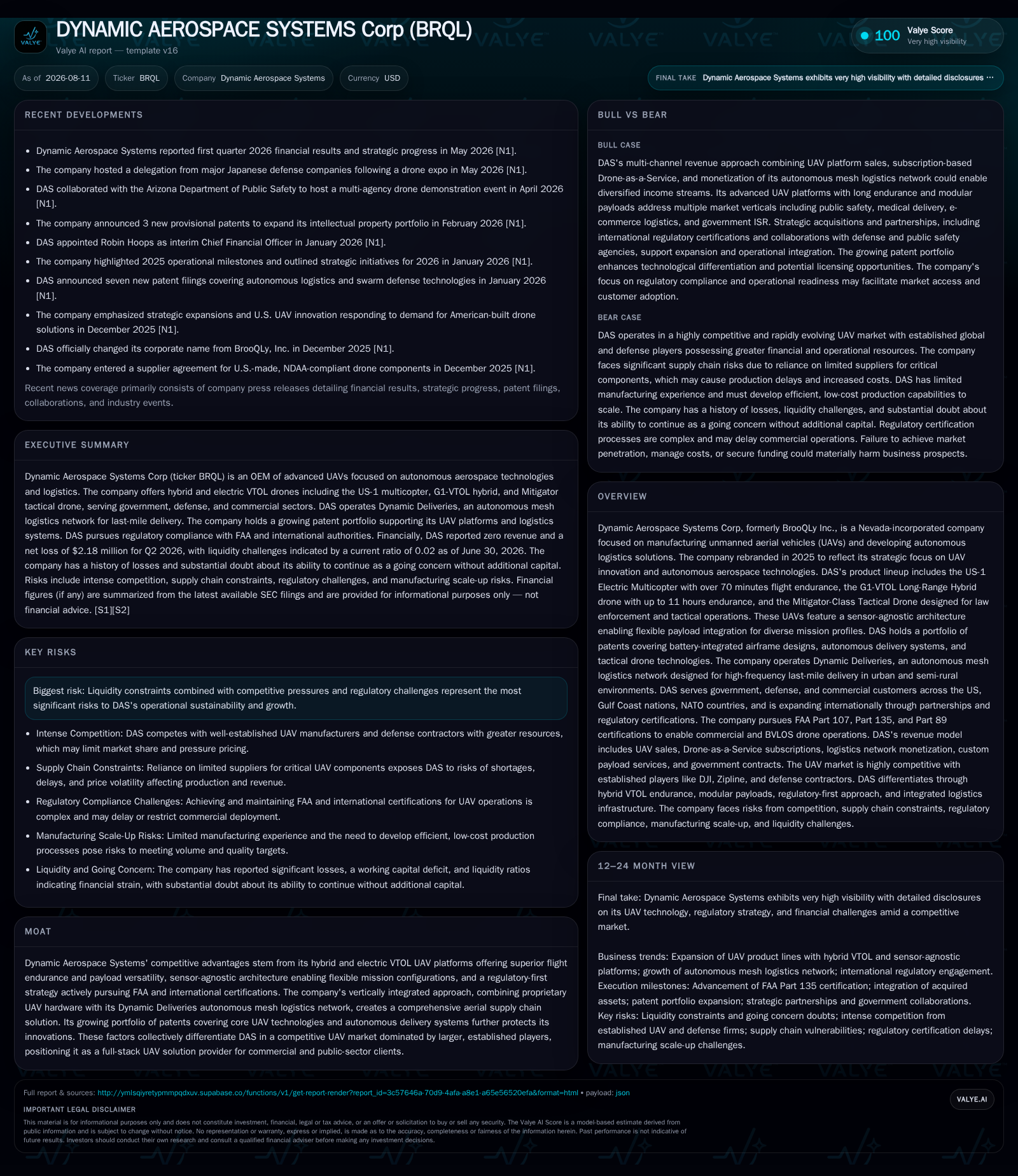
Dynamic Aerospace Systems Corporation (DAS) recently reported continued strategic progress in UAV manufacturing and autonomous logistics amid ongoing liquidity constraints. Leveraging its portfolio of proprietary VTOL and electric multicopter platforms, along with an expanding patent family and regulatory engagements, DAS aims to commercialize its UAV solutions for government and commercial sectors. However, significant cash burn, a working capital deficit, and intense regulatory and competitive pressures underscore operational risks in this early-stage aerospace company.
Recent Operating Update
Dynamic Aerospace Systems Corporation (DAS), trading as BRQL, disclosed in its latest quarterly Form 10-Q filed August 10, 2026, that it has yet to generate revenue from its UAV manufacturing and autonomous logistics operations while continuing to invest heavily in research, development, and product commercialization efforts [S2]. The company completed a private placement financing on June 18, 2026, raising $750,000 through sales of common stock paired with warrants exercisable for additional shares under Section 4(a)(2) exempt offerings [S3]. This infusion aims to bolster capital resources during ongoing liquidity pressures.
Operationally, DAS maintains focus on advancing flagship UAV platforms such as the US-1 Electric Multicopter—offering over 70 minutes of flight endurance with a three-kilogram payload—and the G1-VTOL Long-Range Hybrid drone capable of up to 11 hours endurance for extended missions [S1]. Coupled with the Mitigator-Class Tactical Drone designed specifically for law enforcement and tactical operations, these products embody DAS's strategy of delivering versatile aerial solutions across commercial logistics, defense reconnaissance, and public safety markets.
Key technology differentiators include DAS's sensor-agnostic architecture permitting flexible payload integration which enhances mission customization compared to fixed payload designs typical among competitors. The company's patented battery-integrated airframe further underpins extended flight durations facilitating competitive advantages in mission endurance—a focal point distinguishing it from traditional electric multicopter or fixed-wing UAV OEMs relying on less energy-dense configurations [S1].
Business Model Analysis
DAS operates primarily as an original equipment manufacturer (OEM) combining hardware innovation with emerging autonomous aerial logistics capabilities through its Dynamic Deliveries division. Its monetization involves direct sales of advanced UAV platforms alongside software-enabled logistics network services targeting both government defense contracts and commercial customers engaged in last-mile deliveries.
Revenue streams depend heavily on successfully converting demonstrations into customer contracts during complex regulatory environments. Pricing mechanics reflect per-unit hardware sales supplemented by recurring service agreements linked to ongoing network support or operational data services inherent in mesh-networked delivery systems. Production volume capacity utilization remains an important lever affecting gross margins given fixed manufacturing overheads inherent in aerospace production lines.
The company's intellectual property portfolio expansion signals a strategic intent to protect core technologies around autonomous drone delivery systems, interceptor drones, and tactical applications—a crucial moat element given intense competition from well-established players like AeroVironment or Northrop Grumman who possess deeper pockets but cannot match DAS's specialized vertical integration into autonomous logistics networks [S11], Industry Knowledge Layer.
Industry Structure and Competitive Position
The unmanned aerial vehicle sector is highly fragmented but increasingly dominated by key legacy aerospace contractors supplemented by nimble startups focusing on innovation in battery tech, autonomy software, or niche tactical use cases. Regulatory clearance such as FAA certification serves as a gatekeeping function influencing how quickly new entrants can achieve scaled deployments. DAS's proactive regulatory-first strategy positions it favorably relative to non-compliant rivals but must still navigate evolving international standards impacting exportability.
Technological innovation around hybrid propulsion systems significantly enhances UAV flight endurance—a critical operating KPI influencing customer purchasing decisions especially within defense ISR missions or time-sensitive commercial deliveries. DAS’s G1-VTOL illustrates industry-leading hybrid design delivering extended airborne times exceeding many pure-electric competitors limited by battery densities.
Peer companies encompass large defense contractors offering broad defense portfolios including UAV divisions, pure-play manufacturers specializing solely in drone hardware (e.g., Impossible Aerospace), and autonomous delivery network operators such as Zipline modeling service-based UAV ecosystems rather than discrete platform sales alone. DAS uniquely integrates hardware manufacturing with mesh networking software enabling full-stack aerial supply chain solutions creating differentiation opportunities but also substantial execution complexity.
Growth Drivers
Structural demand drivers include growing reliance on unmanned systems by governments for reconnaissance and resupply campaigns accelerated by geopolitical tensions fostering defense modernization budgets supplemented by increasing commercial adoption of drones in logistics where urban last-mile challenges incentivize autonomous delivery firms.
Additionally, advances in battery energy density coupled with hybrid propulsion expansion underpin improvements in flight endurance—turning previously short-range UAVs into viable options for complex multi-hour missions. Regulatory clarity progress especially FAA approvals for beyond visual line-of-sight (BVLOS) operations unlocks the potential scale needed to commercialize broad drone delivery infrastructure.
Strategic partnerships bolster market access: DAS’s memorandum of understanding with Drops SmartHubs targets EU distribution channels aligning with NATO countries’ procurement priorities while cooperation with UAE’s Noon Fulfillment leverages regional e-commerce growth anticipated to foster mandated autonomous delivery percentages by 2030 [S1]
Further expected growth stems from patent filings targeting autonomous delivery architectures reinforcing long-term defensibility while internal investments aim at ramping manufacturing readiness addressing supply chain bottlenecks observed elsewhere in aerospace tech sectors.
Risks and Watchpoints
Financial sustainability remains a paramount concern as reflected in the extreme working capital deficit noted at quarter-end June 2026: current assets totaled approximately $98,866 versus current liabilities exceeding $4.38 million resulting in a critical current ratio near 0.02 highlighting liquidity constraints that could impair operational continuity absent timely capital raises or revenue generation [F1]
Competition from entrenched aerospace OEMs possessing extensive supplier relationships and procurement priorities poses challenges compounded by aggressive innovation cycles threatening technology obsolescence risks if DAS cannot keep pace.
Regulatory delays can materially postpone revenue realization timelines since FAA certifications act as prerequisites for most large-scale mission deployments particularly in commercial airspace environments. Customer adoption rates remain unproven with technical validation phases ongoing requiring significant demonstration-to-contract conversion efficiency improvements.
Operationally integrating recently acquired technologies from Vayu Inc., Impossible Aerospace Corporation assets adds managerial complexity risking delayed synergies realization; meanwhile legal compliance failures especially regarding data privacy or export controls could trigger costly penalties or reputational damage given international outreach ambitions [S1], [S19].
What to Watch Next
Upcoming milestones worth monitoring include successful completion of additional tranches of private placements supporting cash runway extension beyond mid-2026 horizons as referenced in recent filings [S3]; progress obtaining FAA certifications governing key UAV models necessary for commercial scalability; execution updates on MoUs converting trial demonstrations into firm purchase orders particularly within Gulf Coast/NATO aligned nations; patent grant announcements adding depth to the company's competitive IP posture; ramping production volumes reflected in manufacturing capacity utilization metrics; and any material developments surrounding uplisting aspirations onto major national exchanges which could enhance institutional investor access [S1], [S11].
Indicators signaling durable demand traction would be growing order backlog disclosed publicly or through shareholder communications alongside contract wins directly citing government or large-scale commercial customers affirming trust in DAS’s integrated offerings.
Financial Profile Discussion
Balance sheet positioning remains fragile with total debt approximating $873,333 and net debt near $867,790 as of June 30, 2026, against minimal cash reserves of approximately $5,543, combined with elevated current liabilities substantially outweighing liquid assets placing solvency under pressure without further financing events imminent [F1]
Capital expenditures focus primarily on R&D investments expanding patent coverage alongside incremental manufacturing equipment acquisitions intended to enable transition from prototype to scaled production capable of meeting initial customer demand forecasts establishing path towards future revenue growth contingent upon regulatory clearances achieved timely.
In summary, financial resources are tightly constrained creating execution risk amid substantial upfront investment needs typical of early-stage aerospace technology firms transitioning from developmental phases toward commercialization.
This analysis synthesizes data from Dynamic Aerospace Systems Corporation’s recent SEC filings combined with industry expertise specific to the unmanned aerial vehicle manufacturing sector without issuing investment research views.
Disclaimer: This is research-only, informational analysis and not investment advice. It may include AI-generated interpretation and general industry context. Always verify important details using primary sources.

Comments