
BridgeBio Pharma Spurs Growth with Attruby and Late-Stage Genetic Therapies
Q2 2026 results highlight BridgeBio’s expanding commercial footprint with Attruby alongside advancing late-stage genetic therapy candidates, reinforcing the strength of its portfolio operating model.
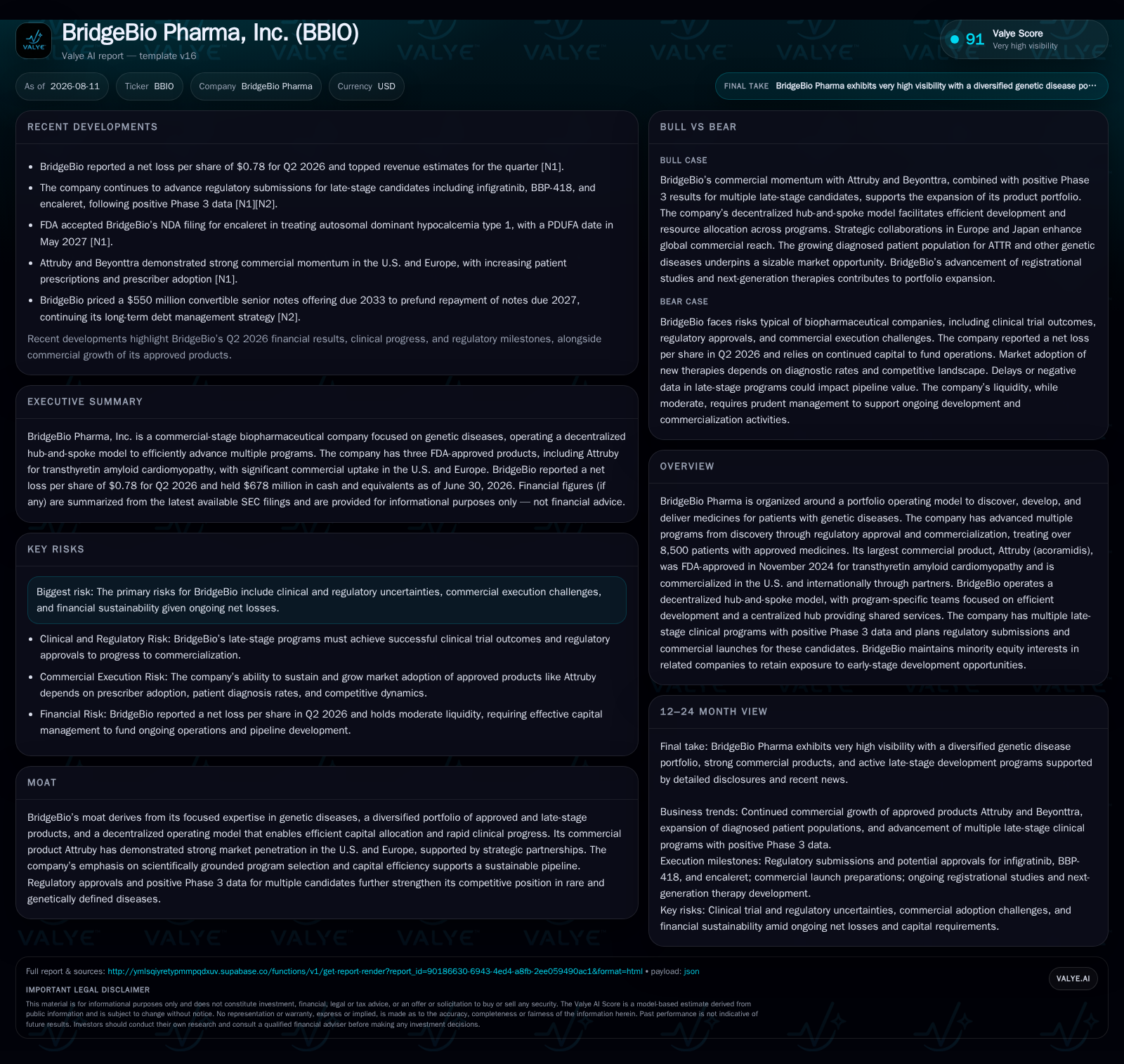
BridgeBio Pharma’s latest quarterly filing reveals accelerating revenue growth driven by its flagship product Attruby (acoramidis) for transthyretin amyloid cardiomyopathy, supported by international partnerships and patient access initiatives. Concurrently, its portfolio approach delivers efficient capital allocation with multiple Phase 3 genetic disease programs reporting positive data and nearing regulatory submissions. This decentralized hub-and-spoke model enables rapid clinical progression and disciplined investment, positioning BridgeBio well within the competitive rare disease biotech landscape. Key risks remain in regulatory uncertainties and commercialization execution, balanced against promising launch readiness across new indications.
Q2 2026 Operating Update Signals Growing Commercial Momentum for Attruby
BridgeBio’s Q2 2026 filing highlights a meaningful uptick in revenues propelled chiefly by commercial sales of Attruby (acoramidis), approved in November 2024 for transthyretin amyloid cardiomyopathy. The reported sales performance exceeded consensus estimates, benefiting from both U.S. market penetration and robust international royalty/licensing income from partners Bayer in Europe and Alexion in Japan under the Beyonttra brand [S2][N1]. Patient treatment counts have expanded steadily, reflecting effective co-pay assistance initiatives that ease affordability barriers common in orphan disease markets. This increasing prescription uptake is pivotal as pricing power in specialty rare disease therapeutics critically depends on payer coverage dynamics and patient access programs [S4]. The company’s simultaneous focus on pharmacovigilance ensures sustained safety profiles vital for long-term market acceptance.
BridgeBio’s Portfolio Approach Enhances Development Efficiency in Genetic Diseases
BridgeBio is structured around a portfolio operating model characterized by decentralized program-specific teams with centralized shared services providing synergy across R&D, regulatory affairs, manufacturing coordination, and commercial support [S1]. This hub-and-spoke design enables agile decision-making on advancing or discontinuing clinical assets, minimizing capital waste typical of traditional linear pipelines. The firm reports an average investment of less than $40 million to achieve proof-of-concept per program and approximately $10 million to reach Investigational New Drug (IND) submission stages—an efficiency that stands out among mid-sized rare disease biopharma peers who often face ballooning costs at early clinical phases.
This capital discipline supports simultaneously working on multiple genetically targeted therapies including underserved indications that conventional pharma might bypass due to small population economics but which BridgeBio hopes to develop profitably leveraging NPV-positive outcomes [S1].
Competitive Edge: Decentralized Model Supports Swift Clinical Progression and Capital Discipline
The recent clinical successes underscore the operational merits of BridgeBio’s structure. Positive Phase 3 topline data reported for infigratinib addressing achondroplasia (a prevalent form of dwarfism), BBP-418 targeting limb-girdle muscular dystrophy type 2I/R9, and encaleret for autosomal dominant hypocalcemia type 1 are central to the company’s advancement trajectory [S1][S2]. These molecularly driven candidates benefit from well-defined genetic markers facilitating patient selection—critical in rare indications—and streamlined regulatory pathways fostered by increased FDA willingness to approve therapies for orphan diseases.
Compared to specialized rare disease biotech peers like Ultragenyx or Alexion Pharmaceuticals (before its acquisition), BridgeBio combines a broader pipeline diversity while maintaining nimbleness via its intensive program focus. Its ability to escalate multiple Phase 3 programs concurrently also mitigates binary risk inherent in single-asset firms.
Industry Dynamics: Rare Disease Market Access, Reimbursement, and Partnership Landscape
Operating in the rare genetic disease segment entails navigating complex reimbursement landscapes where securing formulary placement by third-party payors is essential yet challenging. BridgeBio's management acknowledges that market acceptance hinges not only on demonstrated drug efficacy and safety but also on ensuring competitive pricing structures backed by supportive patient access policies such as co-pay assistance while complying with evolving regulatory scrutiny on promotional practices [S4][S8]
Internationally, partnering approaches expand reach without proportional commercial overheads. Bayer's collaboration facilitates European distribution where healthcare systems differ markedly from the U.S., requiring local payer negotiating expertise. Similarly, Alexion's role in Japan attests to strategically leveraging established specialty pharma networks for efficient product launches [S1].
Upcoming Regulatory Catalysts from Late-Stage Clinical Programs in Pipeline Expansion
Looking ahead, regulatory submissions are planned imminently or underway for key late-stage assets following recent Phase 3 data disclosures. These include filings for infigratinib in achondroplasia and BBP-418 targeting limb-girdle muscular dystrophy type 2I/R9 seen as poised to expand treatment options where no or limited therapies exist currently [S3][N7]. Encaleret’s positive trial outcome supports NDA filings addressing autosomal dominant hypocalcemia type I; additional studies targeting chronic hypoparathyroidism commence this year enhancing label breadth.
Success at FDA review milestones will be critical inflection points monitored closely by stakeholders given their potential to trigger the next wave of commercial launches. Achieving timely approvals can validate BridgeBio’s platform-centric approach integrating science-driven candidate selection with efficient clinical development.
Growth Drivers: Market Penetration, Diagnostic Advances, Strategic Collaborations, and Label Expansions
The company’s growth prospects depend substantially on increasing diagnosis rates of rare genetic diseases through improved molecular diagnostics that expand identifiable patient populations. Enhanced physician awareness driven by medical education efforts further supports uptake velocity.
Strategic partnerships amplify geographic reach while reducing direct sales force burdens outside core U.S. markets. Co-pay assistance remains an essential patient access tool underpinning adherence given high specialty drug costs often encountered even with insurance inclusion.
Ongoing efforts at label expansions to address related indications will leverage existing regulatory approvals enabling accelerated marketing access without full-scale trials—a standard biotech growth lever leveraged widely among peers.
Risk Factors: Clinical, Regulatory, Commercial Execution Challenges, and Financial Sustainability Concerns
Despite promising developments, BridgeBio faces broad industry-standard risks such as potential clinical trial failures or delays that could defer pipeline maturation or impair future revenue streams [S4][S11]. Regulatory risks include possible rejection or delayed approval impacting launch timelines amid evolving FDA scrutiny especially concerning promotional compliance highlighted by recent warning letters received related to direct-to-consumer advertising practices for Attruby [S20]. Commercial execution risks manifest through dependence on payor reimbursement environments susceptible to political pressure over drug pricing reforms affecting gross-to-net realizations.
Financial sustainability remains under watch given ongoing net losses stemming from significant R&D spending needed across multiple early-to-late stage programs concurrent with scale-up of commercial operations. However, sizeable cash reserves mitigate imminent liquidity concerns [F1][S2]
What to Watch Next: Upcoming Milestones in Clinical Trials, Launch Execution Metrics, and Revenue Indicators
Investors should track regulatory review statuses for major pending NDAs especially those with PDUFA dates announced during the remainder of 2026. Early commercial sales trends post-launch of new approvals will provide insight into market acceptance beyond ATTR-CM indications.
Clinical enrollment rates for initiating Phase 3 studies—such as encaleret’s planned trials—offer intermediate signals on pipeline momentum.
Market penetration metrics including prescription volume growth curves and payor coverage expansions will reveal operational efficacy supporting sustained revenue scaling crucial for transitioning towards profitability.
Financial Profile Discussion
Conclusion
BridgeBio Pharma’s August 2026 quarterly update cements its trajectory as a portfolio-driven biotech innovator leveraging a decentralized operating model tailored toward genetic diseases. The commercial success of Attruby paired with advancing late-stage candidates underscores both near-term revenue concreteness and longer-term growth visibility uncommon in comparable mid-sized biopharmaceutical firms focused exclusively on orphan indications. Operational agility fostering rapid proof-of-concept achievement complements sound capital stewardship enhancing overall company resilience.
Challenges persist across regulatory scrutiny landscapes and reimbursement uncertainty inherent in orphan drug commercialization; nonetheless, BridgeBio's strategic global partnerships combined with expanding patient access initiatives position it competitively within specialized genetic therapeutics markets now poised for significant growth.
This update should be contextualized within broader sector dynamics emphasizing innovation efficiency coupled with pragmatic launch execution excellence as critical differentiators shaping rare disease biotech success stories.
Disclaimer: This analysis is informational only, based solely on publicly available data as cited; it does not constitute investment advice or research view.
Disclaimer: This is research-only, informational analysis and not investment advice. It may include AI-generated interpretation and general industry context. Always verify important details using primary sources.

Comments