
Playboy’s Capital-Light Licensing Model Stabilizes Amid Direct-to-Consumer Retail Challenges
Playboy consolidates its licensing foothold while navigating operating losses and liquidity pressures in its DTC segment.
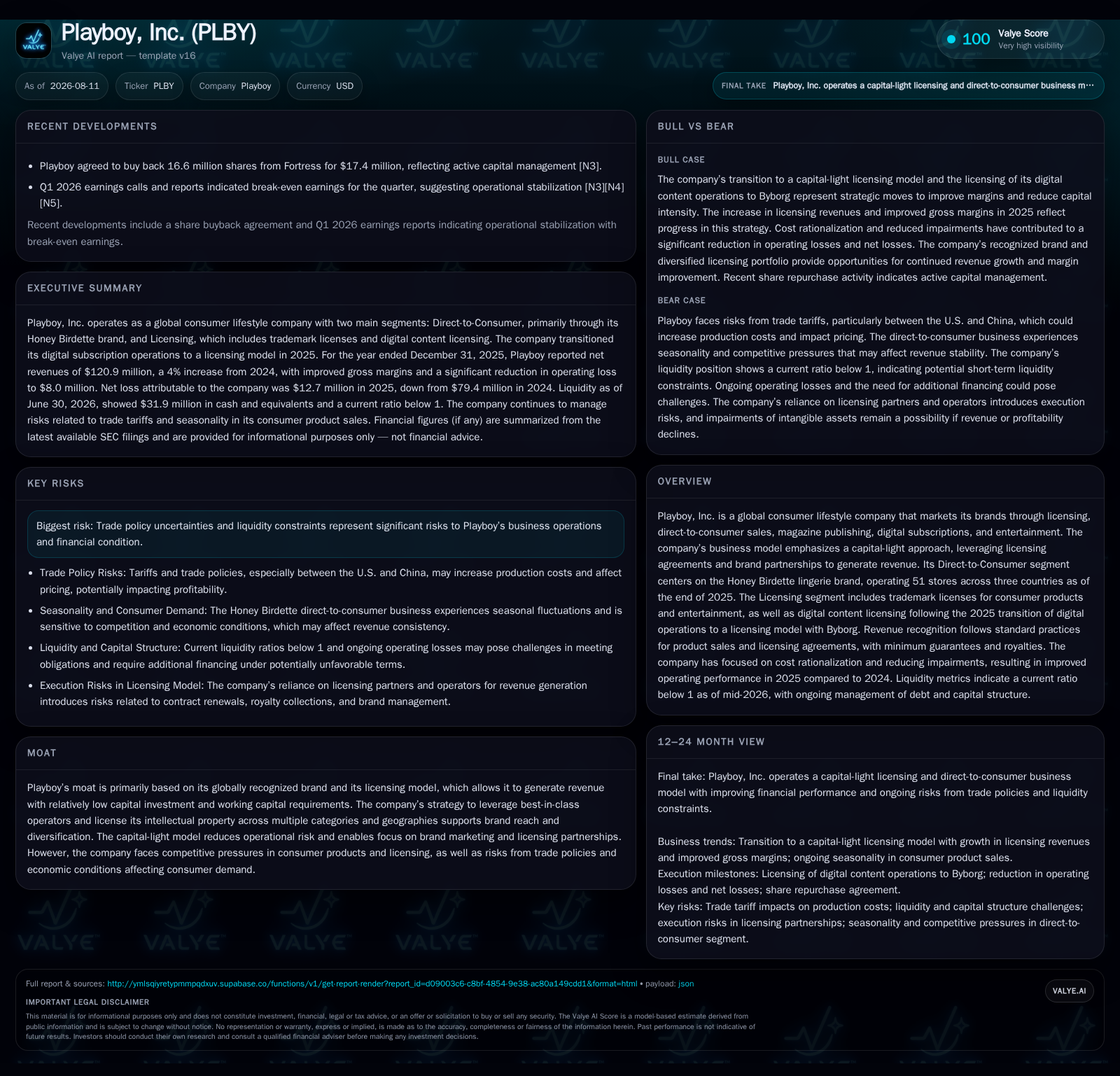
In Q2 2026, Playboy, Inc. continued executing its capital-light strategy centered on licensing intellectual property and leveraging strategic partnerships, notably the Byborg License & Management Agreement which provides $300 million in minimum guaranteed royalties over 15 years. The company’s direct-to-consumer segment, anchored by Honey Birdette’s retail footprint of 51 stores, faces seasonality and competitive pressure impacting sales momentum. While operating losses persist due to corporate costs and retail challenges, the licensing segment benefits from stable cash flows and expansion into new territories like China through joint ventures. Trade tariffs and macroeconomic uncertainties pose ongoing risks, with impairment exposure mitigated relative to prior years. Playboy's liquidity, backed by $32 million cash but burdened by net debt near $113 million, remains a watchpoint as it balances growth investments and debt service.
Recent Operating Update
Playboy’s latest quarterly filing for Q2 2026 confirmed its continued focus on scaling a capital-light business model centered on licensing its globally recognized Playboy brand. The core development underpinning recent performance is the License & Management Agreement (LMA) with Byborg initiated January 1, 2025. This LMA transfers operation of Playboy’s digital subscription assets—including Playboy Plus and Playboy TV—to Byborg, providing Playboy with $300 million in minimum guaranteed royalties spread over an initial 15-year term [S1][S2]. This licensing arrangement significantly stabilizes revenue streams from digital content offerings by replacing operational variability with contractual minimums.
On the retail front, the Direct-to-Consumer (DTC) segment is anchored by Honey Birdette lingerie sales via an international store footprint of 51 locations at the end of 2025 across three countries [S1][S7]. However, this segment confronts seasonality trends and competitive pressures that influence sales volumes and gross margins. The quarterly report highlights efforts to increase full-price product sales within Honey Birdette stores as a margin-improvement lever
Playboy also restructured its China licensing operations during Q1 2026 by terminating a previous JV with CTL and establishing a new JV with UTG owning a 50% interest each [S1]. Given that licensing revenues from China comprised about 10% of total company revenues in both 2024 and 2025, this move aims to optimize local market governance while preserving materiality for overall licensing income
Business Model Analysis
Playboy operates primarily as a licensor of its intellectual property (IP), leveraging brand recognition across multiple consumer lifestyle verticals: apparel, accessories, hospitality ventures, digital media subscriptions, gaming content, location-based entertainment experiences, and traditional publishing (notably Playboy magazine). The company monetizes through two core segments:
Licensing Segment: Generates royalty revenue from strategic partners who manufacture or operate businesses using Playboy trademarks under license agreements. This segment benefits from minimum guarantees and potential excess royalties geared toward mitigating revenue volatility.
Direct-to-Consumer Segment: Produces revenue chiefly via Honey Birdette retail operations encompassing brick-and-mortar stores supplemented by e-commerce channels. Here Playboy owns or operates retail assets directly or through affiliates.
This dual structure balances predictable royalty income against higher-margin but more volatile retail operations. The Company’s shift towards capital-light licensing reduces working capital demands and operational risk yet constrains upside growth inherent in owned digital content or retail channels.
Revenue recognition follows contractual minimum guarantees supplemented by accrued royalties based on partner sales performance — an industry-standard monetization mechanic maintaining healthy cash conversion due to lower asset intensity [S1]. Seasonal fluctuations in consumer discretionary spending especially influence DTC sales volumes. Meanwhile, licensing revenue scales primarily with the breadth of partner relationships across product categories and geographies plus pricing power embedded in license fees.
Industry Structure & Competitive Position
Within the Consumer Lifestyle Brands and Licensing sector — home to global licensors such as Authentic Brands Group — Playboy holds a niche brand legacy leveraged predominantly through external operators rather than vertically integrated manufacturing or distribution. This limits operational complexity but necessitates robust brand management capabilities.
Playboy faces challenges typical for iconic lifestyle brands transitioning toward licensing-heavy models: maintaining brand relevancy amid changing consumer preferences; safeguarding trademark equity amidst proliferation; managing quality consistency via licensees; and negotiating favorable royalty terms despite competitive pressures.
Retail peers emphasize store productivity metrics along with omnichannel integration — critical KPIs not explicitly disclosed here but likely monitored internally given Honey Birdette’s sizeable store base [S1][S7]. Digital subscription monetization rivals require sustained subscriber growth balanced against churn rates — a dimension now outsourced to Byborg limiting direct control but offering steady guaranteed fees.
Externally imposed trade tariffs between the U.S. and China add input cost uncertainty particularly affecting Honey Birdette’s supply chain sourced mainly from China as well as other licensees’ manufacturing bases. These costs risk pressuring gross margins unless offset by price adjustments or efficiency gains [S1].
Growth Drivers
Playboy’s growth strategy prioritizes:
- Expanding Licensing Footprint: Targeting new product categories beyond apparel into experiential sectors such as hospitality and entertainment with best-in-class partners.
- Geographic Penetration: Especially emerging markets like China where regulatory or JV restructurings create new commercial opportunities.
- Brand Revitalization: Utilizing editorial assets (e.g., Playboy magazine’s relaunch) and strategic collaborations to enhance consumer engagement.
- Digital Monetization Stability: Via Byborg’s licensed operation guaranteeing annual royalties plus potential excess fees.
- Direct Retail Enhancements: Focused on improving Honey Birdette’s full-price product mix to elevate gross margin resilience amid competitive pressures.
Milestones including establishment of the New China JV (expected Q1-Q2 2026 closing), incremental extension of retail footprint or online sales growth rates at Honey Birdette will be pivotal demand markers going forward [S1][S3]
Risks & Watchpoints
Principal risks remain:
- Liquidity Constraints: Despite recent capital raises increasing ATM availability to $200 million in common stock issuances capacity (February 2026), current liquidity of approximately $31.9 million cash against net debt near $113 million creates financial flexibility concerns if operating losses continue unchecked or if market conditions impair access to additional funding sources [F1].
- Operating Losses & Cost Structure: The company reported operating income deficits ($-8M year-end Dec 2025) driven partly by severance linked to restructuring shifts toward licensing; increased corporate-level marketing; legal expenses; stock-based comp; partially offset by decreased impairment charges compared to prior years [F1][S7][S23].
- Trade Tariffs Impacting Margins: Persistent tariffs between U.S.-China supply chains could increase production costs for DTC products sold by Honey Birdette and licensing partners’ merchandise offerings jeopardizing pricing power or compressing margins [S1].
- Intangible Asset Impairments: While impairments declined notably post-2024 ($17M goodwill impairment then none recorded in 2025), future revenue declines could trigger new non-cash asset write-downs reducing balance sheet strength [S1].
- Seasonality Volatility: As business shifts more toward capital-light modes factoring into variable royalty income streams versus seasonal consumer purchasing patterns influencing physical store revenues [S1].
Monitoring adherence to upcoming debt covenant tests scheduled from June 30, 2026 onwards will be central given levied covenants tied to leverage ratios, minimal unrestricted cash requirements ($7.5M minimum), as well as potential refinancing dynamics amidst persistent negative macroeconomic factors [F1]
What to Watch Next
Key upcoming indicators include:
- Completion timing and operational ramp of the New China JV partnership.
- Retail same-store sales growth rates at Honey Birdette reflecting brand strength amid competition.
- Digital licensing excess royalty accruals over guaranteed minimums indicating underlying digital business health beyond contracted floors.
- Cost trajectory related to legal settlements or restructuring expenses impacting operating losses.
- Effects of trade tariff policy changes — any alleviation could improve DTC margin outlook.
- Liquidity trends including equity issuance alongside debt covenant compliance starting H2'26 testing periods.
These metrics will clarify whether the balance between steady royalty/license fee earnings offsets ongoing retail volatility and corporate cost headwinds driving losses.
Financial Profile Discussion
As of June 30, 2026, Playboy reported cash & equivalents totaling approximately $31.9 million against total debt near $144.9 million yielding net debt around $113 million [F1]. Current assets stood at roughly $59.3 million opposed by current liabilities around $74.8 million producing a current ratio near 0.79, signaling tight near-term liquidity coverage constraints given working capital dynamics [F1].
Interest expense remains significant given adjusted term loan cost components at spreads over SOFR plus mid-single-digit percentage margins.
Equity issuance activity totaled over $32 million net proceeds between late 2024 (private placement) through early 2026 (ATM sales), enhancing liquidity reserves but diluting share counts—a necessary tradeoff given negative free cash flow trends related primarily to corporate overhead amid retail investment needs [F1]
Capital expenditures remain steady relative to prior years indicating limited reinvestment outside controlled owned assets while disposition of legacy art assets has marginally improved cash flow profile without large operating impact given their non-core nature [S4][S16][F1]
Overall financial positioning portrays a company balancing high fixed obligations under debt facilities against unpredictable revenue cycles characteristic of lifestyle brand licensors migrating toward more annuity-like income streams through long-term license contracts.
This analysis synthesizes the latest available regulatory disclosures up to August 10, 2026 alongside broader sector expertise on consumer lifestyle brand licensing models without issuing investment research views or forecasts.
Disclaimer: This is research-only, informational analysis and not investment advice. It may include AI-generated interpretation and general industry context. Always verify important details using primary sources.

Comments