
General Catalyst Global Resilience Merger Corp. IPO Capital Structure and Trust Mechanics Define Path to Business Combination
As a newly public SPAC, GCGR’s value hinges entirely on executing a business combination within the mandated timeframe while managing redemption and warrant dynamics.
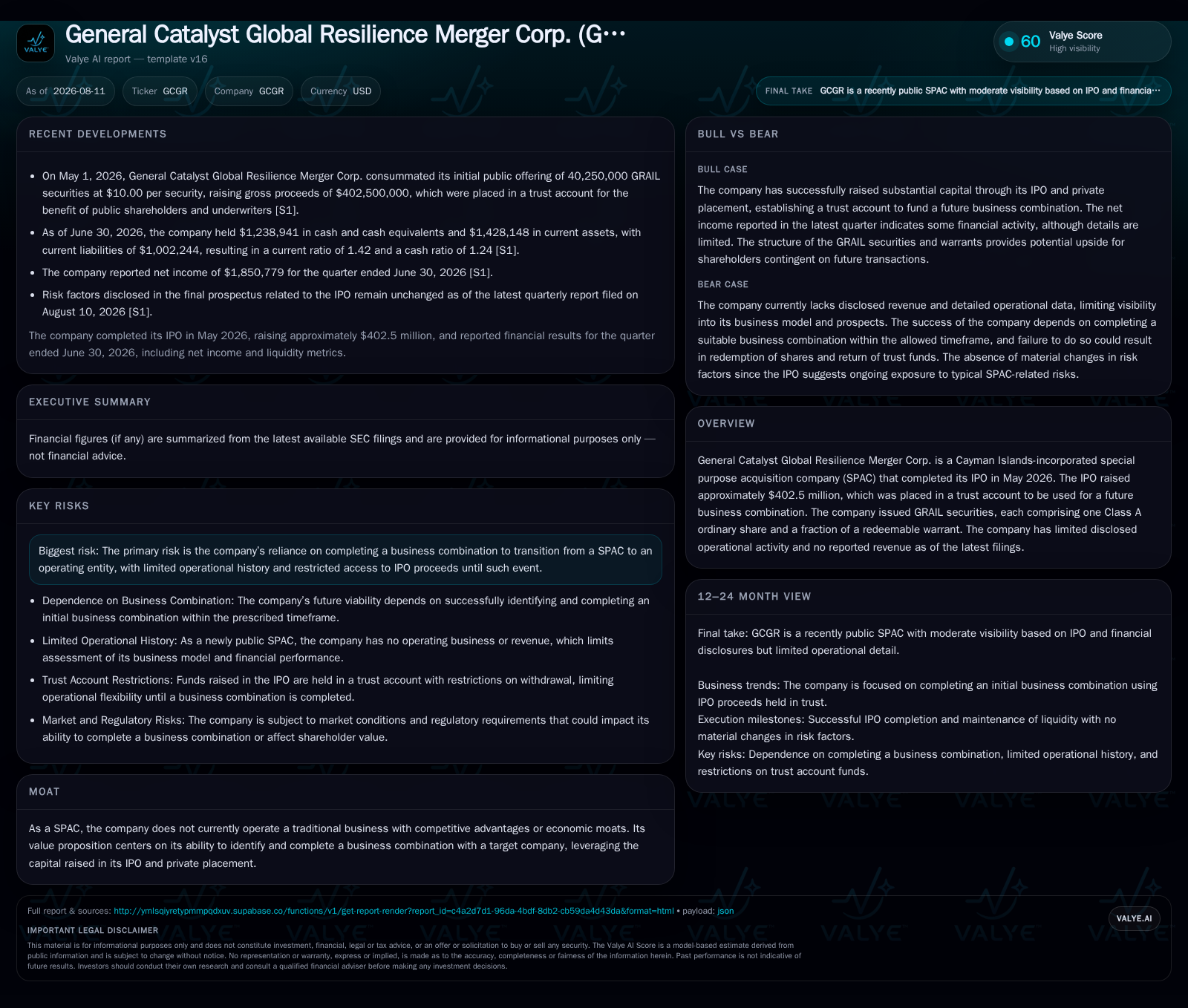
General Catalyst Global Resilience Merger Corp. completed its IPO in May 2026, raising $402.5 million through a structured issuance of units combining Class A shares and redeemable warrants. The company holds these proceeds in a trust account pending a de-SPAC merger with a private company, yet has no operating revenues or business operations at this stage. Key risks revolve around successful deal execution within the 24-month deadline and potential shareholder redemptions that could reduce available capital for the transaction. The recent quarterly filing confirms no material changes in risk profile or operational activity, while the granting of separate trading rights for shares and warrants offers liquidity complexity. Understanding GCGR requires placing it in context with SPAC lifecycle norms, sponsor incentives, redemption rights impact, and market environment dynamics.
Recent Operating Update
General Catalyst Global Resilience Merger Corp. (GCGR) publicly listed on the Nasdaq in May 2026 through an initial public offering that raised gross proceeds of approximately $402.5 million [S10][F1]. These funds were placed into a trustee-managed investment trust account designed to preserve capital until GCGR executes a qualifying business combination or returns funds upon liquidation if no combination occurs within the prescribed timeframe. The company does not currently operate any business generating revenue or earnings — its financial activity so far is consistent with industry-standard SPAC pre-combination profiles [S2][F1].
In June 2026, the company announced an optional mechanism allowing holders of its issued units (GRAIL Securities) to separate their constituent Class A ordinary shares from the accompanying fractional warrants for individual trading starting June 22, 2026 [S3][S8]. This development introduces both greater liquidity flexibility for security holders and additional complexities in tracking warrant dilution potential and share price behavior.
No material changes were reported regarding risk factors since the IPO prospectus filing in April 2026; key risks remain those inherent to blank check companies dependent on successful target identification and merger completion within statutory deadlines [S2]
Business Model Overview
As a Special Purpose Acquisition Company (SPAC), GCGR serves exclusively as a capital-raising intermediary without direct operating activities or product offerings. Its monetization model centers on issuing securities composed of Class A shares paired with redeemable warrants during its IPO — known collectively here as GRAIL Securities — which trade publicly until conversion during a de-SPAC transaction (business combination).
Shareholders supply capital upfront at $10 per unit while retaining rights including redemption options if shareholders oppose proposed mergers or no combinations materialize in time. Redeemable warrants represent optional equity stakes exercisable at $11.50 per share post-business combination, introducing prospectively dilutive instruments that affect equity value post-merger.
Crucially, GCGR’s cash sits majorly in a trust account controlled under strict covenants prohibiting access to principal except upon meeting specific milestones like merger completion or liquidation events. This trust account construct protects public investors’ capital but also constrains cash flow flexibility prior to deal consummation.
Sponsor participation materializes through private placements — GCGR’s Sponsor acquired about $9 million worth of securities with attached non-redeemable warrants priced identically to those issued publicly but exempt from redemption rights [S10][S17]. This aligns Sponsor incentives towards successful execution within timelines and supports coverage of administrative costs billed monthly until de-SPAC event closure.
Industry Structure and Competitive Positioning
GCGR is positioned upstream in the financial value chain as an intermediary between public market investors seeking alternative access points via SPACs versus traditional IPOs, and private companies seeking swift listings without typical underwriting delays.
Peer analysis places GCGR among thousands of SPACs launched during recent years — some high-profile sponsors include Pershing Square Tontine Holdings (PSTH) which executes mega-deals often accompanied by extensive investor scrutiny, and Churchill Capital Corp series that focus on sector-specific acquisitions leveraging targeted sponsor expertise.
Compared with established peers that may benefit from scale advantages reflected in larger trust balances or broader deal pipelines, GCGR faces significant execution risk typical of smaller/newer entrants whose value relies heavily on sponsor acumen amid crowded market conditions. Competitive differentiation is usually achieved through sector focus or proprietary pipeline access — however, GCGR’s filings do not explicitly reveal target sectors at this stage.
Growth Drivers
SPAC growth dynamics depend greatly on external capital market environments dictating investor appetite for alternative public listings over traditional IPOs via underwriters. Favorable macroeconomic conditions encouraging risk tolerance signal potential increases in demand for vehicles like GCGR.
Sponsor reputation combined with proactive deal sourcing pipelines enhances likelihood of timely business combination announcements — critical triggers that unlock share price appreciation post-announcement due to perceived value creation. Furthermore, regulatory climates enabling smoother de-SPAC transactions facilitate faster closures reducing dilution risks.
The unlocking of separated trading for warrants introduces possible secondary liquidity events stimulating market participation from diverse investor classes beyond initial purchasers. Additionally, innovation emerging from new sectors attracting SPAC interest could create more attractive targets boosting closing probability.
Lastly, ongoing improvements in SPAC governance practices concerning transparency surrounding valuation assumptions and conflicts can foster stronger investor confidence supporting unit stability prior to combination events.
Risks and Watchpoints
Foremost is the practical challenge of closing a qualified business combination within the 24-month window stipulated by GCGR’s governing documents — late-stage extensions up to 27 months require certain preconditions including letters-of-intent or definitive agreements being signed promptly [S18]. Failure results in mandatory liquidation returning capital net expenses but diluting shareholder returns.
Redemption risk is acute: shareholders tendering redemption rights upon merger proposal announcements can materially reduce the cash held in trust available for transaction financing thereby pressuring alternative deal structures or requiring additional sponsor investments.
Warrant exercises trigger dilution impacting ownership percentages; heavy exercises may depress share prices post-deal affecting long-term value realization. Sponsor promotes (incentive ownership stakes usually around ~20%) further complicate dilution math especially if combined with significant warrant conversions.
Regulatory scrutiny remains elevated given historical SEC examinations spotlighting disclosures accuracy relating to Sponsor conflicts and fair valuation metrics used during negotiations. Market volatility also influences share price performance possibly deterring prospective target companies reliant on stable public valuations post-listing.
Another watchpoint lies in monitoring how many GRAIL Securities have separated their Class A shares versus warrants after June 22 initiation since this impacts both trading volumes across ticker symbols ("GCGR" for shares; "GCGRW" for warrants) as well as logistics around transfer agent operations [S8].
What To Watch Next
Key near-term milestones include:
- Announcements regarding signed letters-of-intent or definitive agreements signalling progress toward business combination completion.
- Shareholder vote schedules approving proposed mergers — high approval rates correlate strongly with timely deal closure.
- Redemption figures following merger announcements which directly influence available cash flexibility.
- Warrant exercise levels post-merger determining dilution trajectory affecting shareholder base valuation.
- Any amendments proposed altering redemption timing or other fundamental rights requiring shareholder approval legally impacting deal timing [S11][S18]
Investors should also observe market sentiment reflected through share price movements relative to peer SPACs undergoing de-SPAC processes which provide comparative benchmarks for timing expectations and potential post-merger valuation multiples.
Financial Profile Discussion
As of June 30, 2026, GCGR reported cash and equivalents totaling approximately $1.24 million outside its trust account alongside total current assets of roughly $1.43 million versus current liabilities near $1 million resulting in a current ratio of 1.42 [F1]. This indicates sufficient short-term liquidity primarily intended for covering administrative expenses rather than operational investment given absence of revenue-generating activity.
The trust account balance itself remains substantial reflecting nearly all net IPO proceeds (~$402 million), segregated under an Investment Management Trust Agreement administered by Continental Stock Transfer & Trust Company as trustee maintaining principal protection unless released upon fulfilling defined transactional criteria [S10][S17]
Net income booked for the period showed positive results estimated at approximately $1.85 million primarily attributable to non-operating gains such as interest income on trust deposits minus administrative costs totaling about $0.39 million operating loss reflective solely of pre-combination administrative spending [F1]
Given this financial posture typical among early-stage SPAC vehicles before merger execution phases, emphasis centers not on profitability metrics but balance sheet robustness preserving capital ahead of complex transaction executions where rapid expense spikes can occur due to legal fees, due diligence costs, proxy solicitations among others.
Conclusion
General Catalyst Global Resilience Merger Corp.’s profile epitomizes classic SPAC characteristics: substantial capital raised swiftly through an IPO followed by prudent segregation into trust accounts safeguarding investor funds pending identification and consummation of an attractive business combination opportunity within an enforced timeline framework. Success is contingent upon navigating unavoidable structural risks: redemption uncertainty diluting transaction funding availability; dilution pressures; regulatory compliance; competitive pressure within crowded SPAC markets; and sponsor reliance on sourcing high-quality targets.
The recent initiation of separate trading for its Class A ordinary shares alongside redeemable warrants further deepens market complexity but also enhances investor flexibility—an important micro feature supporting liquidity conditions ahead of future corporate actions. Investors monitoring GCGR should focus on forthcoming transactional milestones including signed acquisition agreements, shareholder vote outcomes, redemptions ratios post-announcement, and warrant exercise behaviors shaping diluted ownership structures post-merger.
This positioning places General Catalyst Global Resilience Merger Corp. firmly as an upstream financial vehicle dependent on sponsor expertise poised between private companies seeking expedited public access outside conventional IPO routes and public investors wagering on execution skillsets amid evolving regulatory frameworks influencing sector maturation.
This report was prepared solely for informational purposes without offering investment advice or research views regarding General Catalyst Global Resilience Merger Corp.’s securities or transactions related thereto.
Disclaimer: This is research-only, informational analysis and not investment advice. It may include AI-generated interpretation and general industry context. Always verify important details using primary sources.

Comments