
Babcock & Wilcox Enterprises’ Q2 Performance Highlights Contract Stability Amid Refinancing Pressures
Q2 2026 results underscore Babcock & Wilcox’s fixed-price contract backlogs balancing operational execution with looming debt refinancing challenges.
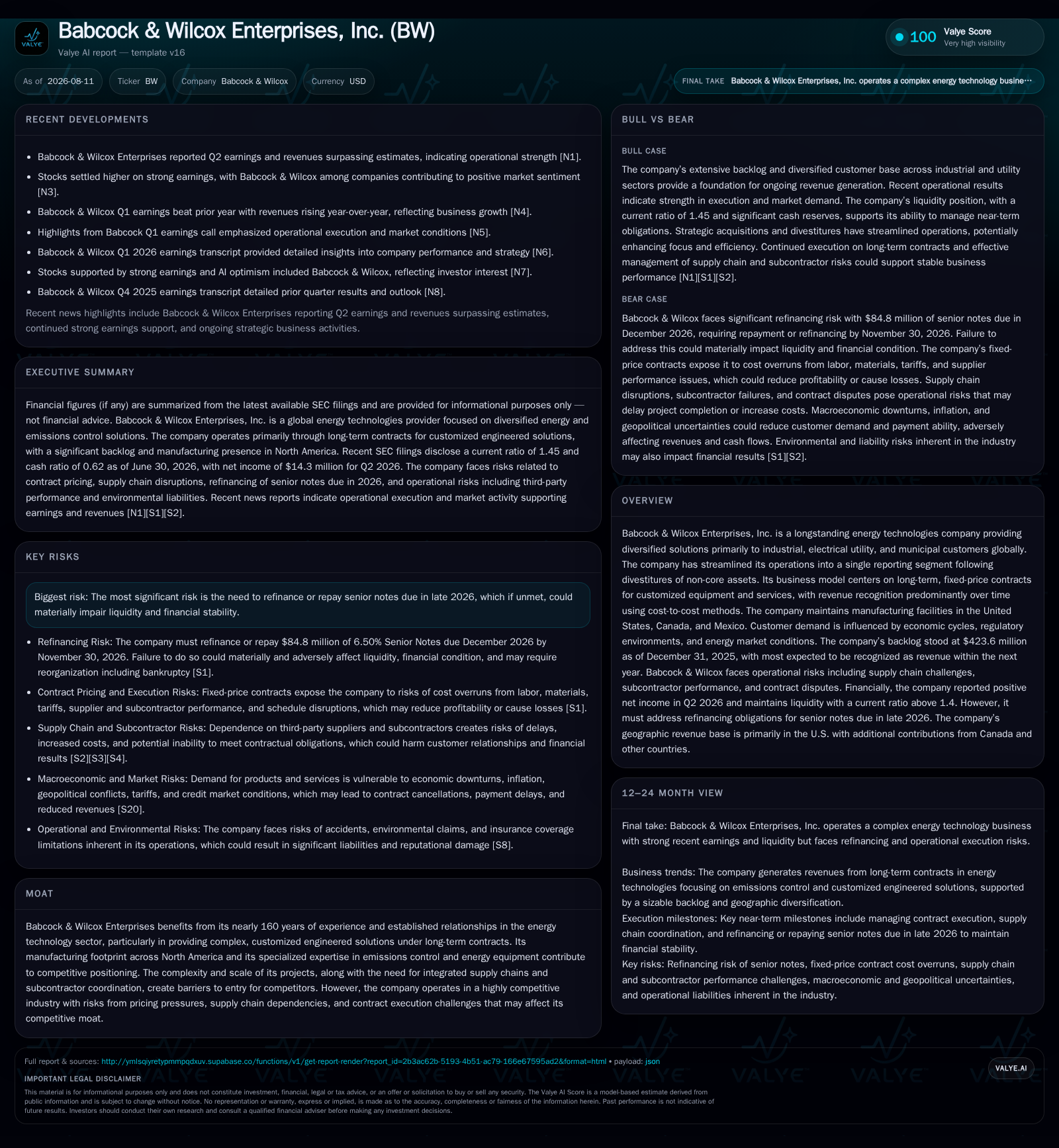
Babcock & Wilcox Enterprises posted a stable backlog of $423.6 million at year-end 2025, forming the backbone of near-term revenue visibility. The company's fixed-price contract model, recognized on a cost-to-cost basis, continues to present margin volatility risks amid supply chain and subcontractor complexities. With senior notes due late 2026 requiring refinancing action, liquidity management remains pivotal. Peer comparisons highlight similar sector pressures around contract execution and capital structure optimization. Regulatory-driven demand for emissions control and infrastructure modernization support growth potential despite cyclical headwinds.
Q2 Operational Performance Frames Backlog Stability during Fixed-Price Contract Risk
Babcock & Wilcox Enterprises’ (BW) second quarter filing dated August 10, 2026, provides essential clarity on the company’s operational footing entering the second half of the year [S18]. At December 31, 2025, BW reported a backlog of $423.6 million, which acts as a forward revenue guide given the firm’s long-term engineering contracting model. Critically, approximately $380.7 million of this backlog is slated for revenue recognition within the upcoming year under their cost-to-cost accounting method—a standard in industrial engineering sectors dealing with multi-year projects
This backlog size affirms solid near-term top-line visibility; however, BW’s business centers on fixed-price contracts where cost overruns pose material risks. The company’s filings note the inherent volatility arising from labor and raw materials price fluctuations (notably steel), tariff impacts, schedule disruptions due to subcontractor performance variations, and design complexity challenges that can erode gross margins or even cause losses if unmanaged [S1]. The degree to which BW mitigates these risks will directly influence margin stability evidenced in upcoming quarters.
Engineering Complexities and Manufacturing Footprint Sustain Competitive Edge but Challenge Execution
BW operates manufacturing facilities in the United States, Canada, and Mexico—a footprint that supports the delivery of engineered solutions to diverse industrial and municipal customers across North America [S1]. This geographic spread provides a competitive moat through proximity to key markets but simultaneously introduces complexity in supply chain management and subcontractor coordination.
Project execution depends heavily on orchestrating inputs from myriad suppliers and specialty fabricators alongside internal manufacturing capacity utilization. Any disruption—whether due to raw material shortages or quality alignment issues with third-party subcontractors—can delay completion timelines or trigger liquidated damages stipulated in BW’s customer contracts [S1]. The company explicitly highlights these operational points as continual focus areas essential for sustaining contract pricing power during intense industry competition.
Industry Context: Peer Approaches to Supply Chain Volatility and Pricing Pressures
BW’s operational profile aligns with broader industrial engineering peers such as General Electric’s energy equipment segment and Mitsubishi Power in emissions control niches. These firms also face pressures from fixed-price contracts where supply chain lead times fluctuate amid global raw material volatility.
For instance, Fluor Corporation's EPC contracting experience underscores how rigorous cost control measures paired with enhanced supplier agreements can partially offset margin pressure caused by unforeseen inflation or tariffs [S1]. While BW operates at a smaller scale than GE and Mitsubishi Power, their exposure to similar subcontractor risks demands equally focused risk mitigation frameworks
Growth Catalysts Rooted in Emissions Control Regulation and Infrastructure Modernization Demand
The company benefits from structural demand drivers embedded in tightening regulatory emission standards globally. Governments increasingly mandate upgrades to legacy energy infrastructure requiring advanced emissions control solutions—a sector where BW holds specialized expertise [S1].
Coupled with infrastructure modernization spending targeting efficiency improvements across utilities and municipalities, such regulatory-induced capex trends augment BW’s medium-term growth runway [S18]. Additional tailwinds arise from energy transitions favoring cleaner natural gas plants—a market supported by BW’s recent agreement with Base Electron to design four natural gas-fired power stations valued potentially up to $2.4 billion including variable time-and-materials fees to be recorded gradually
Refinancing Senior Notes by Year-End Poses Critical Liquidity and Credit Risk Considerations
A central concern highlighted during Q2 surrounds imminent capital structure pressures relating to $84.8 million in senior notes maturing in late 2026 [S1]. Under the company's Credit Agreement amended earlier this year, these notes must be refinanced or repaid by November 30; failure could precipitate covenant breaches or even insolvency proceedings given the loss of creditor support [S3].
Management has acknowledged these refinancing needs as material uncertainties influencing near-term strategic planning.
Risks From Contract Execution Delays, Cost Overruns,and Competitive Pressures Require Close Monitoring
BW operates in a capital-intensive environment where fixed-price contracts offer limited room for absorbing cost inflation caused by labor or supply disruptions after contract signing. Recent disclosures affirm ongoing vulnerability toward supplier-related delays adversely affecting project timelines; liquidated damages clauses could further exacerbate profit erosion if deadlines are missed [S1]. Contractual claims or disputes may arise over responsibility for additional costs when initial designs prove deficient or site conditions diverge from expectations.
The interplay between aggressive pricing to secure contracts versus realistic estimation is a recurring challenge mirrored across peers—a delicate balancing act that affects both profitability and client relationships.
Forward Indicators: Backlog Trends, Cost Control Metrics,and Capital Structure Milestones To Watch
Key operational indicators for forthcoming quarters include examining shifts in BW’s backlog composition — especially new order intake rates relative to project completions — which collectively signal potential revenue trajectory changes beyond current guidance [S2]. Monitoring gross margin fluctuations related to cost variance on fixed-price projects will illuminate effectiveness at containing overruns amid raw material price inflation.
Critically, execution progress on refinancing senior notes will serve as an overarching financial event marker influencing BW's ability to fund existing contracts without distress-related adjustments or covenant waivers from lenders.
Financial Profile Discussion
Operating income reported at year-end 2025 was about $20.7 million while net income remained negative attributable largely to interest expenses consistent with legacy capital structure burdens—although adjusted EBITDA figures trend positive when excluding non-cash items such as stock compensation revealing underlying operational earnings strength [F1,S16,S24]
This analysis integrates Babcock & Wilcox Enterprises’ latest quarterly disclosures highlighting both operational contract execution realities within fixed-price project bidding environments alongside mounting refinancing imperatives shaping near-term financial health safeguards. Peers operating at larger scale but facing similar industrial engineering dynamics underscore that managing supply chain volatility while sustaining backlog quality forms the core challenge amid evolving regulatory demand catalysts for emissions control solutions.
No investment advice is offered herein; readers should refer directly to company filings for decision-making considerations.
Disclaimer: This is research-only, informational analysis and not investment advice. It may include AI-generated interpretation and general industry context. Always verify important details using primary sources.

Comments