
AerSale Advances Integrated Mid-Life Aircraft Solutions Leveraging FAA Repair Certifications
AerSale’s latest quarterly update highlights its integrated aftermarket services combining leasing, MRO, and engineered solutions for mid-life flight equipment.
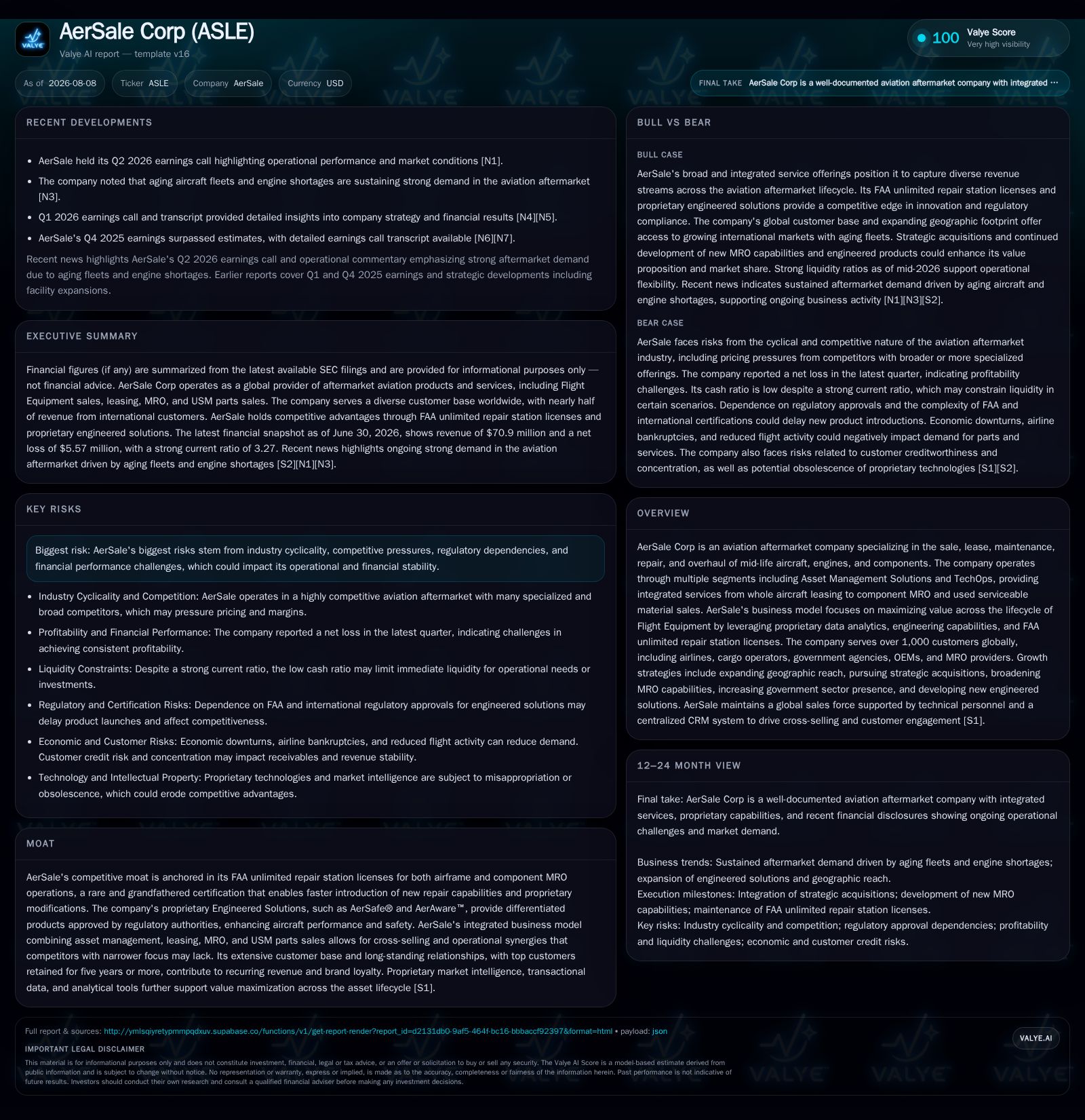
In its most recent quarter, AerSale Corp reinforced its position as a specialized aviation aftermarket player focused on mid-life aircraft, engines, and components. The company integrates asset management, technical operations, and parts sales through its unique FAA unlimited repair station certifications and proprietary engineered solutions. Serving over 1,000 global customers, AerSale leverages a diversified revenue model combining aircraft leasing, maintenance, repair and overhaul (MRO), and used serviceable material (USM) sales. Key growth avenues include geographic expansion, government sector penetration, and strategic acquisitions. Financially, the firm maintains a robust current ratio of over 3x with manageable net leverage reflective of its capital-intensive model.
Recent Operating Update
AerSale’s latest quarterly report filed on August 7, 2026 confirms stable execution across its integrated aftermarket aviation services without deviation from prior strategic directions [S2]. The company's August 6 earnings announcement reiterated focus on servicing mid-life aircraft with a blend of leasing arrangements, maintenance repair overhaul (MRO) activities under its TechOps segment, and used serviceable material (USM) sales integral to its Asset Management Solutions segment [S3]. No significant disruption in revenue drivers or material adverse events were disclosed.
Business Model Overview
AerSale operates within the aviation aftermarket value chain primarily targeting mid-life commercial aircraft and engines—a niche balancing between OEM new deliveries and end-of-life disassembly [S1]. Its business centers on maximizing the residual value of "Flight Equipment" through an integrated approach: leasing operational assets (whole aircraft/engines), performing MRO services leveraging FAA unlimited repair station certifications, selling USM parts recovered from end-of-life assets, and offering proprietary engineered solutions that enhance performance or reduce maintenance costs
Revenue arises from several interconnected streams:
- Asset Management Solutions: Includes leasing aircraft and engines tailored to customer needs often on short-term or highly customized contracts commanding lease premiums due to service inclusions; whole asset sales also contribute.
- TechOps Services: Comprises extensive MRO operations for airframes and components facilitated by rare FAA certifications allowing unlimited scope repairs—as well as manufacture-approved component modifications supporting both internal fleet needs and third-party clients.
- Used Serviceable Material Sales: Parts harvested from retired aircraft disassembly feed the USM inventory sold globally at lower cost alternatives to OEM spares.
- Engineered Solutions: Proprietary products such as AerSafe® reinforce safety compliance while AerAware™ delivers performance enhancements approved by regulatory authorities.
This vertically integrated model enables cross-selling synergies—for example leasing customers often become recipients of in-house MRO support or USM parts—improving revenue per client relationship and fostering customer retention exceeding five years in top accounts [S13]
Industry Structure & Competitive Context
The Aviation Aftermarket Services sector is segmented among pure-play lessors focused on new or late-life assets (e.g., Air Lease Corporation), specialist MRO providers (StandardAero), parts distributors (HEICO Corporation), government-focused service companies, and OEM aftermarket divisions.
AerSale distinguishes itself through its institutionalized breadth: combining asset management expertise with technical capabilities backed by FAA unlimited repair station licenses—a rare grandfathered certification giving faster approval pathways for new repairs not broadly available outside major OEMs or large MRO networks. This confers a competitive advantage in speed-to-market for repairs and modifications enhancing aircraft lifecycles.
Additionally, integrated offerings help AerSale diversify revenue against cyclicality tied to airline fleets’ utilization rates or economic slowdowns affecting leasing volumes [S26]. Peers like AAR Corp also provide integrated aftermarket services but AerSale’s niche emphasis on mid-life flight equipment combined with engineered proprietary solutions carves defensible differentiation
Growth Drivers
Several structural trends underpin anticipated growth:
- Global Fleet Aging: As global airlines’ fleets age into mid-life phases requiring increased maintenance or replacement parts support vs new asset acquisition, demand rises for MRO services and leasing options that extend asset utility cost-effectively.
- International Expansion: AerSale targets emerging aviation markets lacking robust aftermarket infrastructures where it can supply USM parts and technical services directly—a strategy supported by increasing non-U.S. revenue comprising nearly half total sales [S14].
- Government Sector Penetration: Growing government aviation needs for reliable mid-life Flight Equipment support provide expansion opportunities leveraging AerSale’s engineering certifications.
- Strategic Acquisitions: Historic deals adding composite manufacturing (Aircraft Composite Technologies), landing gear repairs (Aero Mechanical Industries), accessories (Avborne Accessory Group), bolster product breadth enabling cross-segment sales gains [S14].
- New Engineered Solutions Development: Continuous innovation through engineering teams focusing on reducing downtime and maintenance costs enhances the portfolio's competitive edge [S19].
Monitoring KPIs like fleet utilization rates of leased assets, backlog of maintenance orders signaling TechOps demand traction, customer retention rate indicating relationship longevity, turnover velocity of USM inventory reflecting market acceptance all serve as leading indicators for future growth momentum.
Risks & Watchpoints
AerSale faces typical cyclical risks inherent to aviation aftermarkets: downturns in passenger/cargo traffic can depress aircraft utilization impacting leasing demand while extended OEM warranties or technology shifts might reduce aftermarket volumes.
Regulatory dependencies constitute significant operational risk—the company’s FAA repair station certifications are critical to maintaining scope but changes in regulations or audit findings could impair capabilities or increase compliance costs [S2].
Competitive dynamics include pressure from large OEMs expanding aftermarket reach via direct sales or captive MRO facilities alongside specialized regional providers undercutting pricing or focusing narrowly on key components.
Financial constraints are non-trivial given the capital intensity required to finance aircraft leases and maintain high-value inventories; effective working capital management is essential to fund operations without excessive leverage that could exacerbate downturn impacts.
Supply chain risks—especially regarding availability of materials for component repairs or disruptions affecting turnaround times—also bear watching given their influence on customer satisfaction.
What to Watch Next
Key upcoming monitoring points include:
- Quarterly updates on lease utilization rates and renewal activity illustrating stability/flexibility of asset management effectiveness.
- Backlog movement in TechOps reflecting underlying aftermarket demand strength or worsening competitor pressures.
- Progress in geographic expansion initiatives particularly outside North America indicating international footprint scaling.
- Execution on acquisition strategy clarifying whether inorganic projects meet integration cost-synergy targets.
- Regulatory developments affecting FAA repair station licensing scope potentially impacting Engineered Solution rollouts.
- Operational metrics such as average turnaround time for repairs shedding light on efficiency improvements supporting margin expansions.
While full-year guidance is generally conservative in this sector due to macro volatility factors, any clear trajectory shift visible in these markers would materially influence valuation considerations.
Financial Profile Discussion
As of June 30, 2026, AerSale held cash & equivalents near $2.2 million against total debt approximating $148 million with a strong current ratio of about 3.27 indicating sufficient short-term liquidity coverage [F1]. The company's net debt after subtracting cash equates roughly $146 million which reflects typical leverage levels given the capital intensive nature of owning/leasing sizable flight equipment inventories combined with operating MRO facilities.
Capital expenditures tend to focus heavily on maintaining FAA-certified facilities capable of handling extensive airframe/component overhauls plus investment in inventory replenishment especially for high-turnover used parts stock—this capex cadence directly influences future revenue capacity enhancement potential.
Working capital dynamics require close supervision due to large inventory balances inherent in USM parts holding coupled with receivables from diverse global customers including government agencies which sometimes exhibit elongated payment cycles. Any deterioration here may constrain cash flow conversion amid ongoing debt servicing obligations revealing a critical execution risk factor in financial management.
Disclaimer: This is research-only, informational analysis and not investment advice. It may include AI-generated interpretation and general industry context. Always verify important details using primary sources.

Comments