
Kimbell Royalty Partners Leverages Acquisition and Operator Growth to Strengthen Cash Distributions
Kimbell Royalty Partners reported strong Q2 2026 revenue and cash flow, driven by acquisition activity and organic operator development despite regulatory headwinds.
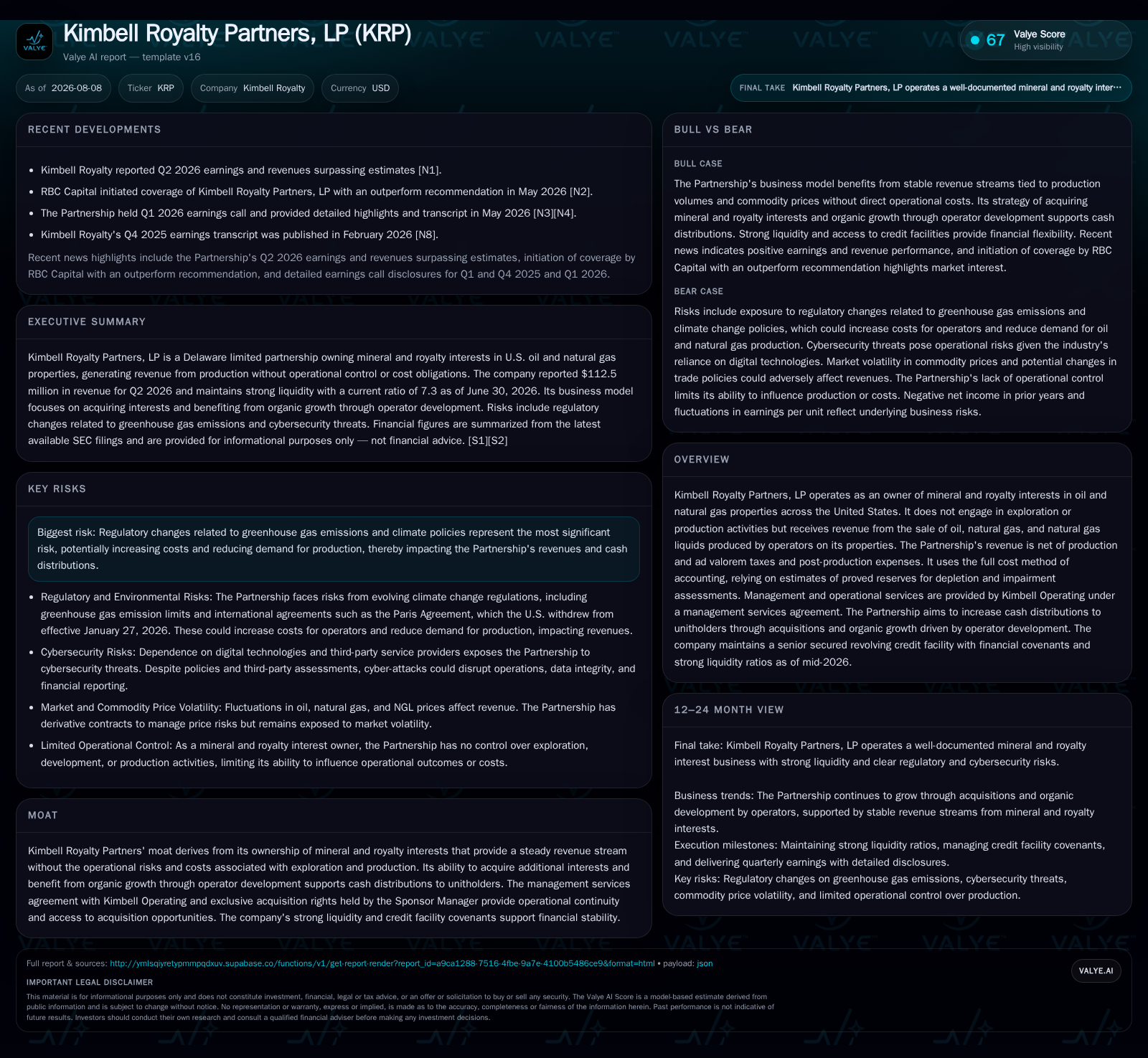
Kimbell Royalty Partners, LP operates as a non-operator owner of mineral and royalty interests in U.S. oil and gas properties, generating revenue from production by third-party operators. Its Q2 2026 results showed robust cash flow supported by strategic acquisitions and accelerating operator development across its asset base, enhancing distributable cash. The Partnership maintains a conservative balance sheet with strong liquidity under a senior secured revolving credit facility. The company faces regulatory risk from climate policies but benefits from a business model that avoids exploration risk and operational costs. Growth will depend on continuing acquisition discipline and sustained operator production growth.
Recent Operating Update: Q2 2026 Commentary
Kimbell Royalty Partners announced second quarter 2026 financial results on August 7, 2026, surpassing market expectations for both earnings and revenues [S2][S3][N1]. The Partnership's business model centers on owning mineral and royalty interests across diverse U.S. oil and natural gas properties without engaging in exploration or production activities. Revenue streams are thus primarily generated from the proceeds of hydrocarbon sales operated by third-party producers on Kimbell’s leased properties. This structure insulates Kimbell from operating costs but exposes it to commodity price fluctuations and operator-driven production volumes.
The latest quarter demonstrated strong cash flow generation capacity supported by accretive acquisition activity completed recently—including the June 2026 closing of an approximately $44 million mineral interest purchase spanning multiple counties in Texas and New Mexico [S25][S26]. This inorganic growth complements ongoing operator development efforts which expand production volumes attributable to the Partnership’s net revenue interests. These factors combined have sustained quarterly cash distributions to unitholders, aligned with Kimbell's objective to increase distributions through both organic growth and acquisitions [S3].
Business Model: Low-Risk Royalty Ownership with Strategic Capital Deployment
Kimbell Royalty Partners operates as a midstream/financial player within the oil and gas value chain by holding mineral and royalty interests that entitle it to production revenues net of royalties, production taxes (e.g., ad valorem), and post-production expenses borne by operators [S1]. By not participating in drilling or production activities directly, Kimbell avoids the capital intensity, operational risk, and environmental liabilities typical of upstream operators.
Revenue mechanics hinge on several interrelated drivers: realized commodity prices for oil, natural gas, and NGLs; production volumes from fields under lease; percentage net revenue interests defined by contractual terms; and acquisition volume growth [S1]. These revenues are subject to deductions for taxes assessed on gross production values plus post-production costs such as transportation or processing fees
Financially, Kimbell employs full cost accounting based on proved reserves estimation conducted by independent engineers to calculate depletion expense and test for impairments regularly [S1]. Changes in reserve estimates due to commodity price shifts or updated geological data materially influence depletion rates recorded against capitalized mineral properties—this can cause volatile impairment charges impacting reported earnings but not necessarily cash flow.
Management services are outsourced to Kimbell Operating via an agreement that assures operational continuity including day-to-day administration, facilitating focused capital management toward acquisitions that broaden the mineral portfolio—a critical growth lever complementary to organic production improvements driven by active operators developing wells beneath these mineral rights.
Industry Structure and Competitive Position
Within the niche sector of publicly traded oil and gas royalty partnerships—alongside peers like Permian Basin Royalty Trust or Sabine Royalty Trust—Kimbell differentiates through its geographic footprint concentrated primarily in prolific U.S. basins such as the Midland Basin and favorable contractual structures granting high-quality net revenue interests [S21]
This peer group shares common exposure patterns: sensitivity to commodity prices; dependency on upstream operator performance; capital market access for acquisitions; accounting volatility from reserve estimate revisions; regulatory environment tied to energy transition policies.
Kimbell sustains competitive strength via a conservatively managed balance sheet supported by a senior secured revolving credit facility with an initial borrowing base of $625 million extendable up to $1.5 billion overall borrowing capacity [S4][S5]. This facility is collateralized by proved reserves estimated at more than 75% of PV-9 value in lending calculations with regular borrowing base redeterminations supporting disciplined leverage management.
Growth Drivers
Two primary mechanisms drive Kimbell’s long-term growth: acquisition activity expanding the mineral interest base; and organic net revenue escalation from increased production volumes as operators develop underlying acreage.
Recent acquisition transactions—like the mid-year Mesa Visa Royalties asset purchase funded partly through equity issuance—underscore management’s commitment to opportunistic yet disciplined portfolio expansion [S25][S26]. These acquisitions not only add immediate scale but also diversify geographical risk profiles.
Simultaneously, operator development introduces higher hydrocarbon flows from producing wells under existing leases. As operators invest in completions and drilling within Kimbell's leased mineral rights areas, attributable production volumes incrementally rise without incremental capital outlays by Kimbell itself. This leads naturally to increased royalty payments enhancing distributable cash flow.
Commodity price levels also remain a core factor influencing realized revenue per unit of production. While prices experienced volatility over recent years tied to global macroeconomic factors and geopolitical events, stable or rising price environments benefit royalty owners disproportionally since they bear minimal operational costs.
Risks and Watchpoints
Regulatory risk constitutes the most significant medium-term threat confronting Kimbell Royalty Partners. Ongoing international climate initiatives such as the Paris Agreement (from which U.S. rejoining status continues shifting) herald increasing likelihood of fossil fuel emission regulation tightening—with implications for elevated compliance costs or reduced drilling incentives affecting operator economics [S1].
Such regulatory uncertainties could translate into lowered development activity on leased properties or higher operational costs passed onto third-party operators—curbing upstream production volumes critical for Kimbell’s top-line.
Additionally, reserve estimation uncertainty inherent in full cost accounting introduces earnings volatility through depletion expense swings or periodic impairment charges driven by fluctuating price assumptions or technical revisions [S1]. These do not directly impact cash distributions but affect earnings predictability.
Dependence on third-party operators also exposes Kimbell to counterparty credit risk or operational disruptions restricting anticipated net revenue flows.
What To Watch Next
Key milestones include monitoring subsequent borrowing base redeterminations around November 2026 which will reflect reserve valuations post recent acquisitions impacting borrowing capacity utilization [S4]
Operator development progress remains pivotal—quarterly disclosures quantifying attributable production volumes linked directly to newly developed wells will provide forward guidance on organic growth sustainability.
Acquisition pipeline transparency is another focal point; any announced deals increasing acreage footprint or improving asset quality merit close attention given their effect on future distributable cash flow expansion.
Earnings calls or updated presentations detailing the partnership’s exposure to evolving climate policies will shed light on how regulatory shifts translate into operational realities for underlying producing assets [S3]
Finally, distribution announcements tied explicitly to enhanced cash flows validate management’s execution against its stated goal of steadily growing unitholder returns through combined acquisition-organic growth strategies.
Financial Profile Discussion
As of June 30, 2026, Kimbell held approximately $45 million in cash equivalents alongside current assets totaling about $101 million against current liabilities near $13.8 million yielding a current ratio of ~7.3—a comfortable liquidity position indicating low short-term financial stress risk [F1]
While total debt figures available lag back at around $172 million as of end 2020 with net debt estimated near $127 million factoring recent cash balances, more recent credit facility usage details reflect significant drawdowns aligned with recent acquisitions [F1]. The availability under this facility combined with strong operating cash flow supports ongoing acquisition funding capability while preserving distribution flexibility.
Depletion expense alongside impairment charges remains volatile reflecting reserve estimation updates consistent with industry peers employing full cost accounting methodologies; these non-cash expense variances impact GAAP earnings rather than actual operating liquidity generation [S24]
In conclusion, Kimbell leverages a well-structured financial framework balancing prudent leverage use with ample liquidity supported by sizeable credit facilities collateralized against high-quality proven reserves that underpin its core business model as a royalty/mineral interest owner reliant on operator-driven hydrocarbon extraction activities.
Disclaimer: This is research-only, informational analysis and not investment advice. It may include AI-generated interpretation and general industry context. Always verify important details using primary sources.

Comments