
NL INDUSTRIES Navigates Stable Manufacturing Operations with Strong Liquidity Amid Environmental and Market Pressures
The company’s latest quarterly filing highlights steady operational execution in industrial hardware and specialty chemicals, supported by robust liquidity and targeted capital investments.
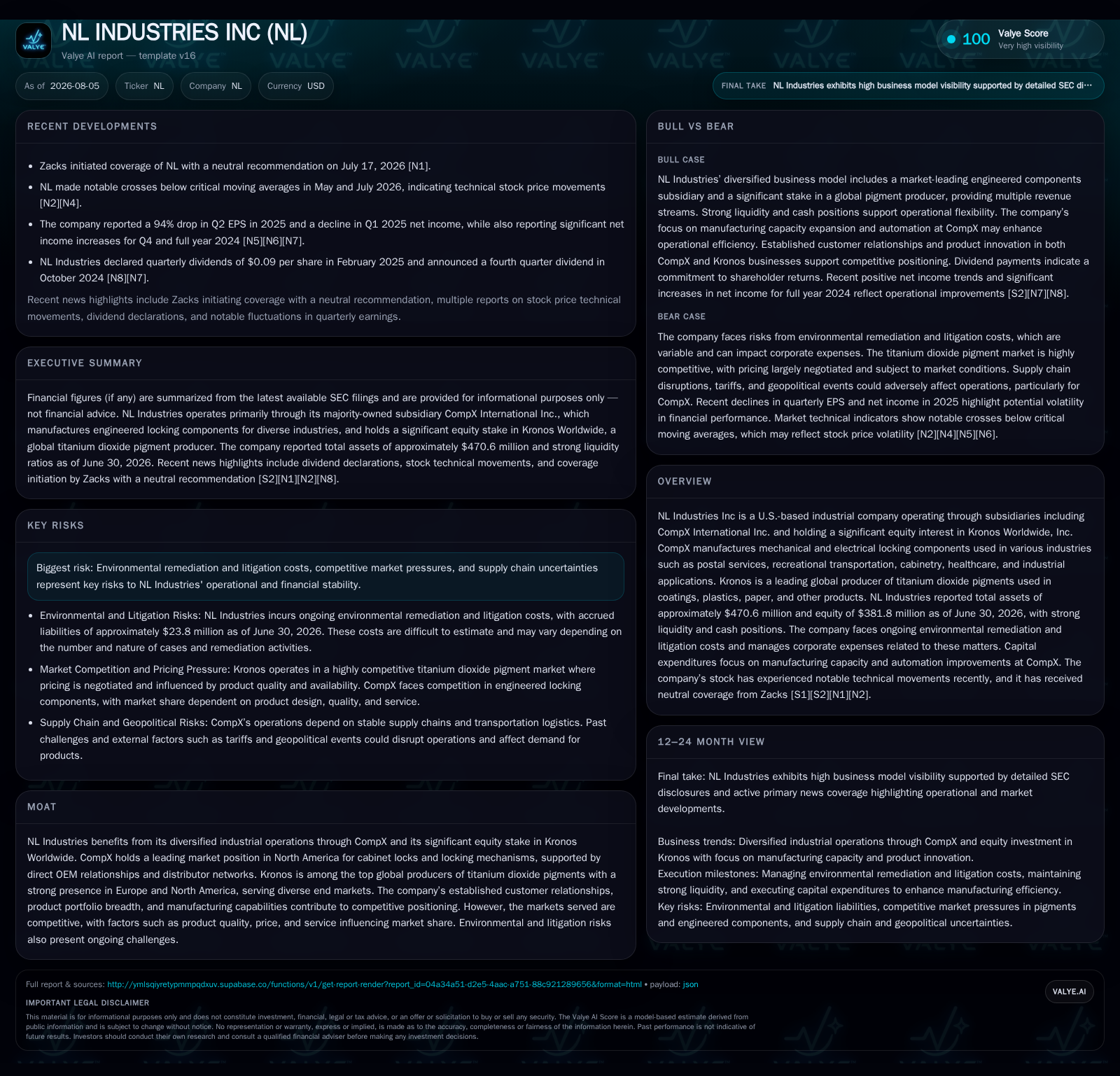
NL Industries maintains a diversified industrial portfolio anchored by CompX International’s manufacturing of mechanical and electrical locking components and a significant equity stake in Kronos Worldwide’s titanium dioxide pigment production. As of mid-2026, NL exhibits a strong liquidity position with approximately $107 million in cash and equivalents and a current ratio exceeding 9, providing financial flexibility to support automation-driven capacity expansions. Environmental remediation and litigation costs remain key operating challenges, influencing profitability and cash flow. CompX’s competitive edge is underpinned by durable OEM relationships and an extensive North American distributor network, while Kronos benefits from sustained demand trends in coatings and plastics sectors.
Recent Operating Update
NL Industries’ August 5, 2026 quarterly filing ([S2]) confirms ongoing operational stability across its two core segments: the manufacturing of locking mechanisms via CompX International and the equity investment in Kronos Worldwide's titanium dioxide pigment production. The company reported liquidity strength with cash and equivalents of approximately $106.99 million as of June 30, 2026 ([F1]) alongside current assets totaling $163.6 million against current liabilities near $18.1 million, resulting in an unusually strong current ratio of about 9.02 ([F1]). This liquidity underpins NL's capacity to fund capital expenditures focused on automation improvements aimed at enhancing manufacturing efficiency within CompX.
No new debt was recorded during the quarter; NL remains essentially debt-free per available balance-sheet data ([F1]), providing financial flexibility to manage capital-intensive operations during market uncertainties.
Environmental remediation obligations persist as a notable expense item at the corporate level with associated litigation costs continuing to influence net income volatility ([S1], [S2]). These legacy liabilities require ongoing cash outlays that affect free cash flow despite stable core business operations.
An accompanying event filing on the same date ([S3]) reiterated management's commitment to operational improvements without disclosing material strategic shifts beyond routine execution.
Business Model Analysis
NL operates through two principal avenues: CompX International Inc., which manufactures mechanical and electrical locking components; and its significant equity stake in Kronos Worldwide Inc., a leading global titanium dioxide pigment producer.
CompX serves diversified end markets such as cabinetry hardware, healthcare products, recreational vehicles (notably boats), postal equipment, and general industrial applications. Its revenue model centers on product sales facilitated by established OEM contracts complemented by a broad North American distributor network ([S1]). Pricing power is influenced by raw material costs—primarily zinc and brass for security products—and manufacturing capacity utilization rates that impact overhead absorption.
Kronos Worldwide contributes specialty chemical exposure through its production of titanium dioxide pigment—a critical input for coatings, plastics, paper products, among others. NL accounts for this investment using the equity method reflecting significant ownership but not full consolidation ([S1]). Kronos’ dual-process technology deployment (chloride and sulfate) provides competitive advantages tied to raw material sourcing efficiencies.
Capital expenditures prioritize upgrading CompX’s manufacturing footprint with automation investments designed to scale throughput while addressing labor cost pressures. This strategy aims to enhance operating leverage responsive to fluctuations in end-market demand ([S2]).
Industry Structure and Competitive Position
Within the industrial hardware space, CompX is recognized as a leading North American cabinet lock manufacturer. Its competitive strength derives from proprietary product design combined with long-standing OEM relationships that create customer switching costs. The expansive distributor network further supports market penetration while providing resilience against direct price competition ([S1]).
Kronos Worldwide competes globally among few producers capable of delivering high-quality titanium dioxide pigments at scale. The industry is shaped by raw material availability (notably ilmenite ore) and process efficiencies that differentiate chloride versus sulfate pigment manufacturers ([S1]).
Both segments face competitive pressures balancing price sensitivity with quality demands; NL’s diversified exposure across manufacturing operations (CompX) and chemical pigment investment (Kronos) offers some insulation from cyclical swings.
Growth Drivers
Demand for secure locking mechanisms benefits from growth in transportation sectors including recreational vehicles as well as residential cabinetry remodeling trends that sustain CompX sales volumes. Automation-led capacity expansions are critical for scaling production efficiently to meet incremental OEM orders while improving margins through reduced labor reliance.
In specialty chemicals, titanium dioxide pigment demand correlates strongly with coatings market expansion—particularly architectural paints—and plastics manufacturing growth. Regulatory trends favoring environmentally compliant pigments may advantage producers like Kronos investing in technological upgrades.
Expansion opportunities also exist through new OEM partnerships or broadening existing distributor channels within North America where industrial hardware distribution remains fragmented ([S1], [S2]).
Risks and Watchpoints
Environmental remediation liabilities remain a material risk due to uncertain timing and magnitude of required expenditures. Litigation-related costs can depress profit margins and constrain free cash flow essential for funding capital projects. Monitoring actual remediation spending relative to accruals will be critical for forecasting cash impacts.
Raw material supply chain volatility—zinc/brass for locking components; ilmenite ore for pigment manufacture—poses margin pressure risks amid fluctuating commodity prices prevalent across industrial sectors.
Competitive pricing pressures are persistent within hardware distribution where alternative suppliers could erode CompX’s market share absent continuous innovation or superior customer service.
Technological obsolescence risk necessitates ongoing reinvestment focused on automation enhancements to maintain operational competitiveness relative to peers.
What to Watch Next
Key near-term performance indicators include:
- Capacity utilization rates at CompX reflecting demand absorption during automation rollout phases ([S2])
- Environmental remediation cash flow trends influencing earnings volatility ([S2])
- Equity income from Kronos Worldwide impacting consolidated profitability metrics ([S1])
- Raw material cost fluctuations affecting gross margins across segments expected in future earnings updates ([S1], [S2])
- Announcements regarding expanded OEM contracts or distributor partnerships signaling potential market share gains or geographic expansion ([S1])
Financial Profile Discussion
NL Industries exhibits robust liquidity with approximately $107 million in cash and equivalents as of June 30, 2026 ([F1]), complemented by a current ratio above 9 indicating ample coverage of short-term liabilities ([F1]). The absence of recorded debt enhances financial flexibility vital for sustaining capital-intensive investments in automation within manufacturing operations.
Overall, NL’s financial position supports its dual focus on industrial hardware manufacturing growth alongside managing legacy environmental liabilities effectively.
Disclaimer: This analysis is based solely on publicly available information as cited and does not constitute investment advice or research views.
Disclaimer: This is research-only, informational analysis and not investment advice. It may include AI-generated interpretation and general industry context. Always verify important details using primary sources.

Comments