
Orion S.A. Faces Margin Pressure Amid Raw Material Volatility and Goodwill Impairment
Orion’s latest quarterly filing reveals sustained commodity price challenges and impaired asset valuations impacting results.
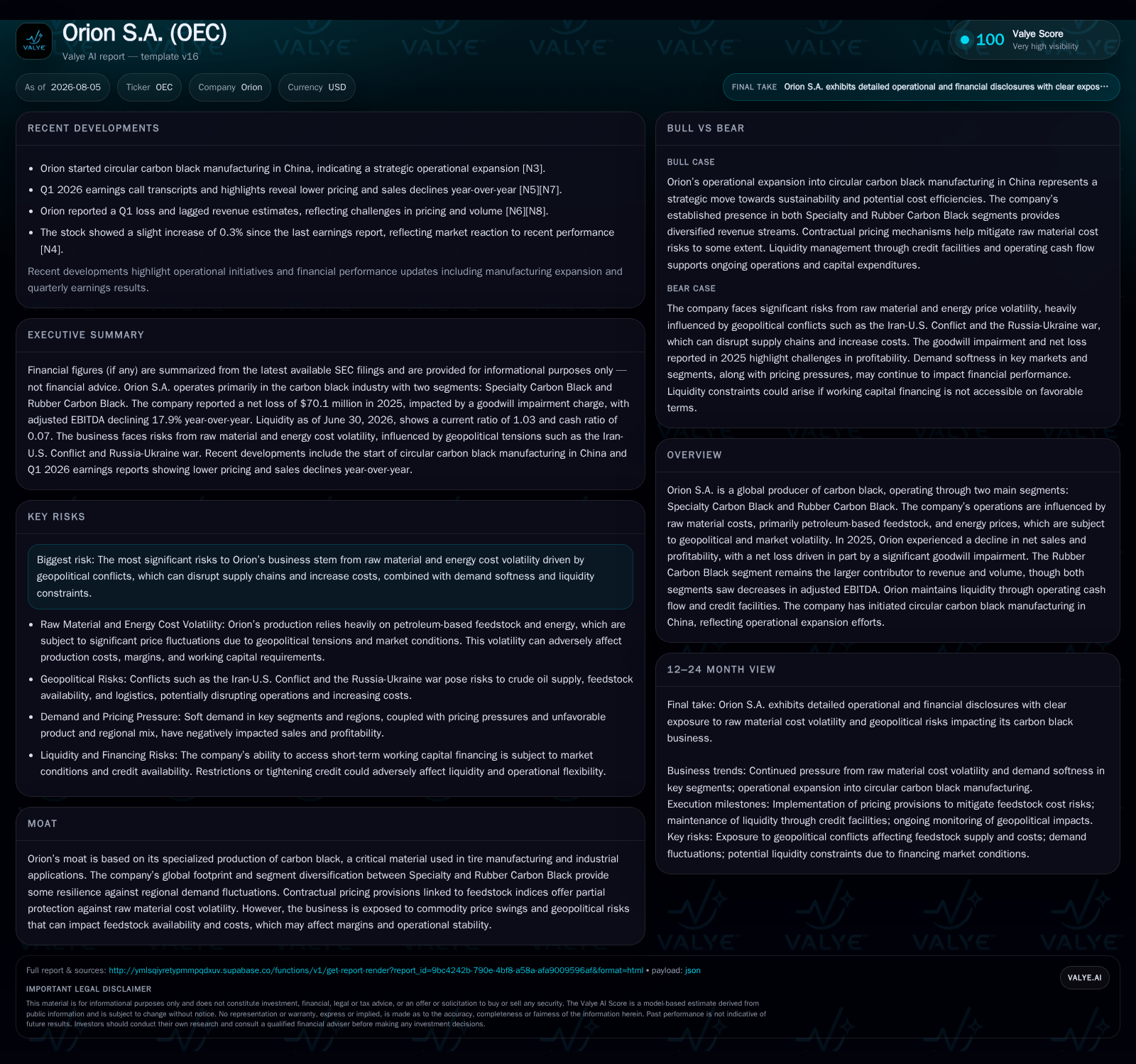
Orion S.A., a global carbon black producer with Rubber and Specialty segments, reported persistent margin compression in its latest filings driven by volatile feedstock costs and competitive headwinds from low-cost imports. The company recognized a substantial goodwill impairment in 2025 related to softness in both segments, while modest volume growth primarily in Rubber Carbon Black was offset by pricing pressures. Liquidity remains supported by operating cash flow and credit facilities, but leverage is elevated. Initiatives in circular carbon black production in China signal strategic investment toward sustainability and growth despite near-term operational challenges.
Recent Operating Update
Orion S.A.’s latest quarterly filing dated August 5, 2026 confirms that the company continues to grapple with the operational and financial consequences of a challenging commodity price environment that has persisted since 2025 [S2]. The key development remains the goodwill impairment of $80.8 million recognized during Q3 2025 following quantitative impairment testing driven by reduced profitability from elevated Asian low-cost tire imports affecting Rubber Carbon Black demand in Western markets, alongside softness and regulatory uncertainty dampening Specialty Carbon Black segment performance [S1]. This non-cash charge fully impaired Orion’s existing goodwill balances.
Volume increased moderately by 1.5% year-over-year to 948.6 kilometric tons (kmt) in 2025, primarily attributable to growth in the Rubber Carbon Black segment. However, this volume gain was insufficient to offset a top-line decline of nearly $71 million or 3.8%, largely due to pricing effects stemming from lower petroleum prices feeding through as reduced realized sales prices per ton [S1]. The contractual pricing mechanisms indexed to feedstock costs provide some mitigation against raw material cost swings but lag rapid market movements periodically undermined gross margins.
Business Model Analysis
Orion operates two core business units: Rubber Carbon Black used predominantly as reinforcing filler in tires and industrial rubber products, representing the larger portion of revenues and production volumes; and Specialty Carbon Black serving coatings, plastics, inks, and other niche industrial applications with higher technical complexity but smaller scale [S1]. The manufacturing process consumes significant amounts of petroleum-based carbon black oil feedstock and energy resources, whose prices are subject to volatile geopolitical influences such as conflicts involving Iran, Russia-Ukraine, and escalating trade tensions between China and Western economies [S2].
Revenue largely derives from volume sold multiplied by realized sales prices which are adjusted by contractual clauses tied to raw material price indices aiming to preserve margin stability. However, these contract provisions can suffer timing mismatches relative to actual feedstock cost changes, leaving Orion exposed during rapid commodity price ramps or declines. This dynamic contributed materially to the compressed gross profit margin seen in 2025 where unfavorable product mix shifts further pressured results along with soft regional demand patterns noting varying recovery trajectories across Western versus emerging markets.
Customer payments primarily come from large tire manufacturers and industrial rubber goods producers through negotiated supply contracts often incorporating price escalators responsive to petroleum-based input costs. Downstream demand trends thus indirectly reflect automotive production cycles, replacement tire markets, and broader industrial activity levels.
Industry Structure and Competitive Position
The global carbon black industry is capital intensive with significant operating leverage tied to plant utilization rates and energy consumption efficiency. Key peers include Cabot Corporation and Birla Carbon who similarly navigate feedstock sourcing risks amid dense geopolitical uncertainties often associated with oil markets that drive their input costs.
Orion’s geographic footprint includes multiple manufacturing sites globally including strategic presence in China where it has recently commenced circular carbon black manufacturing – a cutting-edge process that recycles end-of-life rubber into usable carbon black reinforcing material – reflecting an investment into sustainable production aligning with growing environmental regulations and customer preferences [S3; N14].
Nonetheless, demand headwinds persist especially for Rubber Carbon Black caused by an influx of lower-priced Asian imports disrupting established Western consumer markets forcing Orion into defensive positioning on both pricing power and sales volume retention fronts [S1]. Moreover, specialty segment markets face softness due partly to global industrial economy sluggishness coupled with uncertainties regarding tariffs and trade policies suppressing wider application adoption rates.
Growth Drivers
Despite current challenges, several factors suggest opportunities for Orion’s medium-term growth:
- Expansion of circular carbon black aligns with regulatory drivers supporting sustainable materials sourcing which can open niche premium-priced specialty product streams.
- Contractual feedstock indexing mechanisms provide partial insulation against raw material cost variability fostering more predictable revenue streams.
- Emerging market capacity expansions provide a buffer against Western market softness offering incremental volume growth potential.
- Incremental improvements in production technology focusing on energy use reduction may enhance cost competitiveness over time.
- Broader automotive sector recovery particularly around replacement tires after recent cyclical troughs could bolster rubber carbon black demand.
Risks and Constraints
Several risk factors constrain Orion’s outlook:
- Raw material cost volatility remains a critical risk as feedstock shortages or spikes can compress margins if timely pass-through is unachievable.
- Geopolitical conflicts continue disrupting supply chains creating logistics complexities impacting timely raw material delivery.
- Competition from low-cost Asian producers particularly affects the Rubber carbon black segment's price realizations.
- Liquidity constraints hovering around tight working capital balance with total debt nearing $1 billion versus approximately $51 million cash raise refinancing concerns about capital flexibility if disruptions persist [F1; S7].
- Regulatory developments including EU emissions policies impose continuous compliance expenditures potentially increasing operating costs.
- Demand softness rooted in uneven global economic activity influences overall carbon black consumption levels.
What to Watch Next
Key execution points for evaluating Orion include:
- Monitoring sequential quarterly trends in realized sales prices per ton relative to feedstock price indices will indicate contract pricing effectiveness under current volatility.
- Updated volume metrics across both Rubber and Specialty segments showing expansion or stabilization signal easing demand constraints.
- Progress updates on circular carbon black production scaling particularly commercial acceptance within specialty applications denote potential margin contributions.
- Liquidity management actions addressing working capital needs or potential refinancing activity given high debt loads should be carefully observed.
- Capex timing related to facility expansions or technology upgrades reflecting management confidence in end markets’ trajectory.
Financial Profile Discussion
As of June 30, 2026, Orion held approximately $50.8 million in cash equivalents against total debt close to $1.01 billion resulting in net debt of roughly $959 million alongside current assets of about $734 million balanced against current liabilities totaling approximately $716 million yielding a current ratio near parity at 1.03 [F1]. This ratio suggests marginal short-term liquidity cushions requiring active cash flow management especially given credit facility covenant constraints tightened partly due to leverage ratios outlined in amendments made during early 2026 [S12; S24].
Conclusion
Orion’s latest financial disclosures underscore the complex interplay between commodity-driven margin pressures, evolving competitive dynamics especially due to Asian low-value imports affecting Rubber segment profitability, and strategic initiatives centering on sustainability through circular carbon black technology development. Maintaining contractual price linkages mitigates some raw material risks but does not fully shield herein rapid market shifts. Liquidity appears adequate but leveraged financing demands robust operational execution amid uncertainties linked principally to geopolitical risk exposure affecting feedstock supply chains globally.
Careful observation of volume trends, margin stabilization efforts via mix optimization or pricing negotiations, alongside capex discipline will be crucial markers for determining Orion's ability to regain durable profit expansion moving forward.
This analysis leverages audited filings supplemented by recent event disclosures providing an evidence-based assessment without forecasting future stock performance or offering investment advice.
Disclaimer: This is research-only, informational analysis and not investment advice. It may include AI-generated interpretation and general industry context. Always verify important details using primary sources.

Comments