
Giftify's Strategic Expansion Through CardCash and Restaurant.com Integrates Gift Card Exchange with Digital Dining Deals
Giftify, Inc.’s recent quarterly disclosure highlights operational scale-up prospects driven by acquisition integrations and AI-enhanced transaction processing in the competitive gift card exchange and digital deals market.
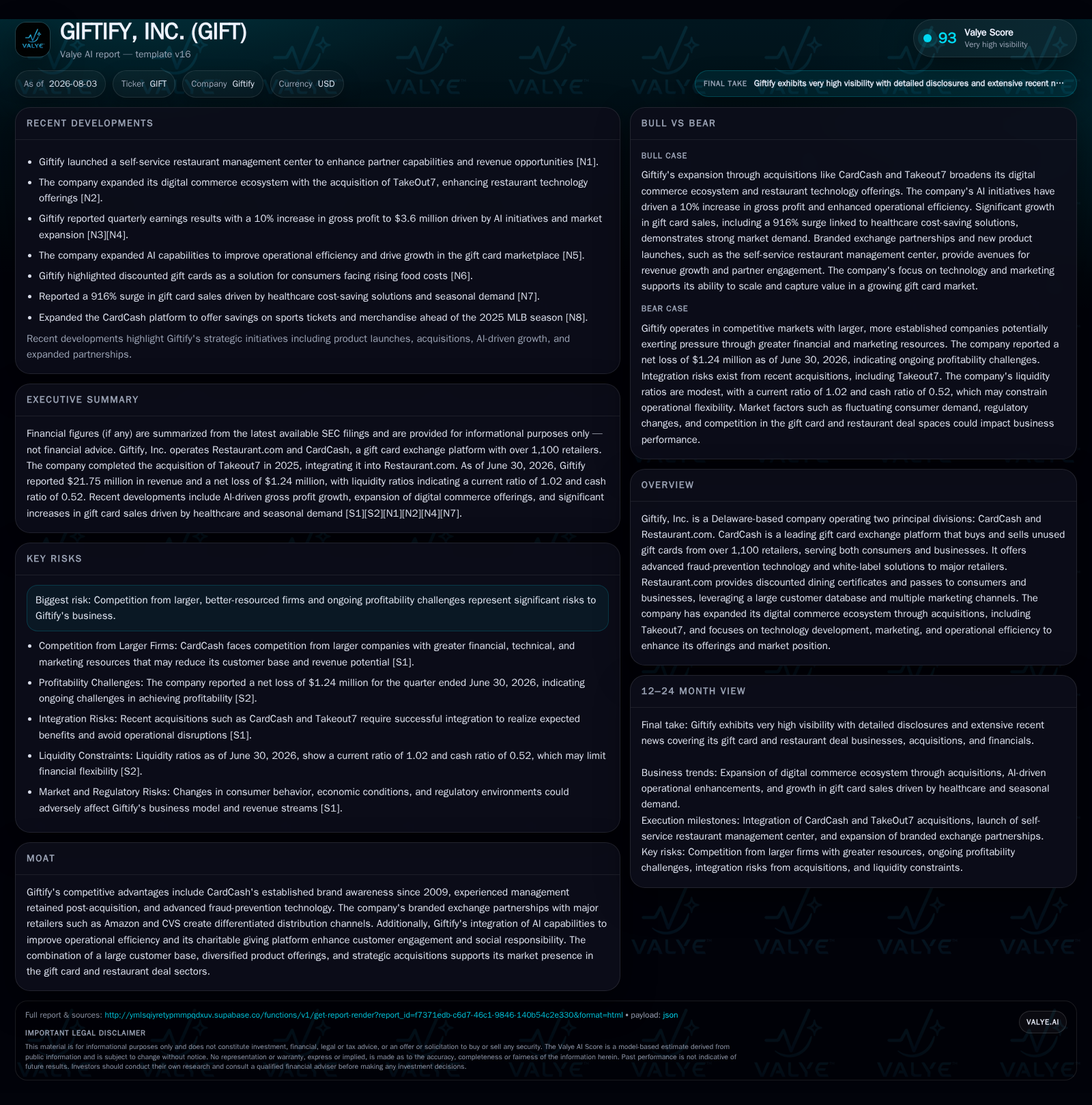
As of Q2 2026, Giftify, Inc. operates two complementary divisions: CardCash, a gift card exchange platform serving consumers and businesses with over 1,100 retailer partnerships; and Restaurant.com, a leading digital dining deal aggregator. The company’s strategic acquisitions of CardCash in late 2023 and Takeout7 in mid-2025 have expanded its e-commerce ecosystem, enhanced technological capabilities, and diversified revenue streams. Despite ongoing losses and modest operating scale relative to larger peers, Giftify emphasizes machine learning-driven efficiency improvements aimed at scaling transaction volume with limited cost increases. Key risks include intense competition from financially stronger incumbents, cybersecurity threats, and profitability challenges tied to discounting and operating leverage. Monitoring will focus on transaction volume growth, margin expansion via technology leverage, integration progress of acquisitions, and capital sufficiency.
Recent Quarterly Operating Update
Giftify’s latest Form 10-Q filed August 3, 2026, confirms ongoing efforts to integrate its strategic acquisitions while scaling core operations across its two main business lines: CardCash’s gift card exchange platform and Restaurant.com’s digital dining deals brand [S2][S1]. The quarterly filing offers limited quantitative detail but aligns closely with the thematic updates presented in the April 10, 2026 amended annual report [S1]. It underscores the importance of improving processing efficiency at CardCash using machine learning techniques that could increase gift card transaction volumes by four to five times with slight cost growth [S1]. This capacity expansion potential is critical given the competitive pressures from larger incumbents.
Business Model Overview
Giftify’s business comprises two primary divisions serving both business-to-consumer (B2C) and business-to-business (B2B) channels. The first division, CardCash, operates as a gift card exchange marketplace buying unused or partially used merchant gift cards from consumers or distributors at discounted prices. It then resells these cards at a markup to other consumers or businesses seeking discounted merchant gift cards [S1]. Revenue derives primarily from the differential between the purchase price (discount rate) and resale price (markup), alongside ancillary fees.
CardCash partners with an extensive portfolio of over 1,100 retailers—including nationally recognized names such as Target, Home Depot, Starbucks, and TJ Maxx—serving as distribution anchors that enhance consumer trust and acceptance [S1]. A crucial facet of this model is advanced fraud prevention technology deployed to minimize counterfeit or unauthorized transactions which can otherwise erode margins due to fraud losses.
The second division is Restaurant.com, which aggregates discounted dining certificates sold via digital channels to consumers aiming for value-oriented restaurant experiences [S1]. This division leverages a sizable customer database cultivated since inception as a pioneer in restaurant deals. The May 2025 acquisition of Takeout7 augmented Restaurant.com's value proposition by integrating comprehensive online ordering solutions and AI-driven digital marketing services tailored for independent restaurants [S1], thereby deepening its technology stack and B2B service capabilities.
Combined under the Giftify umbrella post-acquisitions are cross-divisional synergies including shared marketing channels and data assets intended to drive volume growth and customer engagement across both platforms.
Industry Context and Competitive Position
Operating within the retail consumer sector’s gift card exchange and digital deals platform niche places Giftify amidst diverse peer groups that include specialized marketplaces like Raise.com or GiftCards.com for gift cards; digital coupon platforms such as Groupon; as well as direct retailers issuing proprietary gift cards (e.g., Amazon).
These businesses monetize unused or excess gift card inventories or provide cost-saving propositions on dining or retail experiences through aggregated discount certificates. Success depends heavily on scale to achieve desirable liquidity (high transaction volume), robust fraud prevention systems to sustain trust and limit losses, strong brand recognition supporting consumer acquisition, efficient technology infrastructure permitting rapid transaction processing at low cost, and productive retailer partnerships lending legitimacy.
Giftify differentiates itself through CardCash’s legacy since 2009 fostering established consumer brand awareness alongside advanced fraud-prevention technology embedded into operations [S1]. Retaining key CardCash executives post-merger preserves operational know-how crucial for managing complexities inherent in secondary gift card markets such as valuation accuracy, regulatory compliance around resale restrictions, chargeback risk management, and inventory turnover velocity.
Additionally, Giftify’s recent steps toward integrating AI-powered tools — notably through Takeout7’s marketing platform — target efficiency gains both upstream (merchant engagement) and downstream (consumer targeting), responding to competitive imperatives where rivals may have deeper pockets or longer histories [S1]. However, the company still confronts pressure from competitors possessing far larger user bases that enable lower average customer acquisition costs (CAC), faster adaptation to emerging tech trends, or advantageous pricing power [S1].
Growth Drivers
Key growth drivers for Giftify revolve around structural industry trends such as rising consumer acceptance of secondary market gift card exchanges fueled by growing e-commerce penetration. The ability to handle higher transaction volumes economically via machine learning innovations is vital; scaling processing throughput without linear cost inflation enhances margin prospects significantly [S1]
Similarly, increasing demand for discounted dining options amid cautious discretionary spending supports Restaurant.com’s expansion opportunity. Takeout7’s integration introduces end-to-end restaurant order management combined with targeted AI-based promotion services expected to embed deeper into partner restaurant ecosystems [S1].
The company also benefits from large aggregated customer databases accessed via multi-channel marketing campaigns that underpin cross-selling potential between CardCash’s offerings and Restaurant.com deals.
Strategic retailer partnerships remain essential not only for accepting merchant-issued gift cards but also for branding “white-label” exchange capabilities potentially extendable to large corporate clients seeking custom solutions [S1]. Fraud prevention remains an ongoing enabler — improvements here reduce loss rates directly impacting gross profit margins in an industry where discounting compresses pricing power.
Risks and Growth Constraints
Significant risks shadow Giftify’s path forward. Chief among these is fierce competition from well-capitalized firms enjoying entrenched customer loyalty or proprietary scale effects that lower CAC materially relative to Giftify [S1]. This restricts market penetration speed in mature regions.
Cybersecurity risks present material threats given the high-value nature of electronic gift cards vulnerable to hacking scams or fraudulent activities that may damage brand integrity or necessitate costly remediation programs [S1]. Regulatory scrutiny specifically addressing consumer protections surrounding resale practices could impose operational constraints or additional compliance costs.
Profitability challenges stem partly from a pricing model based on discounts plus markups leaving slim gross margins vulnerable if fraud losses increase or if marketing expenses escalate disproportionately before reaching improved operating leverage thresholds.
Integration complexity associated with recent acquisitions—including Takeout7—introduces execution risk related to technology harmonization, cultural fit among management teams, client retention during transitions, and realization of projected synergies within anticipated timelines [S1]. Economic downturns dampening discretionary spend may reduce trading volumes on both divisions simultaneously.
What to Watch Next
Investors should monitor several milestones indicative of successful execution: Year over year growth in transaction volumes processed by CardCash reflecting uptake of scaling machine-learning initiatives; improvement in gross merchandise value (GMV) metrics demonstrating expanding marketplace liquidity; reduction in fraud loss rates signaling effective technology deployment; stabilization or decline in customer acquisition costs reflecting enhanced brand traction; normalized operating margins approaching breakeven thresholds validating operating model efficiency; progress on integration of Takeout7 reflected in new client additions or revenue contributions within Restaurant.com; potential strategic investments or partnerships announced supporting expanded access to data pools or collaborative synergies.
Guidance provided directly by management regarding volume targets or margin improvement plans will serve as tangible checkpoints. Additionally monitoring macroeconomic indicators influencing consumer spending behavior—especially discretionary categories inclusive of restaurants—will contextualize demand forecasts.
Financial Profile Discussion
As per the latest available balance sheet snapshot ending June 30, 2026, Giftify reported cash plus equivalents around $3.9 million against nearly equivalent current liabilities (~$7.5 million), resulting in a current ratio close to parity at approximately 1.02, indicating balanced short-term liquidity without significant cushion[F1]. Total debt stands minimal near $34 thousand albeit dated at Q3-2023 level without indication of substantial recent borrowings[F1].
Trailing twelve-month revenue approximated $83 million through end-2025 illustrates meaningful top-line scale; however operating income remains negative near $10 million confirming ongoing unprofitability reflecting high SG&A spend related to marketing initiatives and integration expenses[F1]. Net income similarly negative around $10.5 million aligns with continued investment phase despite revenue traction[F1].
Capital allocation appears focused on acquisition-driven growth supplemented by equity issuance activity documented historically implying prudence given ongoing losses[S7][S8]. Maintaining financial flexibility will be essential given operating cash flow deficits requiring alternative funding avenues until sustainable profitability emerges[S26].
This analysis synthesizes facts from Giftify’s latest SEC filings combined with industry sector knowledge relevant to its dual-division model spanning secondary market gift card exchanges and digital restaurant deals platforms. It emphasizes key value drivers such as technological innovation in fraud prevention and AI-enhanced scalability while framing competitive dynamics centered on resource disparities vis-à-vis incumbents. The company’s near-term outlook hinges critically upon execution discipline across integration efforts alongside measuring meaningful ramp in transactional throughput leading toward operating leverage milestones. Risks including cybersecurity threats alongside market acceptance pose ongoing watchpoints requiring close focus.
This report does not constitute investment advice but aims to offer a nuanced internal perspective suitable for buy-side analyst usage.
Disclaimer: This is research-only, informational analysis and not investment advice. It may include AI-generated interpretation and general industry context. Always verify important details using primary sources.

Comments