
Ocular Therapeutix Advances AXPAXLI Amid Strong Liquidity and Ongoing Clinical Risks
The company progresses toward regulatory submission for a key ophthalmic therapy while managing cash runway and development uncertainties.
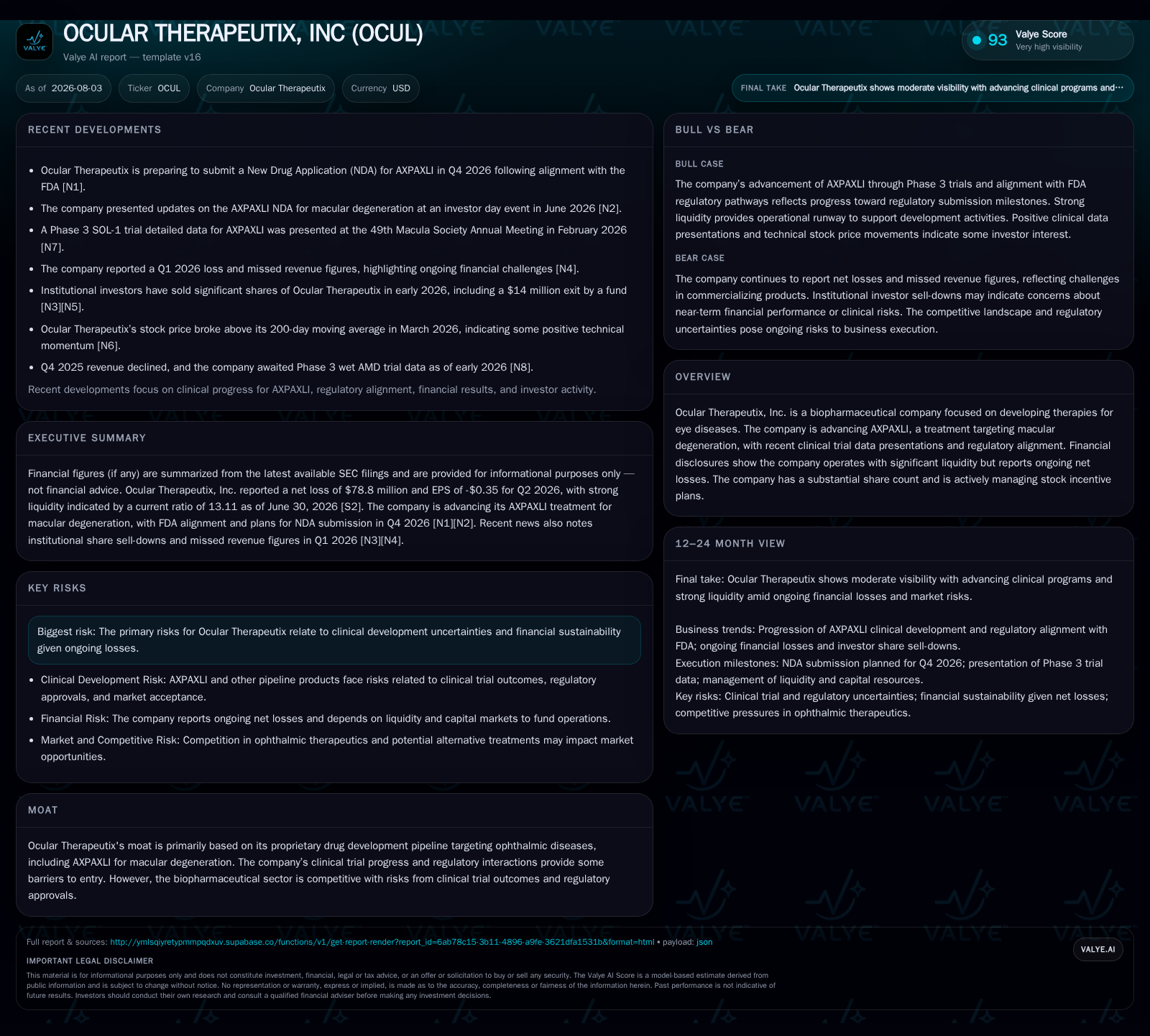
Ocular Therapeutix’s recent quarterly filing highlights progress with AXPAXLI, its intravitreal anti-angiogenic treatment for wet AMD and diabetic retinal diseases, supported by positive Phase 3 trial data aligning with FDA expectations. The firm operates with a robust liquidity position exceeding $598 million but continues to report significant operating losses reflective of ongoing R&D investment. Commercialization readiness hinges on regulatory approvals, manufacturing scale-up, and market acceptance dynamics typical in ophthalmic biotech. Key operational watchpoints include pivotal trial readouts, NDA filing timelines aimed for late 2026, and the company’s ability to sustain funding given high burn rates.
Recent Operating Update: Clinical Progress Anchors Near-Term Outlook
Ocular Therapeutix’s second quarter 2026 filing underscores pivotal advancement toward securing U.S. regulatory approval for AXPAXLI (also known as OTX-TKI), a proprietary bioresorbable intravitreal hydrogel delivering axitinib—a multi-target tyrosine kinase inhibitor aimed at suppressing angiogenesis in retinal disease [S2]. The company reports consistent progress in its Phase 3 registrational programs for wet age-related macular degeneration (wet AMD), including presentation of Week 52 efficacy and safety data from the SOL-1 trial and interim outcomes from the repeat-dosing SOL-R study [S2], [N1]. These developments have facilitated alignment with the U.S. Food and Drug Administration (FDA) on submitting a New Drug Application (NDA) anticipated during the fourth quarter of 2026 [N1], [N2]. This timeline reflects structured clinical program execution coupled with regulatory interaction—a critical success factor in ophthalmic biotech that often faces protracted review periods due to complex clinical endpoints.
Simultaneously, Ocular Therapeutix is progressing Phase 3 evaluation of AXPAXLI for non-proliferative diabetic retinopathy (NPDR), expanding potential addressable markets beyond wet AMD. The Phase 3 clinical development lifecycle typically demands extensive enrollment validation and demonstration of both safety and durable efficacy as prerequisites before market authorization can be considered. Hence, continued trial enrollment velocity, endpoint achievement, and confirmatory safety data remain watchpoints that will ultimately shape the credibility and commercial viability of the product.
Business Model: Proprietary Hydrogel Delivery Platform Drives Pipeline
The company’s value creation hinges on its ELUTYX bioresorbable hydrogel technology platform facilitating sustained intravitreal drug delivery—a route preferred in treating retinal diseases due to direct access to ocular tissues while minimizing systemic exposure. Aside from AXPAXLI, this platform underpins the FDA-approved DEXTENZA product used primarily for ocular inflammation and pain post-surgery as well as allergic conjunctivitis [S1], [S23]. Additionally, OTX-TIC—a travoprost intracameral hydrogel undergoing investigation for open-angle glaucoma—represents further pipeline diversification leveraging the same core technology.
Ocular Therapeutix monetizes through product sales upon approval (currently only for DEXTENZA), alongside licensing collaborations such as its arrangement with AffaMed Therapeutics which covers certain Asian territories for development and commercialization rights [S25]. Revenue recognition predominantly arises from product sale contracts via specialty distributors whose concentration accounts for a significant share of total revenue—around two-thirds derived from three major distributors [S8]. This downstream distribution dependency typifies niche biotech firms still expanding commercial footprint.
Operational cost structure is heavily weighted toward research and development expenses supporting ongoing trials—reflected in accrued R&D expense declines from $14.7 million in mid-2025 to approximately $10.5 million as of Q2 2026—indicating measured investment pacing aligned with clinical milestones [S2]. Selling, marketing, and manufacturing efforts continue to scale mainly around DEXTENZA while preparing infrastructure suitable for AXPAXLI’s anticipated commercial launch.
Industry Structure and Competitive Position
Ocular Therapeutix participates in the highly capital-intensive ophthalmic biotechnology sector characterized by lengthy drug development cycles often exceeding a decade from discovery to commercialization. Its focus areas—wet AMD and diabetic retinal diseases—are competitive domains served by incumbents like Regeneron Pharmaceuticals with EYLEA (aflibercept) and Apellis Pharmaceuticals developing complement inhibitor therapies.
Differentiation stems from AXPAXLI’s innovative delivery vehicle—a bioresorbable hydrogel that potentially reduces dosing frequency via sustained axitinib release versus traditional intravitreal injections requiring more frequent administration. This could meaningfully impact patient adherence burdens prevalent in chronic retinal disorders.
Leveraging a small molecule tyrosine kinase inhibitor distinguishes it mechanistically from biologics dominating current treatment paradigms. However, securing durable intellectual property protection around both drug formulation and delivery method is essential against biosimilar entrants or alternative sustained-release approaches [S23]. Regulatory progress relative to peers remains credible given ongoing positive Phase 3 data disclosures but final approvals will depend on addressing any emerging safety or efficacy concerns during complete dataset reviews.
Growth Drivers
Key growth catalysts include successful completion of pending Phase 3 trials with published positive endpoints confirming AXPAXLI’s efficacy and safety profile aligned with FDA expectations. Achieving NDA submission by Q4 2026 marks an important regulatory milestone underpinning near-term commercial prospects [N1], [N2]. Expansion into diabetic retinal indications offers substantive incremental market opportunity beyond wet AMD.
Commercial launch preparedness involves scaling GMP-compliant manufacturing capable of supplying commercial volumes without compromising quality standards—a challenge common among biopharma startups transitioning from clinical batch production to commercial supply chains [S6]
Strategically expanding geographic reach through licensing partnerships such as that with AffaMed diversifies risk exposure while enabling localized market access across Asia-Pacific regions where diabetic eye disease prevalence is growing rapidly [S25]. Improvements in reimbursement environments for novel ophthalmic therapies will further augment uptake potential.
Risks / Watchpoints / Growth Constraints
Principal risks center on clinical trial uncertainties—including interim safety signals or failure to meet primary/secondary endpoints—which may delay regulatory submissions or necessitate additional studies prolonging timelines [S22]. Regulatory review itself poses inherent unpredictability given evolving agency guidance especially regarding novel drug-device combination products like ELUTYX-based hydrogels.
Manufacturing scale-up represents a constraining factor; ensuring sufficient supply chain robustness compliant with Good Manufacturing Practices (GMP) ahead of launch requires capital intensity and operational discipline. Any lapses could delay commercialization or inflate costs.
Financial sustainability remains a key watchpoint due to persistent annual operating losses exceeding $260 million reported at year-end 2025 [F1], necessitating reliance on prudent cash management alongside capital raising activities that may dilute existing shareholders if executed.
Market acceptance volatility influenced by competitive product launches or reimbursement challenges could adversely impact revenue trajectory post-launch [S8]. Customer concentration risks through leading specialty distributors imply dependency vulnerabilities should contractual terms shift unfavorably or payment delays occur
What to Watch Next
Investors should monitor:
- Timing and data releases from SOL-R long-term extension studies confirming durability of effect/safety profile,
- Official NDA submission confirmation timing expected late Q4 2026,
- Updates on manufacturing capacity expansions including supplemental NDA filings if required,
- Regulatory interactions including FDA feedback post-submission,
- Capital raise activities or strategic partnerships announced to support commercialization expenditures,
- Market launch progress metrics post-product approval such as early adoption rates and payor coverage achievements.
Financial Profile Discussion
As of June 30, 2026, Ocular Therapeutix held cash and equivalents totaling approximately $598.6 million against current liabilities near $49.2 million yielding a strong current ratio (~13.1x), evidencing ample short-term liquidity to fund operations through at least one year provided no dramatic upticks in expenditure arise [F1], [S2]. Total debt reported stood effectively at about $72.8 million related principally to the Barings Credit Facility maturing in 2029 bearing interest above SOFR floor levels plus a structured royalty fee linked to DEXTENZA sales commitments—which introduces contingent cost obligations dependent on commercial performance [S14].
Operating losses remain substantial—the most recent full-year net loss exceeded $265 million—consistent with intensive R&D spending typical of firms advancing late-stage pipelines without full commercialized products except DEXTENZA which generates moderate revenues offset by ongoing commercialization investments [F1]. Effective cash-conversion dynamics will hinge on successful NDA approval followed by market uptake driving product revenues beyond milestone payments or nominal license fees currently recognized.
In summary, Ocular Therapeutix is strategically positioned at an inflection point transitioning from clinical development toward potential commercialization backed by proprietary delivery technology tailored for difficult-to-treat retinal diseases. Its financial runway supports near-term objectives although sustained shareholder value realization depends critically on navigating regulatory hurdles, managing execution risks around manufacturing scale-up, securing favorable reimbursement access amidst competitive pressures, and successfully monetizing its lead asset AXPAXLI post-approval.
This analysis is based exclusively on disclosed SEC filings up to August 3, 2026, supplemented with publicly available information about company operations within the biotechnology ophthalmic therapeutics sector.
Disclaimer: This is research-only, informational analysis and not investment advice. It may include AI-generated interpretation and general industry context. Always verify important details using primary sources.

Comments