
ADP Advances AI-Enabled HCM Solutions Amid Steady Payroll and PEO Growth
ADP leverages technology and global scale to deepen client engagement and expand recurring revenue streams in a complex regulatory landscape.
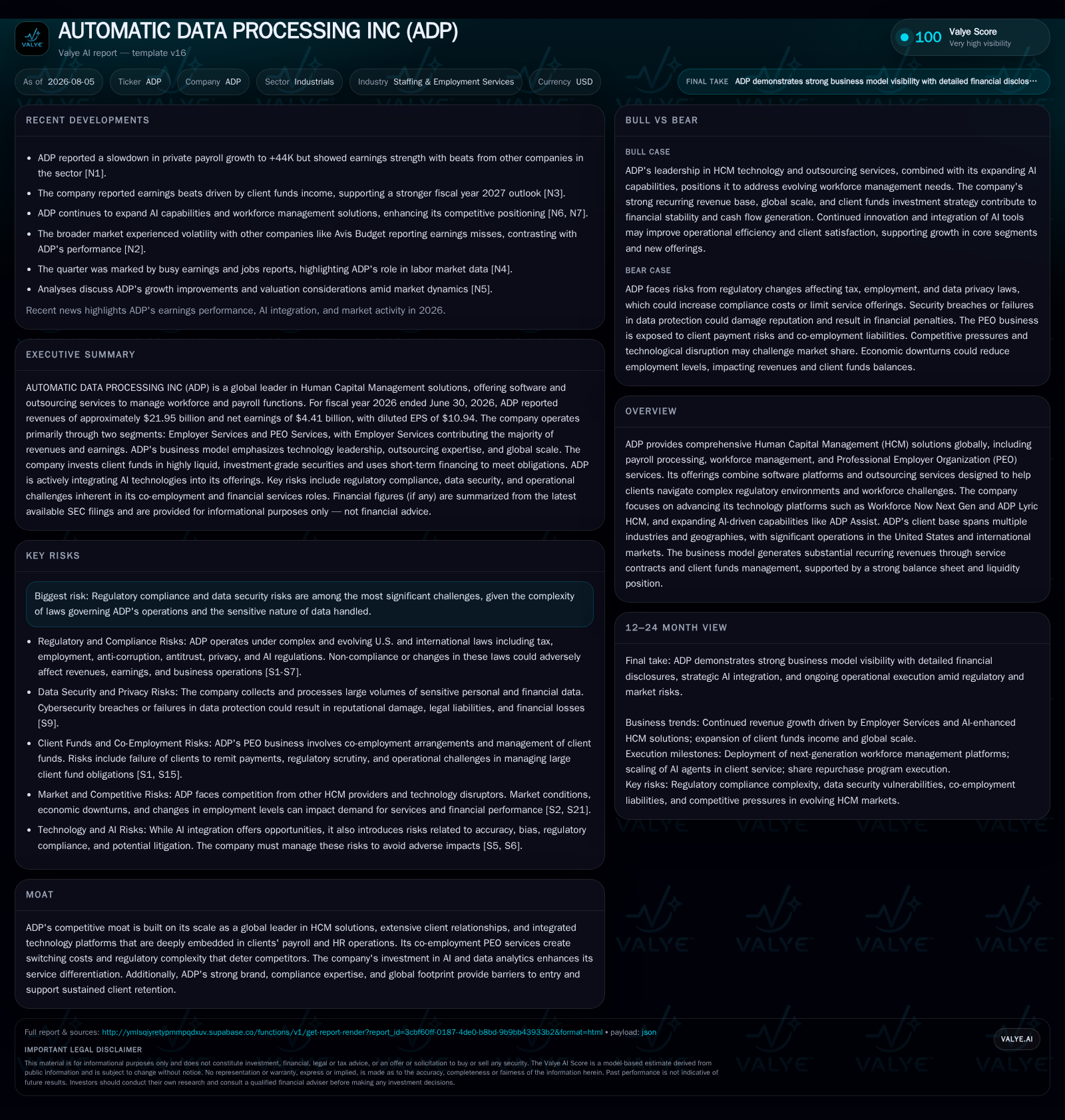
Automatic Data Processing Inc (ADP) reported solid fiscal 2026 results highlighted by 7% revenue growth driven by strong client retention, new business bookings, and increased client funds income. The company focuses on integrating AI across its Human Capital Management (HCM) platforms to enhance payroll processing, workforce management, and Professional Employer Organization (PEO) services. ADP’s hybrid software-outsourcing model benefits from high switching costs and regulatory complexity, supporting sustained client retention and expanding its AI-driven service offerings. Challenges include regulatory compliance, data security risks, and margin pressure related to zero-margin benefits pass-throughs. Cash flow generation remains robust with a strong balance sheet supporting shareholder returns.
Recent Operating Update
Automatic Data Processing Inc (ADP) reported its fiscal year ended June 30, 2026 results with total revenues reaching $21.95 billion, marking a 7% increase versus the prior year and reflecting a solid organic constant currency growth of 6% [S1][S4][S21]. This growth was propelled by new business wins, robust client retention with Employer Services achieving a client revenue retention rate of 92.1%, as well as favorable pricing actions. Key operational KPIs reinforce this trajectory: the US pays per control—a proxy for the number of employees on payrolls processed by ADP’s systems—increased by a modest 1%, while the Professional Employer Organization (PEO) segment saw a 2% increase in average worksite employees [S1][S21]. New business bookings in Employer Services grew by about 6% over the year.
Interest income from client funds—a significant non-subscription revenue source tied to managing large aggregate client payroll funds before remittance—also contributed meaningfully to growth. ADP earned $1.35 billion in interest income during fiscal 2026 compared with $1.19 billion in fiscal 2025, driven by increased average balances held ($40.4 billion, up 7.4%) coupled with an improved average interest rate of approximately 3.4% [S4][S21]. This reflects effective management of client funds within ADP's conservative investment portfolio.
Business Model Overview
ADP operates a hybrid Human Capital Management (HCM) model that blends sophisticated software platforms with comprehensive outsourcing services focused primarily on payroll processing, workforce management, Professional Employer Organization (PEO) services, employee benefits administration, compliance consulting, and tax credit facilitation. The company monetizes through recurring subscription fees for its cloud-enabled software suites like Workforce Now Next Gen and ADP Lyric HCM; transaction-based fees tied to payroll volume or PEO worksite employees; and client funds management income.
Critical to ADP's model is the co-employment structure within its PEO offerings that creates meaningful switching costs due to regulatory complexities and integration depth between ADP’s systems and clients’ workforce operations [S1][S16]. This fosters very high customer retention rates (above industry peers), stabilizing recurring revenues even amidst economic fluctuations.
Alongside its core payroll services, ADP increasingly embeds AI-driven automation into operational workflows via products like ADP Assist—AI agents launched in January integrated across payroll, HR, compliance, benefits administration—which reportedly generate time savings and accuracy improvements for clients’ HR teams [S1][S18]. The company has also created an AI ecosystem within its marketplace platform facilitating partner integration of AI agents enhancing service breadth.
Industry Structure and Competitive Position
Within staffing and employment services—a sector encompassing payroll providers (Paychex), dedicated PEO firms (Insperity, TriNet), HR software vendors (Ceridian), and workforce analytics firms—ADP stands out due to its scale (over one million clients globally), differentiated co-employment PEO footprint, comprehensive bundled offerings combining technology plus outsourced services, and extensive geographic reach supported by localized compliance expertise.
Its substantial investment in AI tools signals an intentional pivot toward higher automation-driven efficiency gains that could widen moat elements versus smaller or less technologically advanced competitors. However, it competes against both traditional pure-service providers like Insperity that emphasize human consulting expertise and emerging cloud-native HR tech vendors such as Workday focusing on enterprise-grade platforms emphasizing analytics.
Growth Drivers
Demand drivers for ADP's offerings are structural: increasing labor regulation complexity compels organizations—especially SMBs—to outsource critical but non-core functions like payroll tax compliance or benefits administration. This trend supports ongoing expansion of outsourcing contracts across size segments.
Adoption of advanced AI tools elevates operational efficiency internally for ADP while enhancing the client experience—lowering error rates or expediting administrative tasks—which could improve client retention metrics further [S16][N8]. Additionally, demographic shifts including growing contingent/gig workforce utilization fuel need for sophisticated workforce management solutions tailored across jurisdictions.
International expansion also presents incremental long-term growth as global workforce regulation fragmentation drives demand for multi-jurisdictional compliant HCM platforms embedded with local expertise.
Risks and Watchpoints
Regulatory risk remains paramount given the dynamic nature of labor laws internationally that can impact how ADP structures offerings or collects revenues[S25]. Changes affecting tax withholding requirements or timing can directly influence interest income derived from client funds balances.
Data security risks escalate with integrations of AI into sensitive payroll/HR systems where breaches could materially damage trust or lead to penalties.[S25] Furthermore, competition from emerging SaaS-only HR tech with disruptive pricing models challenges legacy outsourcing crop margins.
Margin headwinds arise from increasing zero-margin benefits pass-through lines which dilute overall profitability metrics despite top-line growth [S1]. Cost incurred during organizational realignment ($91 million severance charge in Q4 FY26) underscores ongoing operational restructuring pressures aimed at realigning resources behind strategic priorities
What To Watch Next
Key milestones include monitoring continued penetration rates of AI-powered ADP Assist agents among existing clients as an indicator of operational leverage potential. Sustained or improving new business bookings growth beyond the reported +6% would signal healthy demand momentum in a late-cycle economy context.
The trajectory of pays per control growth serves as a proxy for economic activity relevant to ADP's core Employer Services segment—the modest +1% increase may warrant observation if slowing broader employment trends persist [N9].
Margin trends will be crucial given ongoing cost investments balanced against pricing power amid competitive pressures; any incremental disclosures around contract renewals or pricing strategies may illuminate durability.
Finally, tracking regulatory developments impacting the PEO model—such as co-employment interpretations or health plan regulations—will provide early warnings on demand shifts or necessary service adjustments.
Financial Profile Discussion
ADP maintains a solid financial foundation characterized by strong free cash flow generation underpinned by low capital intensity operations typical of the HCM outsourcing industry [S1][F1]. The company's liquidity stance remains robust with over $4.2 billion cash & equivalents on hand as of quarter end June 30, 2026 and a current ratio near 1.05x based on current assets of $52.6 billion and current liabilities of $50.0 billion [F1]. Long-term debt exposure is minimal, with reported total debt around $35 million, consistent with historic levels [F1].
Capital allocation reflects shareholder-return orientation: $2.6 billion paid in dividends coupled with $2.1 billion in share repurchases during FY26 align with consistent distributions supported by reliable operating cash flows from subscription-based contracts plus elevated client funds interest carry income [S1],[S21].
Overall capital expenditures remain modest (~$125 million over nine months ended March 31st), underscoring low physical asset intensity but reflecting continued investment focus on R&D relating to AI tool development and global platform enhancements[S11],[S14].
This analysis synthesizes the latest quarterly disclosure filings alongside annual context without extrapolating unsupported claims or forecasts out of scope of presented data sources. It highlights how ADP’s combination of scale economics in payroll/PEO outsourcing knit tightly with advancing AI innovation positions it competitively in an evolving staffing industry marked by regulatory complexity and accelerating digital transformation.
Disclaimer: This is research-only, informational analysis and not investment advice. It may include AI-generated interpretation and general industry context. Always verify important details using primary sources.

Comments