
Douglas Emmett’s Concentrated Coastal Portfolio Navigates Leasing and Leverage Challenges
Recent quarterly results highlight stable leasing momentum but underscore risks tied to geographic concentration and debt load in premier coastal submarkets.
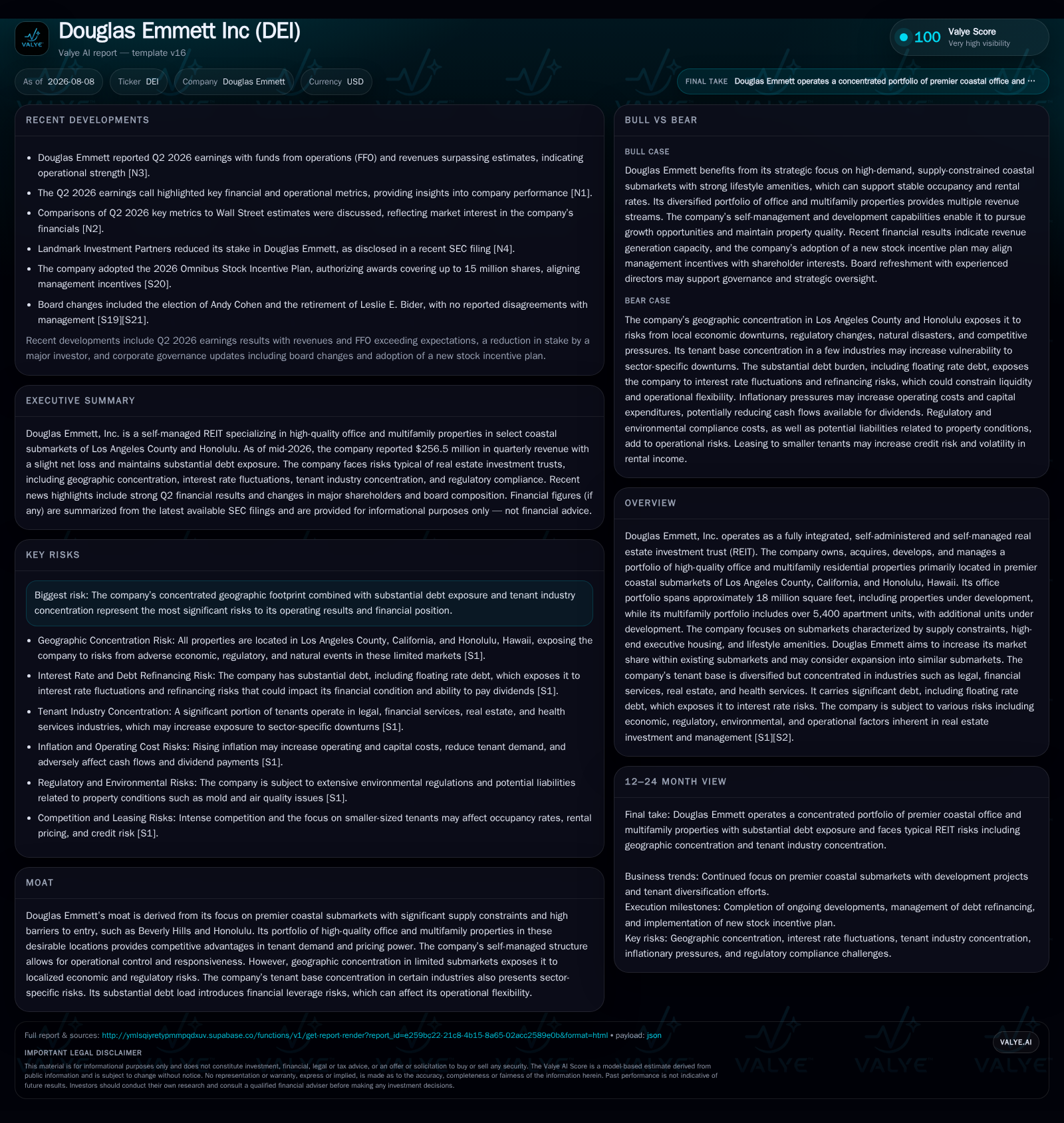
Douglas Emmett Inc (DEI) operates a self-managed REIT with a focused portfolio of approximately 18 million square feet of office space and over 5,400 multifamily units primarily in supply-constrained Los Angeles County and Honolulu submarkets. The Q2 2026 results reveal continued operational resilience with steady occupancy and rent growth amidst ongoing development projects. However, the company’s strategic concentration in high-barrier coastal markets brings exposure to localized economic, regulatory, and tenant industry risks. Additionally, its substantial net debt exceeding $5.4 billion raises refinancing and interest rate sensitivity concerns. Future growth hinges on successful lease renewals, development execution, and managing leverage against a backdrop of inflationary pressures and competitive market dynamics.
Recent Operating Update
Douglas Emmett’s Q2 2026 quarterly filing reveals stable operating performance amid its focused exposure to premier coastal submarkets in Los Angeles County and Honolulu. The company reported consistent occupancy levels across both office and multifamily assets, affirming tenant demand despite the broader commercial real estate headwinds seen nationwide [S2][S3]. Revenue from leasing continues to be bolstered by limited supply in these geographically constrained markets where Douglas Emmett owns about 18 million square feet of office space—including around 456 thousand square feet currently under development—and over 5,400 multifamily apartment units with more than 1,000 additional units underway [S1][F1]. This active development pipeline is intended to support future net operating income (NOI) growth.
These results demonstrate an operational profile that leverages market rent persistence supported by lifestyle amenities and high-end executive housing characterizing Douglas Emmett’s chosen submarkets such as Beverly Hills, Santa Monica, Brentwood, Century City in LA County, and key neighborhoods in Honolulu. The self-managed REIT structure facilitates responsive asset management and leasing strategies reflecting these unique economies [S1]. However, the filings confirm continuing challenges from inflationary pressures on operating costs and capital expenditures combined with competitive leasing dynamics especially within the office portfolio.
Business Model Analysis
Douglas Emmett operates as a fully integrated real estate investment trust primarily monetizing through rental streams from leasing both office buildings and multifamily residential communities concentrated in high-barrier-to-entry coastal locations. Its revenues are driven largely by leasing contracts with corporate tenants primarily from legal (19.7% of base rent), financial services (16.8%), real estate (13.3%), and health services (9.9%) sectors [S22]. Lease renewal rates, occupancy levels, average rental rates per square foot/unit, and tenant retention directly impact monthly recurring revenue.
The company’s property development activities underpin long-term income growth but carry risks related to construction cost inflation, zoning approvals, and project execution timelines [S28]. Capital expenditures for maintenance also influence net cash generation negatively in the short term. Douglas Emmett’s emphasis on smaller tenants within its office portfolio introduces incremental credit risk though offers diversification if managed effectively.
Margins benefit from premium location pricing power driven by persistent local supply shortages which help sustain market rents above broader averages; however, rent roll-down risk remains should new leases fail to meet asking rents or if existing tenants reduce footprint upon renewal [S1]. The firm mitigates this through active portfolio management but must balance tenant mix concentration risk inherent in restricted submarkets versus diversification considerations.
Industry Structure and Competitive Position
Douglas Emmett’s business sits at the asset ownership stage within the real estate value chain—owning, developing, leasing, and managing assets while interfacing directly with tenants who pay rents based on long-term agreements often adjusted for CPI or fixed escalations. This ensures predictable cash flows but exposes the firm to cyclical economic shifts affecting tenant ability or willingness to lease.
In comparison to peers like Kilroy Realty Corporation or Boston Properties focusing broadly on West Coast office markets or multifamily operators such as Equity Residential focusing nationally on residential assets, Douglas Emmett’s sharply concentrated geographical footprint is a double-edged sword [S26][S27]. While it enables commanding market share in niche luxury-dominant submarkets with high barriers limiting new supply entry—driving relatively stable occupancy rates—it subjects the firm to pronounced regional regulatory risks such as California’s rent control laws which restrict rental increases
The self-management approach contrasts with externally managed REITs allowing greater operating agility but requiring robust internal asset management capabilities—a strength for Douglas Emmett evidenced by steady leasing metrics during the past quarters [S2]. The tenant base concentration toward specific sectors can lead to sector-specific downturn sensitivity compared with more diversified peers.
Growth Drivers
Future growth levers include completion of multi-family developments adding over 1,000 units targeted at high-demand executive housing segments where supply constraints limit competitive alternatives [S1]. Likewise, the under-development office properties totaling approximately 456 thousand square feet provide expansion capacity aligned with local demand patterns
Population inflows into coastal metro areas coupled with lifestyle preferences favoring amenity-rich environments should underpin demand long term. Operational initiatives focusing on improving lease renewal rates—critical KPIs given the impact of churn on rental revenue—also provide potential for enhanced profitability.
Favorable financing conditions remain essential given Douglas Emmett’s capital-intensive growth plans; any easing in interest rate volatility would positively affect weighted average borrowing costs enhancing net yields from current projects [S27].
Risks / Watchpoints
Principal risks center around Douglas Emmett's geographic concentration exclusively within Los Angeles County and Honolulu which limits diversification benefits; localized economic downturns or adverse regulatory actions could disproportionately affect results [S26]. Inflation-related cost escalations pressure net operating income unless sufficiently offset by commensurate rental increases which may not be fully achievable due to competitive forces or rent stabilization laws.
Debt leverage is significant with total obligations nearing $5.77 billion against cash reserves of $355 million yielding a net debt position exceeding $5.4 billion that heightens vulnerability to interest rate hikes exposing potential refinancing challenges particularly as floating-rate portions mature [F1]. Sustained elevated interest rates could compress valuations implying headwinds for equity returns.
Tenant sector concentration in legal services (approximate one-fifth of rent roll) alongside financial services also introduces cyclical risk tied to professional service sector performance amid wider macroeconomic volatility [S22]. Lease roll-downs arising from non-renewals at prior rates would impair near-term revenues requiring monitoring.
Development project cost overruns or audit failures could impact expected yield on invested capital adding execution risk particularly given recent inflation trends impacting closely monitored CapEx budgets [S28][S27]. Lastly environmental liabilities stemming from site compliance remain latent risks requiring ongoing assessment.
What to Watch Next
Upcoming milestones include completion progress updates on key development projects contributing incremental NOI starting late 2026 onward. Monitoring same-store property revenue growth rates will signal organic portfolio health beyond acquisition activity.
Lease renewal rates across core assets remain vital operational indicators; sustained renewal above market average secures recurring revenue base minimizing vacancy creep risks. Metrics gauging absorption rates for new apartment units will reveal demand elasticity under current cost structures.
Debt maturity schedules warrant scrutiny against liquidity reserves; any signs of refinancing difficulty amid tightening credit markets would materially affect the company’s financial flexibility going forward.
Management commentary on local regulatory developments particularly regarding rent control or zoning changes will signal potential shifts impacting pricing power.
Financial Profile Discussion
At June 30, 2026, Douglas Emmett held approximately $355 million in cash equivalents against total debt outstanding near $5.77 billion resulting in net debt of about $5.43 billion reflecting elevated leverage consistent with large-scale REIT operations focused on high-cost coastal markets [F1]. The firm finances growth through a mix of secured borrowing facilities supporting acquisitions and developments alongside internally generated funds from operations (FFO), though detailed FFO figures for Q2 were not cited directly here.
High leverage increases exposure to interest rate fluctuations given significant floating-rate components noted previously; maintaining adequate debt service coverage ratios will be crucial especially if capital markets tighten or refinancing terms deteriorate due to external macro factors including Fed policy shifts [S23][S24]. Retaining operational cash flow stability via rental income resilience thus supports dividend payout capabilities expected of REIT structures reliant on distributions.
The capital expenditure intensity linked to extensive maintenance requirements for aging properties combined with investments into development pipelines suggests disciplined capital allocation will remain pivotal balancing internal yield targets against external cost pressures [S27].
Overall liquidity appears sufficient near term yet warrants ongoing review relative to debt maturities occurring over next few years amid evolving credit conditions.
This analysis integrates publicly filed SEC disclosures as well as industry-standard REIT operating frameworks to present a data-driven perspective contextualized by peer considerations without including explicit investment advice.
Disclaimer: This is research-only, informational analysis and not investment advice. It may include AI-generated interpretation and general industry context. Always verify important details using primary sources.

Comments