
Caterpillar's Backlog Surge and Pricing Power Reflect Resilient Heavy Equipment Demand
Robust sales volumes, backlog growth, and price realizations across segments underpin Caterpillar’s Q2 2026 performance amid restructuring efforts.
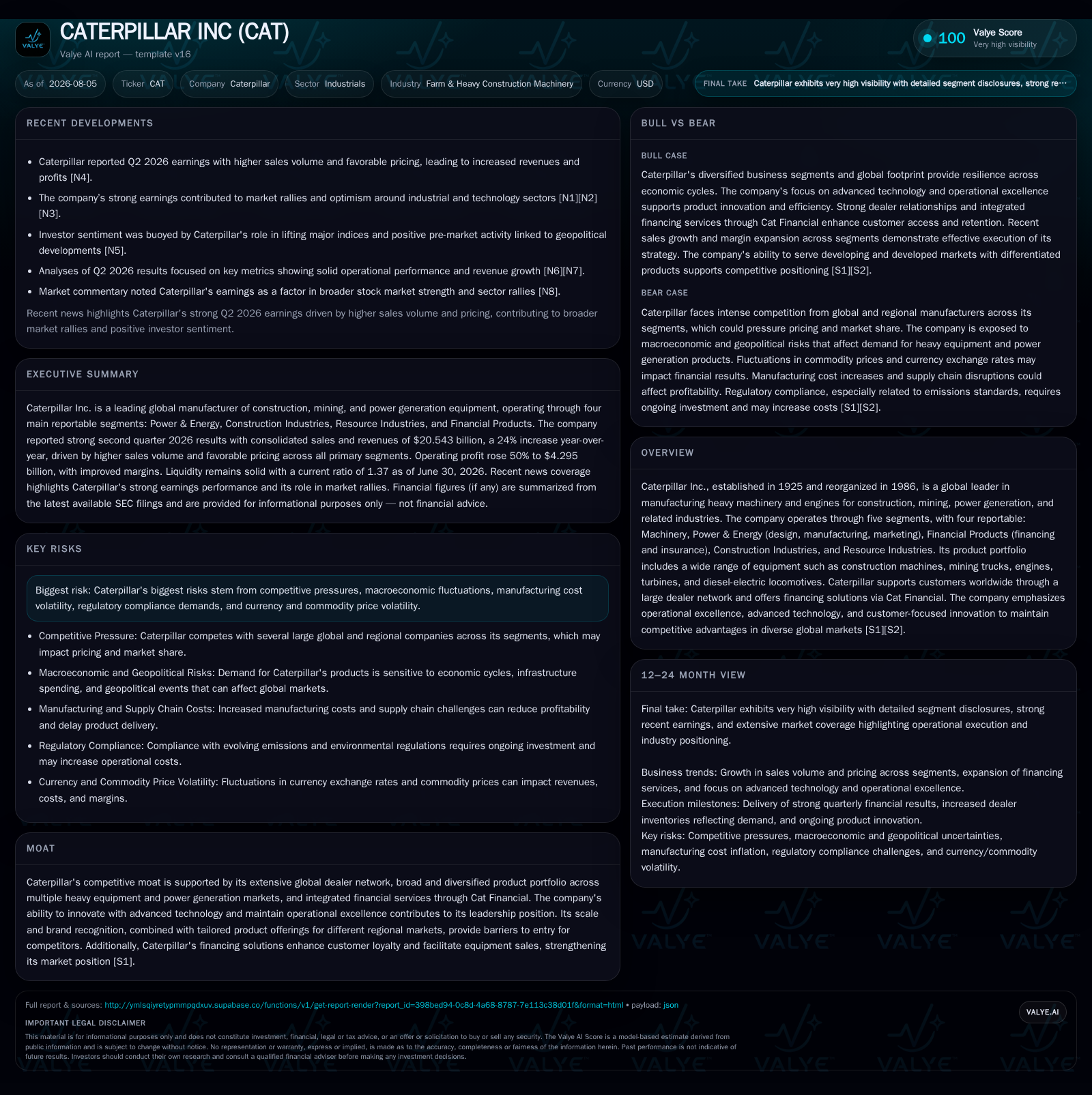
Caterpillar's latest quarterly filing reveals a strong operating environment with total sales up 24% year-over-year, driven by significant volume gains and favorable pricing. The company’s backlog grew to $72.1 billion, signaling sustained demand particularly in Power & Energy. Operational excellence initiatives including restructuring are underway, aimed at margin expansion despite cost pressures. Caterpillar's diversified product portfolio, extensive dealer network, and integrated financial services remain key competitive moats amid cyclical industry challenges.
Recent Operating Update: Strong Volume and Pricing Drive Growth
This volume- and price-driven performance was broadly distributed geographically, with North America leading the charge (+39%), followed by steady advances in Latin America (+10%) and EAME regions (+15%). Asia/Pacific exhibited more modest sales growth but still benefited from favorable currency movements alongside some price increases [S2]. These geographic dynamics reflect differentiated regional investment cycles in infrastructure, mining, and energy sectors that drive Caterpillar’s demand.
Dealer inventory levels increased by roughly $600 million during the quarter compared to just a $100 million rise in Q2 2025. Notably, Construction Industries dealers added about $400 million of new inventory after last year's depletion. This heightened stocking suggests dealers foresee sustained demand ahead or are adapting to extended product delivery timelines stemming from supply chain complexities [S2]. Since dealers set inventory levels independently based on localized demand signals and delivery expectations, these changes hint at confidence underlying forthcoming order fulfillment.
An important metric corroborating strength ahead is Caterpillar's order backlog which stood at approximately $72.1 billion at the end of June—a notable sequential increase of about $9.4 billion from Q1 2026 [S4]. The backlog expansion occurred across all three primary reporting segments—Power & Energy saw the largest jump driven by growing orders for large reciprocating engines and turbines used in energy infrastructure projects [S4][N2]. Nearly $29.2 billion of this backlog extends beyond the next twelve months, reflecting durable demand visibility.
Business Model: Integrated Heavy Equipment Manufacturing with Financing Support
Caterpillar operates predominantly through four reportable segments: Machinery (Construction Industries), Power & Energy (engines and turbines), Resource Industries (mining equipment), and Financial Products (financing operations) [S1]. The core revenue driver is the sale of capital-intensive heavy equipment including excavators, bulldozers, loaders, mining trucks, diesel-electric locomotives, plus stationary power systems.
Revenue accrues from multiple levers within this model: direct machinery/unit sales to end users and OEMs; aftermarket parts which benefit from machine lifetime utilization; equipment servicing contracts; and financing solutions provided via Cat Financial to facilitate acquisitions and leasing arrangements [S1]. This multifaceted monetization arrangement enhances customer stickiness as buyers tied into Caterpillar’s financing ecosystem face switching costs beyond just initial equipment purchase.
From an operational perspective, price realization per unit intertwines heavily with sales volume trends given cyclical capex patterns among industrial customers sensitive to commodity prices and regional infrastructure spending levels [S2][S1]. Dealer networks play a pivotal role not only as distribution partners but also as local market intelligence hubs managing inventory buffers that impact revenue timing and margin profiles
Caterpillar’s emphasis on commercial excellence involves tailoring product offerings to varying economic conditions globally—for instance, developing cost-competitive machines suited for emerging markets where purchase price sensitivity is acute while advancing advanced technology leadership to comply with tightening emissions regulations in developed markets [S1].
Industry Structure and Competitive Positioning
The farm and heavy construction machinery industry is characterized by several large multinational manufacturers competing across geographies alongside regionally focused players targeting niche segments or lower-tier market customers. Key peers include CNH Industrial (CASE brand), Deere & Company (Deere Construction & Forestry segment), Komatsu (a major Japanese competitor), Hitachi Construction Machinery internationally, alongside Hyundai Construction Equipment regionally.
Caterpillar distinguishes itself through its scale—the largest independent global dealer network coupled with an integrated financial services arm enhances both market reach and revenue resilience against cyclical troughs. Its broad product portfolio spanning construction machinery to power generation offers diversified exposure reducing single-market dependency risk [S1]. Furthermore, innovation around electrification, automation, digital integration into equipment analytics positions Caterpillar favorably for future regulatory-driven demand shifts.
However, cyclical industry fundamentals persist as a headwind given capital expenditure sensitivity linked to macroeconomic fluctuations including government infrastructure budgets and commodity prices impacting mining operations which comprise significant end customers for Caterpillar’s mining trucks segment [S1][N2]. Thus backlog growth is an important near-term indicator of sustainable demand; Caterpillar’s recent sizable increase serves as a leading signal supporting continued top-line momentum.
Growth Drivers
Multiple factors provide growth avenues for Caterpillar over coming periods:
- Incremental government infrastructure investments worldwide underpin demand especially in North America and EAME regions where stimulus frameworks emphasize construction activity.
- Mining sector investments tend to follow commodity cycles; recent commodity price recoveries have spurred orders for large mining trucks and resource extraction equipment included in Caterpillar’s Resource Industries segment.
- Technological advancements such as electrified machinery models improve emissions compliance while digital connectivity fosters value-added services boosting aftermarket parts revenue.
- Expansion or optimization of dealer networks improves market coverage particularly in emerging markets where long-term urbanization supports heavier construction activity.
- Increased penetration of customer financing enables otherwise capacity-constrained customers or rental companies to acquire newer fleet units facilitating recurring revenue streams via lease payments [N10][S1][N2]
Risks and Watchpoints
tions is critical as excessive buildup could inflate working capital needs or delay shipments causing order recognition timing distortion.
- Currency exchange rates impact international revenues presents ongoing translation risk given wide geographic exposure including strong presence across EAME and Asia Pacific regions.
What To Watch Next
Key indicators that will validate sustainability of recent gains include:
- Monitoring quarterly changes in order backlog across segments especially the portion expected beyond one year will provide early visibility into durable customer commitments.
- Price realization trends relative to inflationary pressures will signal ability to maintain margins amidst cost headwinds.
- Dealer inventory adjustments reflecting balance between customer demand projection accuracy versus supply chain delivery performance.
- Progress on restructuring initiatives development through periodic cost savings announcements confirming operational execution effectiveness.
- Regional sales performance during upcoming quarters aligned with macroeconomic data points on infrastructure spending or commodity pricing movements.
- Capital allocation cadence particularly share buyback activity levels alongside dividend policy updates indicating free cash flow confidence [S25][N2][N10]
Financial Profile Discussion
Caterpillar’s liquidity position remains solid entering the second half of 2026 with cash and equivalents totaling approximately $6.7 billion as of June 30th alongside current assets exceeding current liabilities resulting in a healthy current ratio near 1.37x—providing ample cushion for short-term obligations [F1]
Total debt stood near $37.8 billion as of December 31st last year with net debt (debt minus cash) roughly at $31.1 billion reflecting manageable leverage consistent with investment-grade credit standing [F1]. Management underscores maintaining a mid-A credit rating as a top priority guiding financial strategy which includes disciplined capital expenditure guidance (~$3.5 billion for Machinery, Power & Energy), robust free cash flow generation driving aggressive share repurchases ($6.5 billion deployed H1’26) combined with dividend increases (8% raise approved) signaling earnings strength underpinning shareholder returns commitment [S25][S13].[N25]
Operating income margin expanded notably from ~17% adjusted last year Q2 towards ~22% adjusted this quarter after excluding restructuring costs incurred related primarily to divestitures of certain non-U.S entities valued around ~$300 million range annually targeted for efficiency gains starting this year [S9]. This margin improvement amidst volume growth reflects effective commercial execution including pricing discipline leveraged against inflationary input costs partially offsetting cost pressures incurred during the transition period associated with operational restructuring programs currently underway [S9][S7].[N5]
Overall Caterpillar maintains financial flexibility combining dependable cash flows from its broad industrial footprint along with well-supported funding sources including readily available credit facilities currently totaling over $11 billion shared between MP&E operations and Financial Products subsidiaries providing ample liquidity buffers when needed [F1][S20]
This analysis synthesizes detailed SEC disclosures from mid-2026 filings combined with established industry context pertinent to Caterpillar Inc., illustrating how operational execution aligns within heavy equipment cyclicality tempered by strategic repositioning initiatives. It avoids speculative claims on product pipelines or order-by-order detail not publicly disclosed while focusing on KPIs driving sustainability of observed growth such as backlog dynamics, pricing trends, dealer inventory management, geographic mix shifts, restructuring impact trajectories, financial positioning including liquidity metrics—all crucial observables that contextualize Caterpillar’s outlook within ongoing macroeconomic complexities shaping farm/heavy construction machinery sector dynamics.
Disclaimer: This is research-only, informational analysis and not investment advice. It may include AI-generated interpretation and general industry context. Always verify important details using primary sources.

Comments