
Tenaya Therapeutics Advances Gene Therapy Pipeline with New CFO and Strategic Collaboration
Tenaya Therapeutics reports clinical progress in cardiac gene therapy alongside financial and management updates.
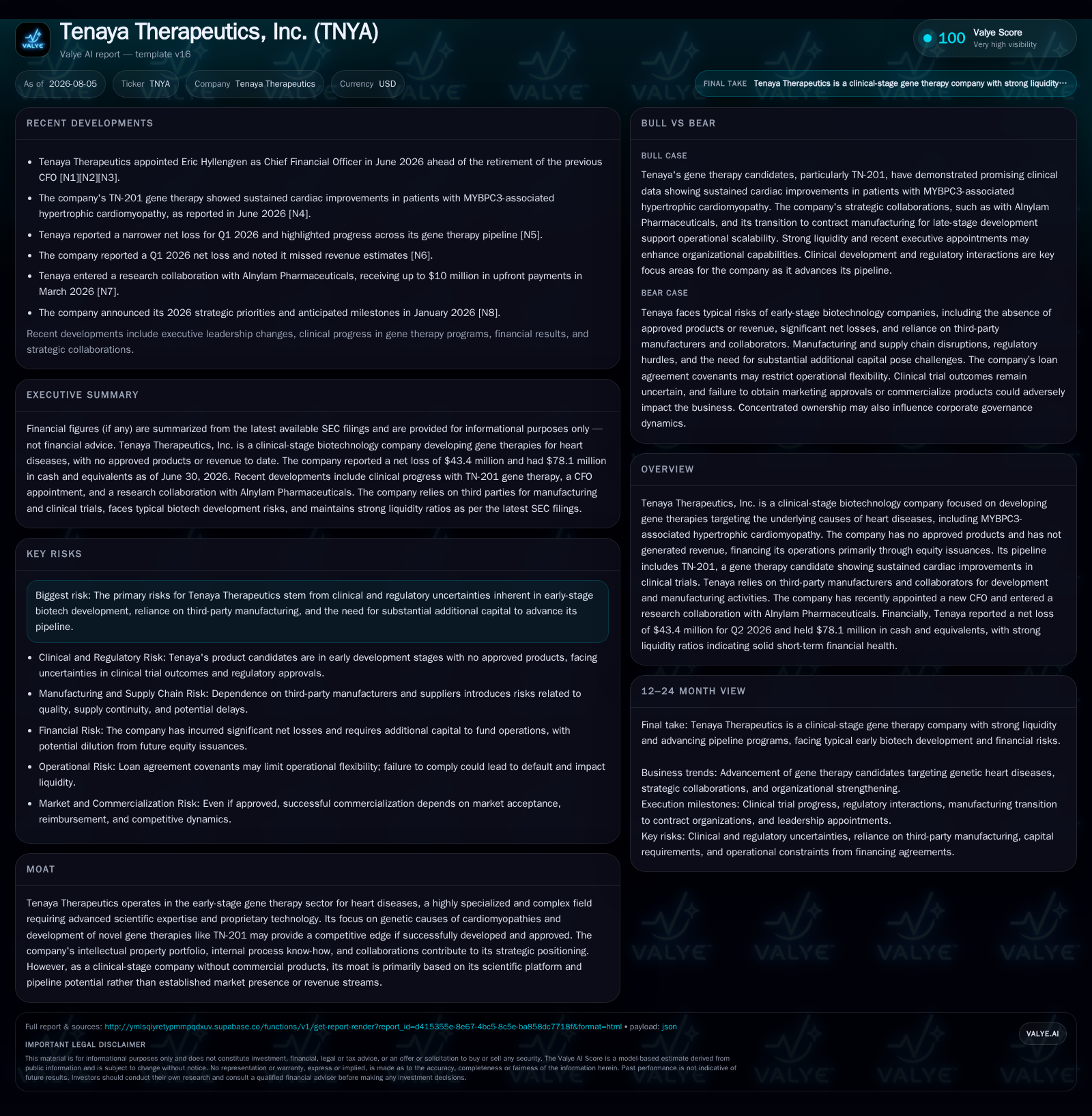
Tenaya Therapeutics, a clinical-stage biotech focused on gene therapies for hypertrophic cardiomyopathy, disclosed its Q2 2026 operational update highlighting ongoing development of its lead candidate TN-201. The company appointed Eric Hyllengren as CFO to further stabilize financial leadership and announced a new research collaboration with Alnylam Pharmaceuticals to strengthen innovation. With $78.1 million cash on hand and a current ratio of 4.52, Tenaya maintains solid liquidity amid early-stage development risks common to gene therapy firms reliant on equity financing and third-party manufacturing.
Q2 Clinical Progress Bolstered by Collaborative Momentum and Management Transition
Tenaya Therapeutics’ latest quarterly report [S2] reveals ongoing clinical activity surrounding TN-201, its gene therapy candidate aimed at treating MYBPC3-associated hypertrophic cardiomyopathy (HCM). Early data signals sustained cardiac improvements in treated patients, marking critical validation steps for this pioneering approach focusing on underlying genetic mutations rather than symptomatic treatment. This progression through clinical phases aligns with meaningful KPIs such as patient enrollment rates and clinical endpoint attainment typical for gene therapy developers advancing through Phase 1/2 trials.
Simultaneously, Tenaya announced the appointment of Eric Hyllengren as Chief Financial Officer ahead of the former CFO’s retirement [N1][N2]. This leadership change supports strengthened fiscal strategy execution crucial to navigating capital-intensive R&D paths where disciplined expense management and fundraising acumen are essential. The timing suggests an emphasis on aligning internal financial oversight with expansive developmental objectives.
Additionally, Tenaya entered a research collaboration with Alnylam Pharmaceuticals [S3], known for expertise in RNA interference therapeutics. This partnership brings complementary scientific capabilities potentially enhancing Tenaya’s pipeline productivity and broadening mechanistic innovation avenues beyond traditional AAV-based gene therapies. Collaborations like this serve not only as innovation accelerants but also validate technology platforms within the competitive gene therapy landscape.
Gene Therapy Business Model Hinged on Pipeline Innovation and Outsourced Manufacturing
Operating as a clinical-stage developer with no approved products or sales revenue, Tenaya’s business model exemplifies typical biotech dynamics: heavy dependence on equity issuances to finance costly early-stage research and development [S1]. Revenues remain absent as commercialization lies several years away pending successful regulatory approvals.
Manufacturing represents a significant operational challenge due to the complexity of vector production. Tenaya strategically outsources vector manufacturing to specialized contract manufacturers [S1][S2], a common practice that mitigates significant capital expenditure burdens while leveraging external expertise required for producing high-quality viral vectors at scale. Outsourcing adds layers of supply chain risk but is necessary given the technical demands of gene therapy production.
The company's intellectual property portfolio around treatment of genetically driven cardiomyopathies underpins its potential competitive moat. Proprietary constructs targeting the MYBPC3 mutation represent high-value assets guarding future milestone payments or licensing opportunities should partnerships or commercialization proceed favorably.
Competitive Dynamics in Cardiac Gene Therapy Highlight Scientific Complexity and Partnering Importance
Within the niche of inherited cardiac disease gene therapies, Tenaya shares competitive space conceptually with companies like CRISPR Therapeutics, bluebird bio, and Spark Therapeutics — all pioneering modalities addressing genetic disorders via sophisticated molecular techniques. Despite novelty granting potential pricing power through orphan drug incentives, market adoption remains uncertain due to therapy modality risks, regulatory hurdles, and payer skepticism around durable cost effectiveness.
Regulatory approval pathways for genetic cardiomyopathy treatments involve rigorous demonstration of safety and efficacy endpoints — areas notoriously fraught with delays or failures due to complex biology and small patient populations. Operating leverage here is highly sensitive; positive trial data can substantially enhance valuation while setbacks may impair funding prospects dramatically.
Therefore, strategic collaborations serve dual functions: extending scientific breadth while validating approaches commercially and scientifically under tougher regulatory scrutiny.
Pipeline Growth Catalysts: Clinical Milestones, Regulatory Steps, and Strategic Collaborations
Near-term growth hinges on tangible pipeline milestones such as patient recruitment rates accelerating TN-201’s trial progression [S2], which if achieved would confirm trial feasibility metrics vital for Phase advancement. Progressing through regulatory submissions or achieving orphan drug designations would offer distinct inflection points enhancing valuation clarity.
The recent Alnylam deal expands capability breadth by integrating RNA-targeted strategies that could complement current therapeutic mechanisms [S3]. Such partnerships mitigate single-product dependence risk while potentially improving go-to-market readiness through external expertise in manufacturing scale-up or regulatory affairs.
Vector production efficiency improvements are another critical driver; any advancements in contract manufacturing collaborations leading to more reproducible or scalable viral vector yields could reduce cost barriers endemic to gene therapy commercialization.
Risks to Watch: Clinical Trial Uncertainties, Cash Burn, Manufacturing Dependencies, and Regulatory Hurdles
The prominent challenges confronting Tenaya include standard early-stage biotech risks: clinical trial outcomes remain inherently unpredictable ([S1],[S2]), any unfavorable safety profile or efficacy shortfall could delay timelines or necessitate costly protocol amendments.
Dependence on third-party contract manufacturers introduces supply chain vulnerabilities potentially disrupting trial material availability or quality standards ([S1],[S2]). Intellectual property disputes or limitations pose additional latent risks impacting freedom-to-operate or partnering prospects.
Financially intensive R&D processes create persistent cash burn pressures necessitating recurring capital raises; failure to secure subsequent funding rounds could curtail operational plans ([S1],[S2]). Regulatory complexities heightened by evolving FDA review frameworks may extend approval durations or alter evidentiary standards ([S26]).
Upcoming Milestones: Enrollment Updates, Submission Targets, Collaboration Developments
Upcoming operational checkpoints include progress toward targeted enrollment milestones essential for robust statistical evaluation in ongoing TN-201 studies [S2]. Monitoring these enrollment rates will be key indicators validating trial design acceptance among patients and clinicians alike.
Regulatory submission ambitions remain focal points; any forthcoming IND filings or orphan designation requests would mark tangible steps toward market entry preparation [S2].
Collaboration progress updates from Alnylam-related projects are also anticipated within successive quarters potentially unlocking expanded therapeutic scopes or co-development synergies [S3].
Financial Profile Discussion
Tenaya reported a net loss of $43.4 million in Q2 2026 reflecting typical R&D expense intensity without offsetting revenues [S2]. At quarter-end June 30, 2026, the company held $78.1 million in cash and equivalents alongside current assets totaling $86.0 million against liabilities near $19.0 million—yielding a robust current ratio of approximately 4.52 indicative of strong short-term liquidity support [F1].
This cash position underpins near-term operational runway enabling continuation of planned clinical studies and corporate initiatives but remains contingent on successful additional financings given ongoing negative cash flow characteristic of pre-commercial biotech firms [S2]. The introduction of a seasoned CFO further underscores management’s focus on optimizing capital structure amid significant investment demands ahead [N1][N2].
This analysis incorporates recent SEC filings as primary data sources while embedding industry-specific context relevant for evaluating Tenaya Therapeutics’ developmental status within gene therapy biotechnology niche focused on inherited cardiac diseases. No investment research views are offered herein; readers should consult comprehensive sources before forming opinions.
Disclaimer: This is research-only, informational analysis and not investment advice. It may include AI-generated interpretation and general industry context. Always verify important details using primary sources.

Comments