
Perrigo Co plc Advances Supply Chain and Innovation Amid Regulatory and Customer Risks
Perrigo’s recent quarterly results highlight operational progress in self-care segment amid persistent supply chain and regulatory challenges.
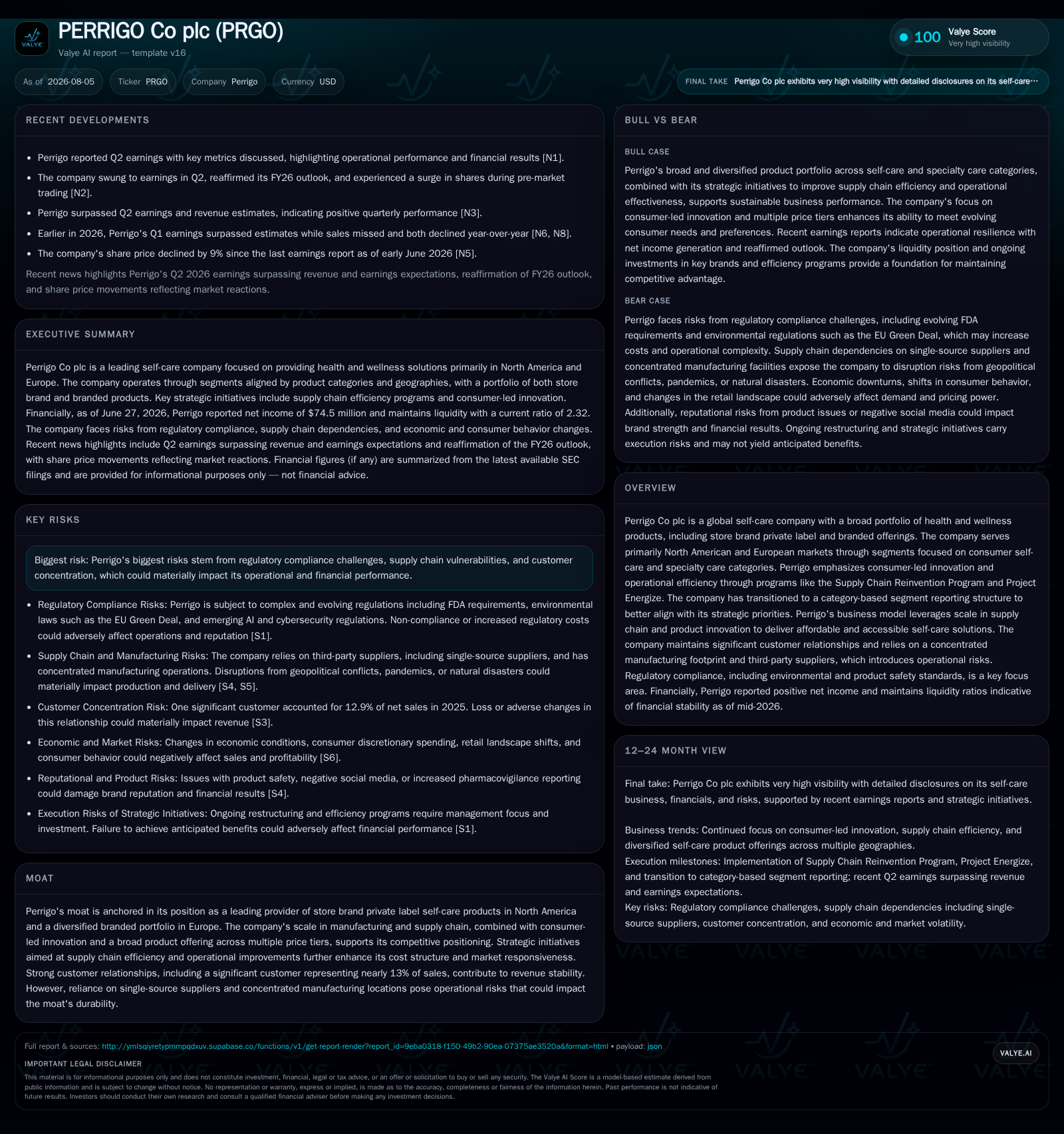
Perrigo Co plc reported second-quarter 2026 results confirming ongoing execution of its Supply Chain Reinvention Program and consumer-led innovation strategy, reinforcing its position in private label self-care products across North America and key branded OTC categories in Europe. The company faces typical industry risks including customer concentration, regulatory compliance complexity, and supply chain vulnerabilities due to reliance on third-party and single-source suppliers. Its business model balances private label scale with targeted branded product investments, leveraging operational initiatives for cost efficiency. Monitoring supply chain metrics, regulatory outcomes, and customer diversification will be critical to assessing durable growth prospects.
Recent Operating Update Highlights
Perrigo Co plc’s second quarter ended June 27, 2026 filing reiterates the active execution of key strategic initiatives centered on enhancing operational efficiency and deepening consumer-focused innovation ([S2], [S3]). The Supply Chain Reinvention Program is a global effort targeting cost reduction via optimized manufacturing footprint management, inventory improvement, and sourcing efficiencies. Parallelly, Project Energize drives global investment rationalization aligned with growth priorities. These programs are designed to stabilize profitability during external pressures. Notably, the company reaffirmed its fiscal year 2026 outlook during the earnings release dated August 5, highlighting solid underlying trends in core markets ([N1], [N3]).
This Q2 update importantly confirms no material change in risk factors compared to the prior annual filing, emphasizing enduring challenges that include regulatory compliance complexity, supply chain vulnerabilities linked to raw material sourcing constraints, and customer concentration risk ([S2]).
Business Model Specifics: Product Mix and Revenue Mechanics
Perrigo operates principally as a manufacturer and marketer of over-the-counter (OTC) self-care products across two core segments: Consumer Self-Care Americas (CSCA) mainly comprising store brand/private label offerings for the U.S. and Canadian markets; and Consumer Self-Care International (CSCI), which focuses on branded products primarily across Europe ([S1]).
The firm leverages scale advantages—manufacturing multiple formulations at various price points—to serve large retail chains who contractually purchase private label store brands at competitive price points. Revenue is driven by unit volumes through these retail partnerships alongside select branded sales that aim for higher margin capture. Product categories span upper respiratory health, digestive health, women's health, pain management, lifestyle wellness, infant formula, and specialty care.
This dual approach allows Perrigo to generate stable cash flow from private label contracts while investing in branded innovation to sustain differentiation across markets. Key brands such as Opill®, Mederma®, Compeed®, e llaOne®, Solpadeine®, Jungle Formula®, and ACO® provide portfolio breadth in Europe matched by mass-market store brand penetration in North America ([S1]). The segment reporting transition towards category-based views signals an intent to enhance alignment between operational decision-making and product line economics ([S19]).
Customer concentration is a significant aspect: one major customer accounts for nearly 13% of sales ([S1]), underscoring negotiation leverage challenges and exposure should the relationship weaken or terms shift unfavorably.
Industry Structure and Competitive Positioning
Perrigo sits squarely within the consumer self-care pharmaceutical landscape characterized by a blend of branded OTC manufacturers (e.g., GlaxoSmithKline Consumer Healthcare) and private label specialists supplying major retailers. The latter group highlights the criticality of cost advantages derived via efficient manufacturing scale, lean supply chains, supplier management including third-party ingredient sourcing, regulatory compliance rigor especially concerning active pharmaceutical ingredients (APIs), pharmacovigilance oversight, as well as maintaining trusted retailer relationships.
The sector mandates balancing affordability with perceived quality given consumer price sensitivity in OTC categories. Perrigo’s strategic emphasis on broad coverage across price tiers reinforces household penetration but necessitates rigorous innovations responsive to evolving wellness trends—ranging from general health maintenance to women’s health solutions—to drive category growth.
Its manufacturing footprint is notably concentrated with reliance on limited suppliers for APIs or specialized dosage forms—a double-edged sword presenting economies of scale but inherent risks of disruption should any single-source relationships falter or regulatory approvals constrain ingredient availability ([S1], [S6]). This configuration differs from some peers who diversify geographically or vertically integrate more extensively.
Regulatory scrutiny in North America and Europe remains complex: evolving policies around sustainability (e.g., EU Green Deal climate targets affecting packaging), tighter API certification procedures impacting supply reliability, post-market safety surveillance demands via pharmacovigilance frameworks all add operating costs that challenge margins ([S1]). Peers similarly walk this tightrope between compliance expense burden versus market access stability.
Growth Drivers
Multiple structural drivers underpin Perrigo’s growth outlook. Increasing consumer preference for self-directed wellness solutions fuels demand for accessible OTC formats. Additionally, major retailers’ expansion of private label portfolios aligns neatly with Perrigo’s strengths as a proven supplier delivering economies at scale while meeting stringent quality standards.
Consumer-led innovation efforts targeting unmet needs—such as novel delivery formats or formulations enhancing convenience—offer avenues for differentiation within crowded categories ([S1]). Expansion beyond established geographies into emerging markets presents potential upside though remains secondary currently given regulatory complexity.
Cost-saving initiatives through supply chain reinvention aim not only at margin uplift but also at improved inventory turnover ratios—critical KPIs that reflect both operational agility and responsiveness to fluctuating consumer demand cycles ([S1], [N3]).
Lastly, sustainability commitments addressing packaging recyclability and greenhouse gas emission reductions respond to rising stakeholder expectations that may influence buyer decisions among retail customers seeking ESG alignment ([S1]). Success here could confer competitive advantage or insulate against emerging regulatory headwinds.
Risks and Growth Constraints
While Perrigo benefits from scale advantages in private label manufacturing coupled with an established branded portfolio abroad, it faces persistent risks common across the industry:
- Regulatory compliance complexities remain high impact; adverse FDA observations have historically demanded remediation efforts inflating costs while risking reputation damage if not addressed timely ([S1], [S6]).
- Supply chain fragility due to dependence on single-source suppliers for key APIs introduces vulnerability to shortages or delays impacting product availability ([S1]).
- Customer concentration exposes revenues to contractual renegotiation risks or volume fluctuations tied to large retail partners’ strategies ([S1]).
- Pricing pressures intensified by both branded OTC competitors ramping innovation investments (e.g., Johnson & Johnson Consumer Health) and private label commoditization forces reduce margin levers ().
- Product recall scenarios linked to contamination or pharmacovigilance issues could lead not only to direct financial costs but also long-term brand erosion.
- Strategic uncertainty surrounds certain portfolios like infant formula undergoing review; success in repositioning or divesting these segments is uncertain ([S1],[N1]).
Trade restrictions or geopolitical tensions affecting raw materials import/export regulations introduce additional layer of unpredictability over input cost dynamics.
What To Watch Next
Key upcoming milestones will include:
- Measurement updates on supply chain KPIs such as inventory days outstanding and lead time reductions demonstrating reinvention program impact.
- Regulatory inspection outcomes particularly FDA responses influencing remediation trajectories.
- Progress on diversifying customer base beyond historically concentrated relationships.
- Execution clarity regarding portfolio streamlining efforts especially infant formula strategic alternatives ([S19]).
- Sustained organic net sales growth at core segments alongside gross margin stabilization reflecting operating leverage realization.
- Non-GAAP financial results excluding amortization or restructuring charges clarifying underlying business trends amid macroeconomic variability ([S3],[S22]).
Investor focus may further hinge on cost inflation pass-through effectiveness amid commodity price fluctuations impacting active ingredient sourcing.
Financial Profile Discussion
At quarter end June 27, 2026, Perrigo reported a current ratio of approximately 2.32 derived from current assets totaling about $2.45 billion against current liabilities near $1.05 billion ([F1]), indicating a comfortable short-term liquidity position supporting operational commitments. Cash plus equivalents stand around $432 million while total debt rests near $823 million based on best-effort recent data points ([F1]).
Given ongoing operating challenges including litigation-related expenses, restructuring project costs along with amortization of acquired intangibles excluded in core financial measures detailed at latest earnings event filings are useful gauges for normalized profit trends but also inject forecasting uncertainty ([S3],[S22]). Monitoring adjusted EBITDA margins will be critical for assessing sustainable cash generation capacity necessary for deleveraging and project funding.[F1]
In sum, Perrigo’s financial structure appears balanced supporting its core self-care business transformation while trading off near-term earnings volatility linked primarily to restructuring-related spending plus ongoing remediation expenses tied partly to FDA compliance requirements.[F1]
This analysis synthesizes SEC-filed disclosures alongside industry knowledge without offering investment advice.
Disclaimer: This is research-only, informational analysis and not investment advice. It may include AI-generated interpretation and general industry context. Always verify important details using primary sources.

Comments