
Regal Rexnord’s Segment Sales Growth and Margin Dynamics Reflect Industrial Market Cyclicality
Q2 2026 results show selective organic sales strength in Automation & Motion Control and Industrial Powertrain Solutions, offset by declines in Power Efficiency Solutions amid cost pressures.
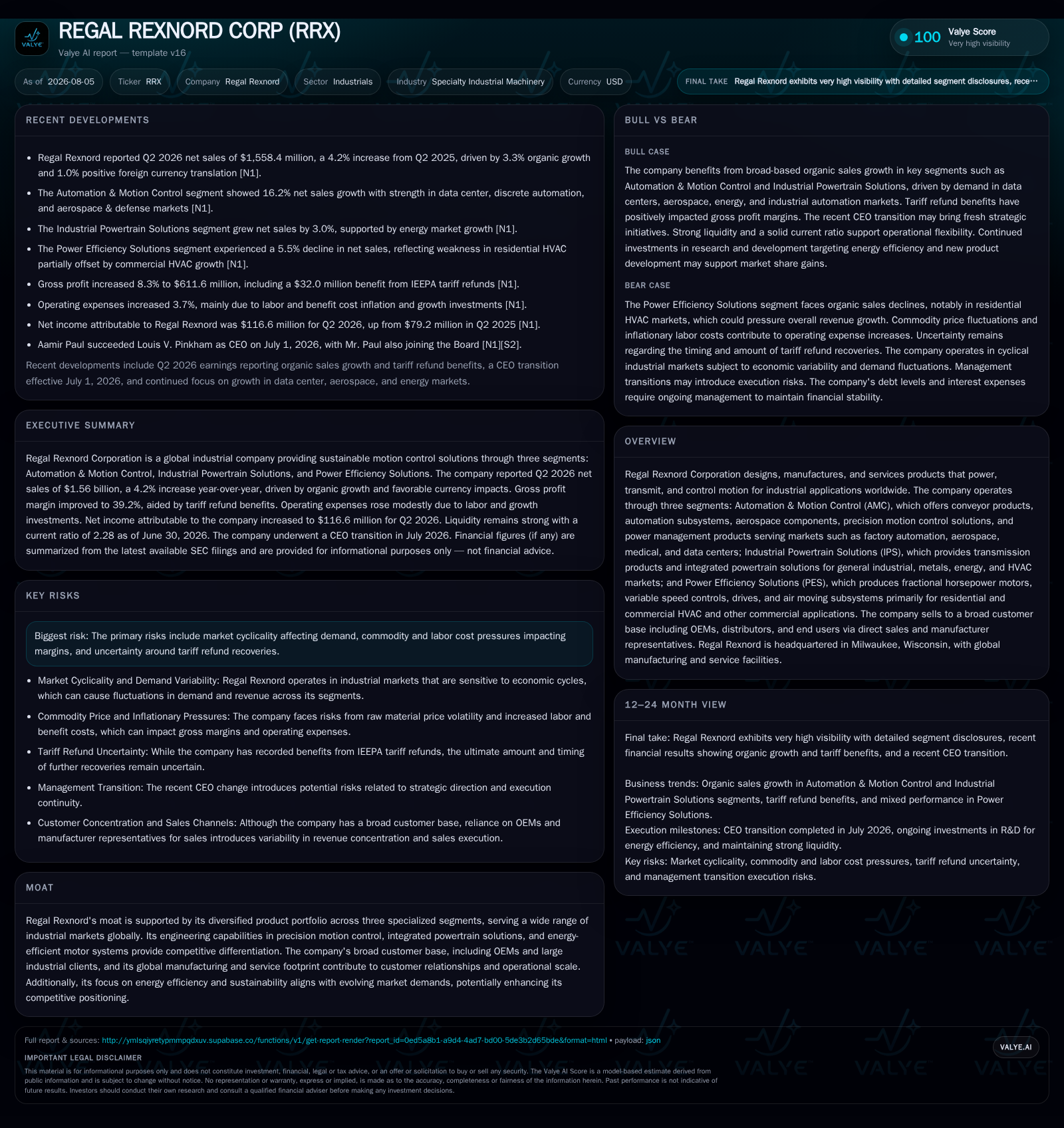
Regal Rexnord posted a 4.2% sales increase in Q2 2026 driven mainly by broad-based organic growth in its Automation & Motion Control and Industrial Powertrain Solutions segments, while the Power Efficiency Solutions segment saw organic declines. Margins benefited from tariff refunds and synergy gains but still face headwinds from rising labor and commodity costs. The company maintains robust liquidity with a strong current ratio and continues to prioritize debt reduction while investing in energy-efficient products aligned with evolving industrial demand. Leadership transitions and tariff refund developments remain key watchpoints for operational execution through 2026.
Recent Operating Update
In the second quarter of fiscal 2026, Regal Rexnord Corporation recorded net sales of $1.56 billion, marking a 4.2% increase compared to Q2 2025 [S2][S21]. This improvement stemmed from a solid 3.3% increase in organic sales alongside a positive 1.0% impact from foreign currency translation effects. The organic sales growth was predominantly driven by the Automation & Motion Control (AMC) segment's robust performance (+15.6%) and moderate gains in Industrial Powertrain Solutions (IPS) (+2.0%), partially offset by an organic decline in the Power Efficiency Solutions (PES) segment (-6.6%)
Cash flow from operations for the first half of 2026 totaled $191.6 million, which represents a significant year-over-year decrease primarily due to the lack of $368.5 million cash proceeds from receivables securitization that occurred in H1 2025 [S2][S9]
Business Model Overview
Regal Rexnord serves diverse industrial markets through three distinct operating segments: AMC, IPS, and PES. Its core business involves designing, manufacturing, and servicing engineered machinery components that power, transmit, and control motion across factory automation, aerospace, metals, energy sectors, and HVAC markets among others. Revenue generation relies largely on direct sales to OEMs and distributors via purchase orders or long-term contracts. The company also derives recurring aftermarket service revenue which bolsters resilience amid industrial cyclicality.
The AMC segment primarily addresses conveyor products, automation subsystems including precision motion control solutions such as servo motors and linear actuators, aerospace components, and power management products like modular electric pods used heavily in data centers and medical equipment applications.[S1][S2] This segment benefits from high engineering content enabling customization critical to OEM customers requiring reliable automation solutions.
IPS offers integrated powertrain solutions comprising transmission products such as bearings, couplings, gearboxes combined with Regal Rexnord's electric motors that efficiently transfer motion within industrial equipment used in metals, energy production, HVAC systems, and general manufacturing environments.[S1] The increasing integration of motor-drive components into subsystems reflects a broader industry trend toward turnkey solutions preferred by OEMs seeking efficiency gains.
The PES segment focuses on fractional horsepower AC/DC motors along with variable speed drives used predominantly in residential and commercial HVAC units plus other commercial applications requiring air moving subsystems.[S1] This segment faces more direct exposure to housing cycles and related end-market volatility than AMC or IPS.
Industry Structure and Competitive Position
Regal Rexnord occupies a critical position within the specialty industrial machinery value chain given its diversified product portfolio spanning motion control components to fully integrated powertrain subassemblies. It competes alongside peers such as ABB, Rockwell Automation, Emerson Electric, and Nidec that similarly offer automation equipment, power transmission components, or electric motor systems tailored for industrial OEMs.
The company leverages engineering differentiators—especially precision motion control technologies—and breadth across multiple end markets to mitigate concentration risk commonly found in single-industry players. Its global manufacturing footprint facilitates localized supply while providing scale advantages crucial under current inflationary pressures affecting raw materials and labor costs.
Market cyclicality varies across segments; AMC’s exposure to factory automation and data centers tends to show steadier demand linked to industrial modernization trends whereas PES is more susceptible to residential construction cycles driving HVAC replacement rates. These sector dynamics influence revenue visibility and margin stability.
Growth Drivers
Key drivers underpinning Regal Rexnord's near-term revenue growth include increasing adoption of factory automation technologies fueling demand for its AMC conveyor solutions and precision motion controls leveraged by data centers expanding capacity [S21][N1]
Industrial Powertrain Solutions benefits from ongoing infrastructure investments particularly in energy generation facilities (including renewables) and metals/mining operations modernizing equipment fleets which create opportunities for integrated subsystem sales [S26][N5]
Power Efficiency Solutions’ product innovation aimed at improving motor energy efficiency aligns well with global sustainability mandates thus providing potential market expansion albeit currently hampered by softer construction activity impacting short-cycle demand.[S17]
Strategic capital investments focusing on R&D upkeep further support new product development targeting enhanced environmental performance which is becoming a critical purchasing criterion for OEM customers aiming to meet tightening regulatory emissions standards.[S17]
Risks and Watchpoints
Industrial end-market cyclicality remains the principal risk with measurable impacts seen through segment-level sales variations—PES experiencing declines calls attention to sensitivity to HVAC cycles that may persist into late 2026 depending on housing starts trends.
Rising commodity prices especially steel and copper inputs alongside persistent inflationary labor cost increases challenge margin expansion efforts despite tariff refund windfalls recognized mostly under IEEPA disputes; regulatory outcomes regarding further CAPE tariff recoveries introduce timing uncertainty around material potential earnings upside [S10][S17]
Working capital buildup reflected in rising inventories and receivables weighs on cash conversion effectiveness; careful management of lead times amid dynamic supply chain conditions will be essential to stabilize operating cash flow [S9]
Leadership changes—Aamir Paul’s recent ascension as CEO coupled with impending retirement of the IPS segment head—require monitoring for continuity risks especially within this strategically important division undergoing integration post-Altra acquisition.[S17][S28]
What To Watch Next
Upcoming milestones include monitoring successive quarterly sales trends segmented by AMC/IPS/PES to assess sustainment or deterioration of momentum amid macroeconomic fluctuations.
Execution on innovation-led product launches enhancing energy-efficient capabilities will provide signals about competitive positioning improvements versus larger diversified peers like ABB or Emerson Electric.
Updates on IEEPA tariff refund recovery phases could materially influence reported profitability beyond recognized pre-tax benefits thus market participants will watch closely for clarity regarding timing and quantum of such refunds.[S17]
Debt reduction progress through continuing operating cash flow coupled with potential share repurchases or dividend policy adjustments will offer insights into capital allocation philosophy amid substantial leverage levels approaching $6 billion net debt [F1][S4]
Continued integration efficiency within IPS following Altra acquisition integration combined with successful leadership transitions remain crucial for margin stability going forward [S28]
Financial Profile Discussion
At quarter-end June 30, 2026 Regal Rexnord maintained approximately $442 million in cash alongside $1.58 billion working capital resulting in a robust current ratio of about 2.28x—a comfort level supportive of near term liquidity needs.[F1] Net debt remains sizable at nearly $6 billion when subtracting cash from total outstanding debt reported at year-end 2023; refinancing efforts during H1 2026 included issuance of an $850 million Term Facility which replaced higher-cost Senior Notes maturing in 2026 improving interest expense metrics slightly.
Interest expense for the first half decreased by roughly 10% year-over-year reflecting deleveraging efforts despite inflationary pressures elsewhere on the income statement.[S27] Capital expenditures are projected at roughly $120 million annually focusing primarily on maintaining manufacturing capacity adequacy rather than aggressive expansion—consistent with current operative strategy prioritizing operational efficiency improvements over rapid top-line scaling given external demand uncertainties.[S9][S17]
Operating income contribution remains segmented unevenly; AMC demonstrates strongest volume-driven profit growth while IPS yields steady contributions aided by synergy realization from recent acquisitions; PES lags as volume softness weighs earnings despite benefits derived from tariff refunds related to historic trade disputes [F1][S27]
Overall financial strategy hinges on striking balance between funding innovation pipelines targeting energy efficiency upgrades demanded globally while reducing leverage burden cautiously without jeopardizing investment capacity needed for long-term competitive positioning.
This report synthesizes SEC-filed financial disclosures alongside industry context tailored for buy-side professionals analyzing Regal Rexnord Corporation's latest operational results without issuing investment research views.
Disclaimer: This is research-only, informational analysis and not investment advice. It may include AI-generated interpretation and general industry context. Always verify important details using primary sources.

Comments