
CNA Financial's Q2 Underwriting Gains Rebound Despite Claims Pressure
CNA reports improved underwriting profits in Q2 2026, balancing rising claims with effective risk management and reinsurance strategies.
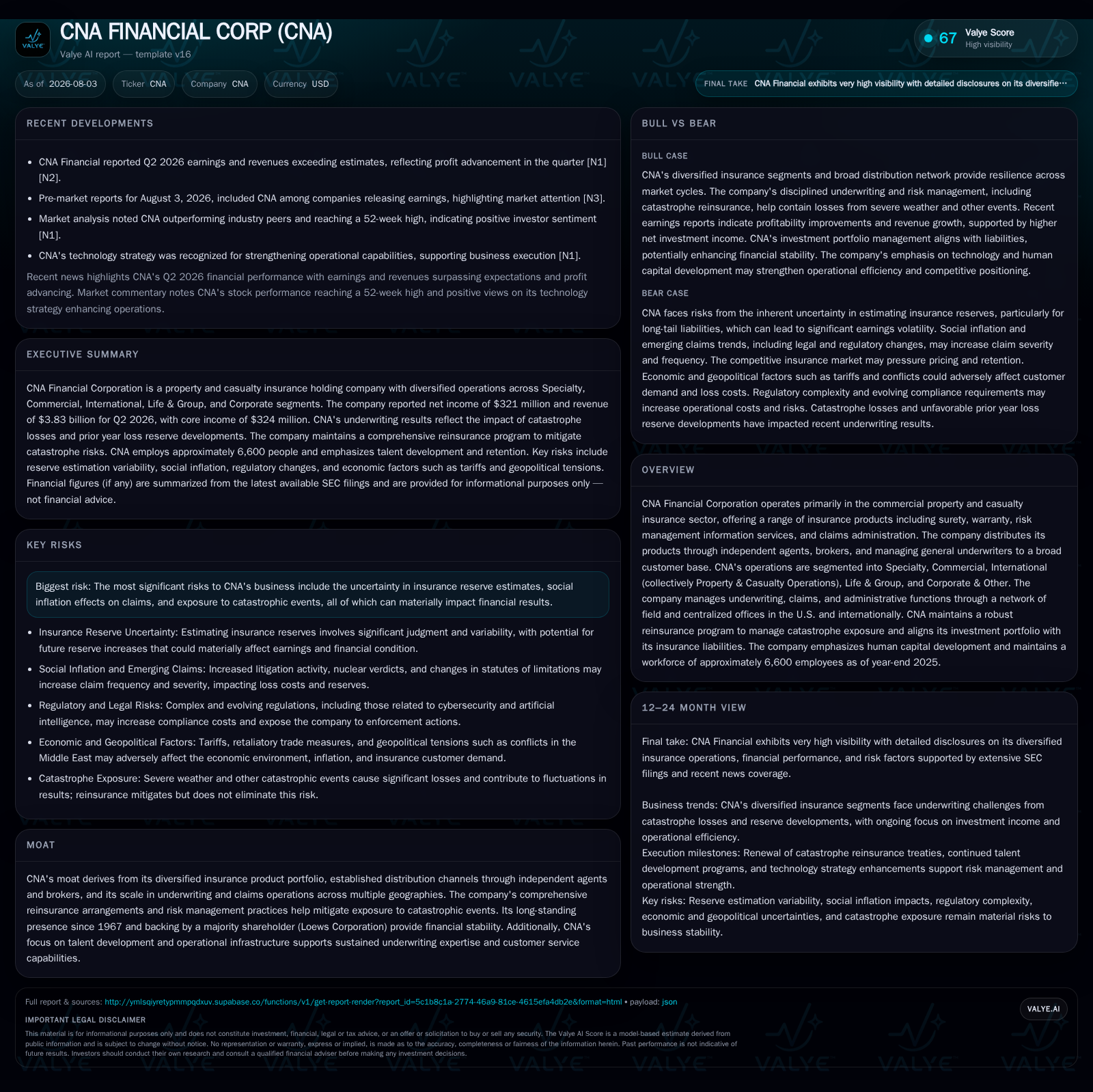
In its August 3, 2026 quarterly filing, CNA Financial Corporation showed a modest rebound in underwriting gains despite persistent claims cost pressures. The company's commercial property and casualty operations delivered a combined ratio increase driven by higher loss ratios, partially offset by expense efficiencies and catastrophe loss management. CNA continues to leverage diversified specialty and international insurance segments, supported by broad independent agency distribution and robust reinsurance protections. Reserve development risks and social inflation remain key earnings uncertainties as the company balances competitive pricing and capital deployment strategies.
Q2 Operating Highlights: Underwriting Gains Against a Rising Claims Backdrop
CNA Financial Corporation’s Q2 2026 results reveal an incremental improvement in underwriting gain despite pressure from elevated claims costs. The company reported a combined ratio of 96.5%, up 1.7 points from the comparable period last year, largely driven by a 2.4 point increase in the loss ratio reflecting higher severity in excess casualty and workers’ compensation lines. However, this was partially tempered by a 0.6 point reduction in the expense ratio due mainly to lower acquisition costs [S21]. Catastrophe losses fell slightly to $53 million (3.7 points of the loss ratio) from $57 million (4.2 points) in Q2 2025, showing effective catastrophe management aided by reinsurance protection.
Net written premiums for the Commercial segment grew by $80 million compared to last year through favorable renewal premium changes and new business gains, consistent with net earned premium increases that underpin revenue growth in core segments [S23]. Despite an unfavorable net prior year loss reserve development of $91 million—principally impacting Specialty, Commercial, and Corporate & Other segments—the company realized a positive underwriting margin adjusted for these reserve effects. Core income declined slightly by $11 million year-over-year, driven mainly by subdued underlying underwriting results partially offset by rising net investment income contributions [S21].
Cash dividends totaling $2.96 per share for the first half of 2026 included a special dividend of $2.00 per share, illustrating robust capital return policy confidence amid ongoing industry challenges. The Board declared another quarterly dividend of $0.48 per share payable September 3, 2026, signaling continued liquidity strength and disciplined capital allocation [S2], [S7].
How CNA’s Diversified Product Mix Supports Risk Absorption and Profitability
CNA operates a diversified insurance portfolio segmented into Specialty, Commercial, International (collectively Property & Casualty Operations), Life & Group, and Corporate & Other units. This multi-line approach allows CNA to balance cyclical exposure inherent in commercial P&C with more stable specialty underwriting lines such as surety and warranty insurance solutions. The inclusion of risk management information services alongside claims administration enhances service integration for a broad customer base ranging from small businesses to large enterprises across the U.S., Canada, U.K., Europe, and Lloyd’s Syndicate 382 participation provides further geographic diversification benefits [S1].
Each property & casualty segment exhibits distinct risk profiles: Specialty lines typically provide higher margins via tailored underwriting focused on niche markets; Commercial lines face more cyclical pressures affected by economic cycles and claim severity volatility; International operations extend underwriting expertise into diverse regulatory environments mitigating concentrated regional risks. This segmentation supports operational leverage through scale in underwriting disciplines while affording risk pool diversification critical for earnings stability.
Distribution Strength: Agents, Brokers, and MGUs Driving Premium Growth and Retention
CNA leverages a broad distribution network comprising independent agents, retail brokers, wholesale brokers, and managing general underwriters (MGUs) who play pivotal roles in customer acquisition, pricing negotiation, policy servicing, and renewals. This channel strategy allows flexible market access across product lines enabling premium growth despite intense competition.
Recent disclosures show steady policy renewal retention bolstered by favorable rate actions calibrated against inflationary cost pressures facing insureds. The reliance on third-party intermediaries creates competitive pricing sensitivity but also embeds embedded switching costs enhancing client stickiness when executed with superior service models.
This model aligns CNA competitively with peers such as The Hartford Financial Services Group or Chubb Limited who also emphasize distributed underwriting approach with robust broker relationships facilitating market responsiveness without expansive captive sales forces.
Navigating Industry Risks: Reserve Development, Social Inflation, and Catastrophe Exposure
Insurance reserve adequacy remains an enduring challenge for CNA as for all commercial P&C insurers due to estimation uncertainties exacerbated by shifting social inflation dynamics—such as nuclear verdicts litigation trends—and evolving legal frameworks including extended claim reporting statutes affecting sexual abuse cases.
The company continually revises its reserving assumptions reflecting recent claims data emerging trends but performs within an inherently uncertain environment that can cause material earnings volatility when adverse reserve developments arise unexpectedly. Favorable net prior year loss reserve development recorded in Q2 ($5 million) contrasts with generally unfavorable prior years recently indicating some reserving cushion but underscores persistent unpredictability inherent in long-tail liabilities.
Catastrophe risk exposure is mitigated through structured reinsurance programs designed to limit net retained losses from weather-related or other catastrophic events; nonetheless significant losses can occur episodically causing quarterly results variability.
Investments & Reinsurance: Enhancing Earnings Stability Amid Volatile Loss Profiles
Investment income remains a vital complementary earnings pillar for CNA benefiting from its sizable fixed income portfolio which generated $562 million in net investment income during Q2 including taxable and tax-exempt securities—a modest increase over the prior period—alongside equity alternative holdings contributing additional returns [S21]. Such stable investment returns help smooth overall profitability given fluctuating underwriting performance.
Reinsurance treaties are carefully structured to defray peak catastrophe losses thereby protecting statutory surplus and reducing earnings volatility although counterparty risk remains inherent as contingent on reinsurer performance.
Growth Prospects: Specialty Expansion, Pricing Power, and Geographic Diversification
Growth drivers highlighted include expansion within specialty insurance lines where CNA's technical underwriting sophistication offers potential for differentiated margin accretion amid less commoditized market segments. Additionally geographic diversification beyond U.S. borders through Canadian operations and Lloyd’s access provides pathways for incremental premium volumes.
Pricing power is increasingly important against inflation-driven cost environment; CNA’s demonstrated rate adjustments reflect ongoing repricing efforts essential to maintain underwriting profitability while balancing customer retention rates.
However economic cycles influence insured exposures constraining upside potential during downturns restricting new business volumes due to suppressed commercial activity.
Risks to Watch: Reserve Adequacy, Regulatory Pressure, and Competitive Rate Environment
Reserve estimation uncertainty heightened by social inflation is the principal risk potentially prompting unanticipated underwriting charges adversely impacting quarterly results. Regulatory oversight varies internationally complicating compliance efforts while pending legislative changes could alter coverage mandates or claims handling standards requiring operational agility.
Competitive pressures remain significant with numerous carriers vying for commercial customers driving defensive rate actions or coverage concessions potentially compressing margins especially in commoditized commodity property lines.
What to Monitor: Guidance Signals, Claims Trends, and Capital Allocation Decisions Ahead
Investors should track management commentary on claims frequency/severity trends including updates on nuclear verdict exposures or reviver statute impacts which materially affect incurred loss estimates going forward. Dividend consistency including continuation of special dividends will provide indirect read on surplus adequacy while observable premium renewal rates will signal franchise health amidst ongoing rating cycles. Quarterly earnings guidance updates may also clarify trajectory of underlying combined ratios signaling turning points between cycle troughs or peaks.
Disclaimer: This is research-only, informational analysis and not investment advice. It may include AI-generated interpretation and general industry context. Always verify important details using primary sources.

Comments