
Asure Software Confronts Liquidity and Profitability Pressures in Workforce Management SaaS
Q2 2026 results highlight operational challenges amid credit market tightening and tariff-driven cost pressures.
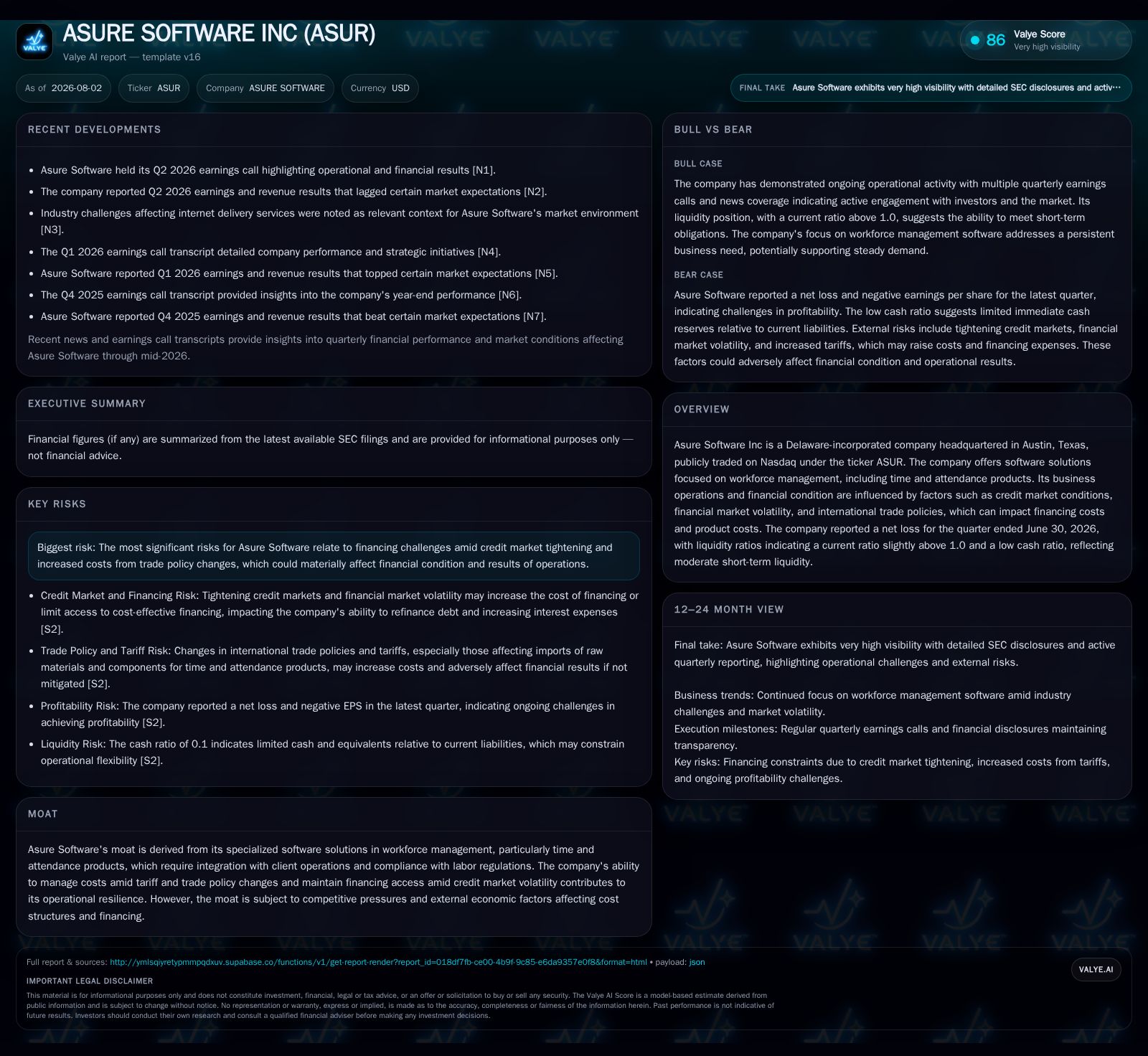
Asure Software Inc’s Q2 2026 financials reveal a continuation of net losses and tight liquidity despite incremental revenue momentum in its workforce management SaaS offerings. The company faces headwinds from volatile credit conditions and rising costs linked to international trade policies affecting its time and attendance hardware components. Asure’s subscription-focused business model relies on expanding and retaining recurring revenue, but elevated operating expenses and leverage constrain near-term financial flexibility. Monitoring ARR growth, retention metrics, and financing terms will be key to assessing execution progress.
Recent Operating Update
Business Model Overview
Asure Software operates primarily as a SaaS provider specializing in workforce management solutions encompassing time and attendance tracking paired with professional services for implementation and integration [S1]. Revenue generation hinges largely on subscription-based billing through annual or multi-year contracts that embed software licensing fees with ancillary support. Notably, the company supplements software sales with hardware components essential to some clientele's time tracking workflows. Hence, product viability intertwines not only with cloud service quality but also with supply chain stability for physical devices.
Recurring revenue streams from subscriptions yield predictable cash inflows when bolstered by high customer retention rates—a critical KPI in the sector [S1]. Customer acquisition costs can be substantial due to competitive market dynamics requiring sustained sales investments and shortened sales cycles to improve unit economics. Integration complexity also influences churn: solutions must plug into customers’ existing HR/payroll systems smoothly while remaining compliant with evolving labor regulations—a domain where Asure claims differentiation
Industry Structure and Competitive Position
The enterprise workforce management software industry is characterized by gradual substitution of on-premise legacy systems with cloud-based SaaS platforms offering superior scalability, mobile access, and analytics capabilities. Larger peers such as ADP, Kronos (Ultimate Kronos Group), Workday, Ceridian, and Ultimate Software provide broad HCM or payroll integrations alongside workforce management modules. These competitors benefit from substantial scale advantages, extensive ecosystems, and deeper R&D budgets.
Asure occupies a niche emphasizing sophisticated time and attendance products augmented by compliance features tailored to regulatory complexity—a moat stemming from technical integration barriers rather than broad platform breadth. However, its smaller scale limits pricing leverage relative to large incumbents, placing pressure on margins especially as raw material tariffs elevate hardware costs packaged alongside software services [S25][S27]. Managing this cost structure effectively while sustaining innovation cadence is crucial for competitiveness.
Growth Drivers
Structural industry tailwinds favor Asure's core capabilities: increasing demand for automated labor management emerges from enterprise quests for productivity gains amidst tighter workforce regulations. The shift towards remote work models necessitates flexible time tracking accessible via cloud-enabled devices—a transition potentially expanding addressable market size.
Integration of workforce management into comprehensive human capital management (HCM) suites presents upsell opportunities for Asure if it deepens interoperability with payroll/ERP systems. Furthermore, adoption of AI-powered analytics for workforce optimization could enhance product differentiation going forward.
New geographic markets represent incremental growth avenues though entail execution risks related to localization compliance. Additionally, growing enterprise attention on labor cost control should sustain demand for precision time attendance solutions amid competitive pricing pressures.
Risks and Constraints
Financing risk looms large due to Asure’s moderate liquidity position: the current ratio (~1.06) barely exceeds the minimum needed to cover near-term liabilities [F1]. Total debt approximated at $71.4 million against cash reserves of about $19.7 million reflects significant leverage that restricts flexibility [F1]. Covenants embedded in loan agreements limit dividend payments and capital deployment choices while potential credit tightening increases refinancing costs or restricts future borrowing capacity [S5][S6].
Externally induced cost inflation is another critical risk vector—recent U.S.-imposed tariffs plus global trade tensions have raised prices for components integral to Asure's hardware offerings bundled into its workforce management products [S25][S27]. Failure to pass these cost increases on or innovate sourcing solutions may erode gross margins further.
Competition from larger HCM providers capable of bundling payroll, benefits administration along with workforce management elevates customer churn risk if Asure fails to maintain feature parity or simplify integration pathways. Customer acquisition efficiency remains key given elongated sales cycles often observed in enterprise IT procurement.
Lastly, regulatory changes imposing new compliance mandates may require ongoing product investment just to maintain relevance rather than enable growth—pressuring earnings in the near term.
What to Watch Next
Key indicators to monitor include quarterly trends in annual recurring revenue (ARR), which would reflect success in subscription expansions or contractions; net retention rates as a measure of account health; and customer churn rates signaling competitive resilience.
Tracking billings versus recognized revenue provides early visibility into order momentum sustainability. Efficiency metrics such as customer acquisition cost (CAC) relative to lifetime value (LTV) will signal sales force productivity improvements.
Operational cadence around product launches integrating enhanced AI capabilities or mobile tools will be informative about the company’s ability to capture emerging workforce trends.
Financial Profile Discussion
At June 30, 2026, Asure Software held nearly $19.7 million in cash against total debt approximating $71.4 million resulting in net debt around $51.7 million [F1]. Current assets stood at approximately $221.8 million compared with current liabilities near $208.4 million yielding a current ratio slightly above one at 1.06—indicating marginal short-term liquidity coverage but limited cushion beyond obligations [F1].
The net loss incurred underscores structural profitability challenges as revenue growth has yet to consistently absorb fixed operating expenses highlighted over recent quarters [N2][S2]. While recurring revenue model traits support eventual margin expansion given scale efficiencies common within SaaS businesses across the sector, immediate operating leverage constraints persist.
Volatile credit market conditions contribute uncertainty around future refinancing terms translating into higher interest burdens or constrained access—an acute risk given restrictive loan covenants currently governing capital movements [S5][S6].
In sum, the company’s financial profile demands careful balancing of growth investments against prudent leverage management until clearer signs emerge of durable gross retention improvements coupled with expense rationalization.
This analysis is provided for informational purposes only and does not constitute investment advice.
Disclaimer: This is research-only, informational analysis and not investment advice. It may include AI-generated interpretation and general industry context. Always verify important details using primary sources.

Comments