
WesBanco’s Risk-Managed Growth and Margin Dynamics in Q2 2026
WesBanco’s Q2 2026 results reveal stable net interest margin expansion driven by disciplined loan growth and robust risk management amid macroeconomic uncertainties.
In its Q2 2026 filing, WesBanco demonstrated resilient earnings performance characterized by net interest margin improvement and balanced loan portfolio growth supported by focused credit quality controls. The company’s integrated enterprise risk management framework, including a multilayered cybersecurity program, underpins operational stability in a volatile interest rate environment. Meanwhile, disciplined deposit cost management and regulatory capital adequacy preserve financial flexibility, enabling prudent dividend policy discretion and strategic growth investments.
Q2 Results Reveal Key Shift in Interest Income Dynamics and Risk Posture
WesBanco's Q2 2026 financial disclosures reflect a key shift in net interest income dynamics, underscored by the fair value holdings of held-to-maturity debt securities totaling approximately $1.11 billion [S2]. This sizeable portfolio contributes to predictable interest revenue streams amid fluctuating rates. Complementing this asset base, the company’s net securities brokerage revenue increased marginally compared to prior periods, evidencing growing fee income from investment services that bolster earnings diversity [S2]. The net interest margin (NIM) benefited from loan yields outpacing deposit costs during this period—a critical profitability driver for regional banks—highlighting WesBanco’s ability to leverage favorable lending rates despite macroeconomic uncertainty [N1][N3]. This margin expansion is pivotal given the sensitivity of regional banks’ earnings to the interest rate environment.
Loan Portfolio Strategy Balances Growth with Credit Quality Discipline
The bank continues to execute a measured loan growth strategy tailored toward commercial loans, real estate loans, and consumer credit segments consistent with its historical focus detailed in the latest annual filing [S1]. The maintenance of a low non-performing assets ratio corroborates the company's judicious credit risk management amid regional economic fluctuations [S2]. WesBanco’s proactive monitoring reduces potential credit deterioration risks—a crucial consideration as economic cycles influence borrower repayment capacity. Lending decisions remain closely tied to underlying regional economic activity, balancing growth aspirations with credit quality preservation integral to long-term sustainability. This approach reflects an embedded enterprise risk governance structure ensuring robust oversight of lending practices [S1][S2].
Deposit Base Evolution Reflects Cost Management amidst Funding Competition
WesBanco’s deposit base shows steady size with disciplined control over the cost of deposits—an essential lever as regional banks face increasing competition for stable funding sources [F1][S2]. Effective liquidity management via customer deposits keeps financing costs contained relative to peer benchmarks. The company’s ability to attract and retain low-cost deposits supports net interest margin resilience and affirms solid franchise positioning within its core markets. Given the industry-wide tightness around deposit pricing, WesBanco’s demonstrated cost discipline mitigates margin compression risks common among similarly sized regional banks.
Enterprise Risk Management Anchors Cybersecurity and Operational Stability
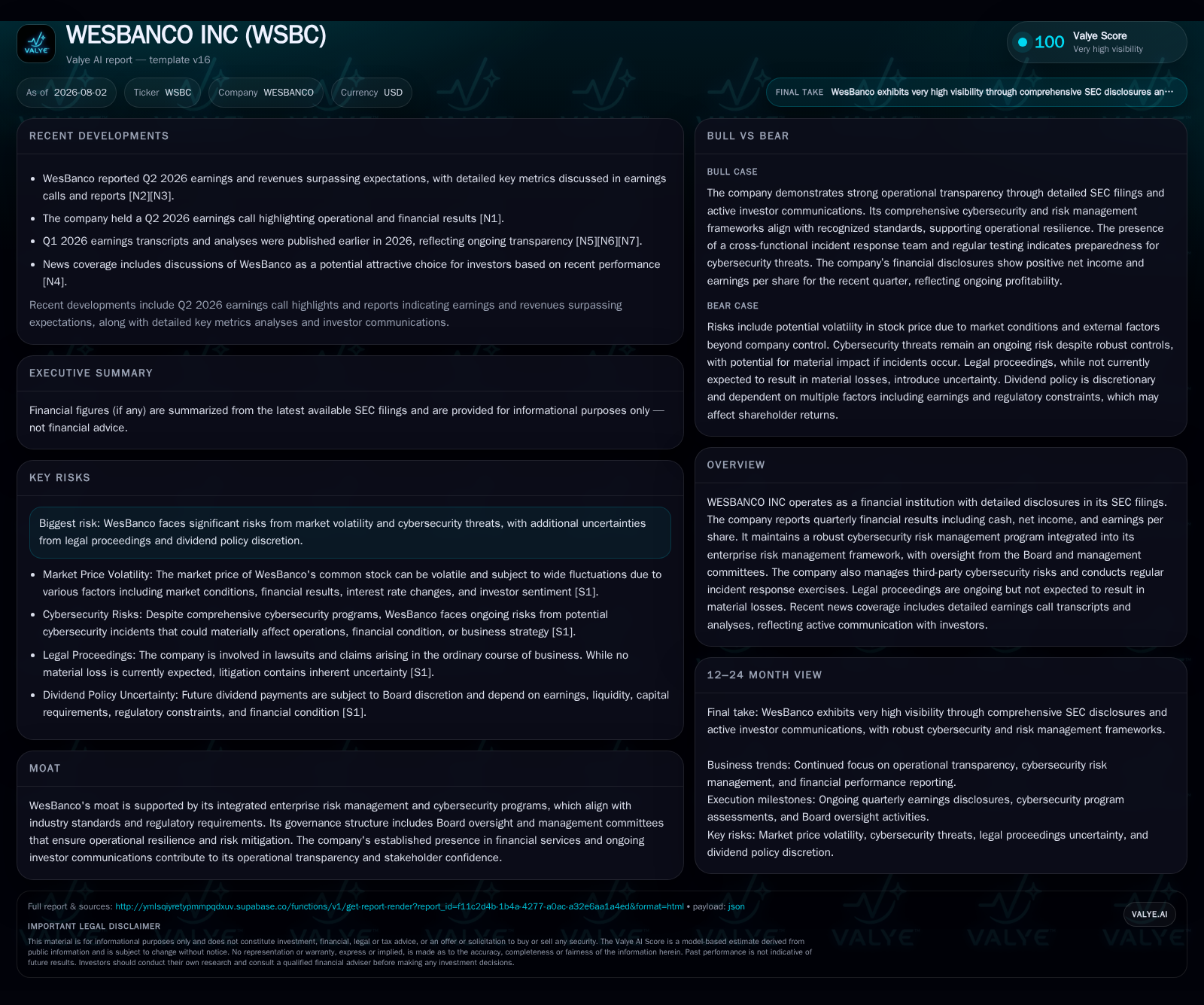
Embedded within WesBanco's governance is a comprehensive enterprise risk management (ERM) system that integrates cybersecurity as a core operational pillar [S1]. The company employs a cross-functional cybersecurity program designed to identify, prevent, and mitigate threats affecting customer platforms and internal processes. Partnering with third-party security providers enhances monitoring capabilities and incident response readiness—imperative safeguards against rising cyber risks prevalent throughout financial services. This integrated ERM approach provides WesBanco with a qualitative moat enhancing operational resilience relative to many regional peers who may lack equivalent sophistication in cyber risk management.
Capital Framework Drives Dividend Policy Flexibility Amid Regulatory Scrutiny
WesBanco maintains regulatory capital levels that afford prudent dividend policy discretion according to board evaluations considering earnings stability, liquidity needs, and regulatory constraints [S1]. This flexibility permits balancing shareholder returns against mandated capital buffers critical for absorbing shocks in volatile markets. Regulatory compliance remains aligned with industry standards ensuring capital adequacy ratios withstand stress scenarios. Dividend policy discretion thus emerges not only as a tool for shareholder value return but also as a buffer supporting strategic investments while navigating cyclical uncertainties.
Growth Opportunities Linked to Mortgage Banking Plus Regional Economic Trends
Non-interest income contributions from mortgage banking activities and securities brokerage fees have registered modest increases, enhancing overall revenue stability beyond traditional lending [S2][N1]. These streams offer growth pathways less sensitive to interest rate fluctuations while serving diverse client needs across wealth management and home financing. Economic trends in WesBanco’s geographic footprint—primarily regional markets—further underpin demand for these services. Expansion in mortgage banking particularly responds to sustained housing market activity locally, potentially driving fee income growth that supports earnings consistency.
Risks Focused on Credit Exposure, Interest Rate Volatility, and Regulatory Environment
Key risks outlined include potential credit deterioration caused by borrower defaults or worsening loan quality associated with economic downturns [S1][S2]. Interest rate volatility remains an ongoing challenge as it directly impacts net interest margin through funding cost fluctuations and asset yield compression. Legal proceedings currently pending do not represent material loss expectations but inject typical financial service sector litigation uncertainty [S1]. Additionally, competition from fintech firms offering alternative financial solutions introduces longer-term competitive pressures.
Indicators To Monitor Include Loan Performance Metrics, Capital Ratios, and Fee Income Trends
Future operating developments merit close observation around several KPIs: movements in non-performing assets ratio will elucidate emerging credit trends; capital adequacy ratios will indicate robustness of buffers supporting dividends and growth; trends in mortgage banking fees signal diversification success beyond core lending; finally, continuing net interest margin trajectories will confirm pricing power amid evolving funding costs [S2][N1][N3]
Financial Profile Discussion: Current Liquidity, Debt Position, and Earnings Snapshot
This analysis synthesizes available filings through Q2 2026 alongside recent news insights to highlight how WesBanco leverages integrated risk frameworks with balanced franchise growth in managing economic cyclicality. Investors should continue tracking key operating KPIs reflecting loan performance quality and capital sufficiency to assess resilience amid evolving sector challenges. No investment research views are offered herein.
Disclaimer: This is research-only, informational analysis and not investment advice. It may include AI-generated interpretation and general industry context. Always verify important details using primary sources.

Comments