
Coinbase’s Expanding Everything Exchange Faces Volatility and Regulatory Complexity
Recent quarterly results highlight Coinbase’s broadening product suite amidst fluctuating crypto market conditions and ongoing regulatory scrutiny.
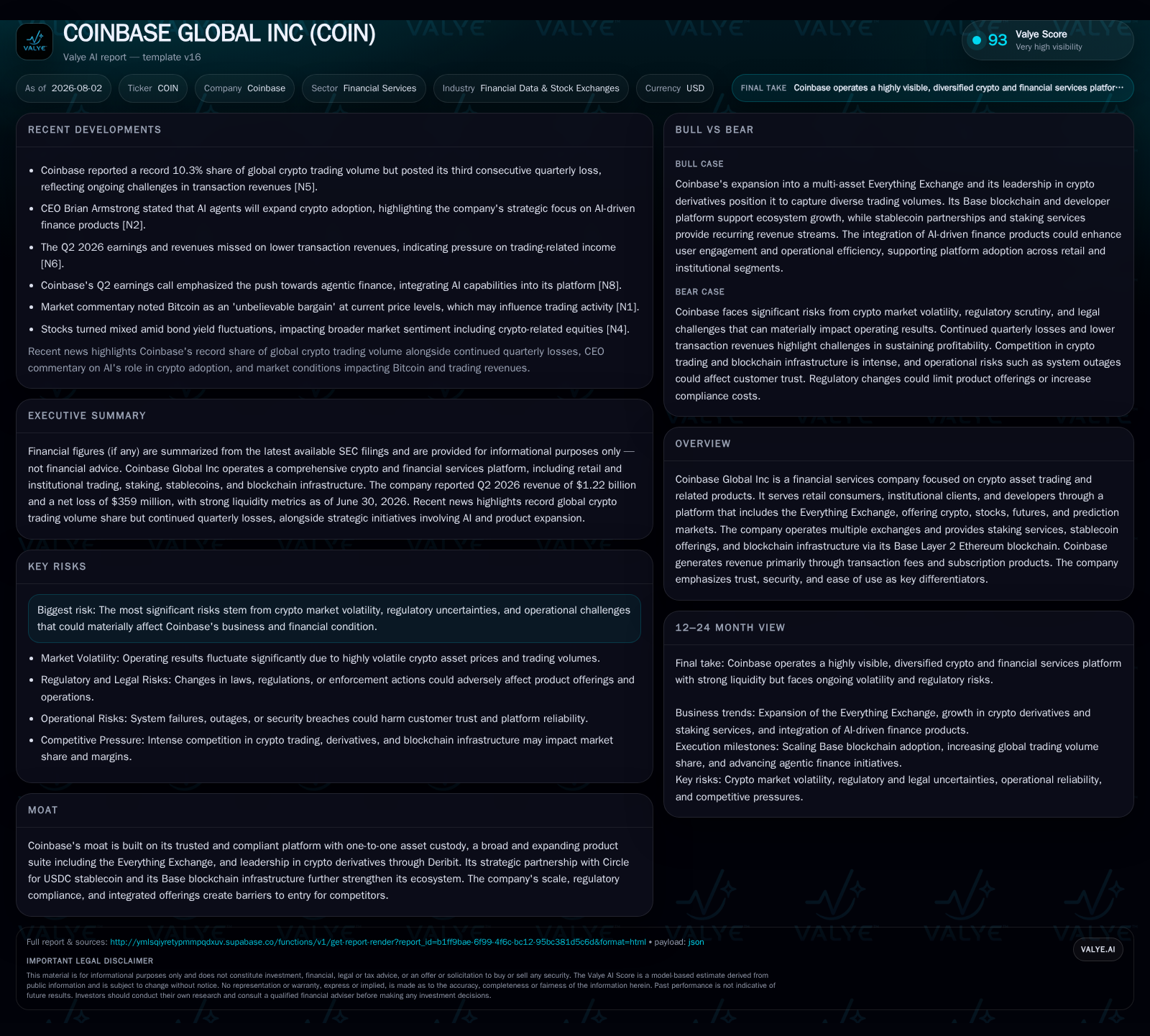
Coinbase Global Inc continues to evolve its platform into the 'Everything Exchange,' expanding beyond crypto spot trading to include stocks, futures, and prediction markets. The company's latest quarter reveals persistent volatility in transaction revenue driven by fluctuating trading volumes amid crypto market turbulence. Despite record share gains in global crypto trading, regulatory uncertainties and operational risks remain key challenges. Coinbase’s diversified product offerings, blockchain infrastructure initiatives, and strategic partnerships support long-term growth prospects, but execution and market dynamics will be critical near-term indicators.
Recent Operating Update
Coinbase’s Q2 2026 results confirmed continued challenges from the highly volatile crypto market environment that affected its core transaction revenue streams despite a record share gain in global crypto trading volume. Transaction revenue declined as trading volumes softened compared to prior periods reflecting broader cryptocurrency price fluctuations and investor sentiment shifts [S2][N1][N9]. This trend underscores the significant sensitivity of Coinbase’s primary revenue drivers — trading activity across crypto assets — which remains exposed to unpredictable price swings common in this sector. Nonetheless, the company emphasized steady advances in subscription revenue lines linked to products like stablecoins and staking services [S2], signaling diversification progress.
The quarter also saw Coinbase highlight its strategic push towards agentic finance using AI tools designed to streamline user decision-making within crypto finance — a potential lever for future engagement and monetization expansion [N2][N5]. These innovations accompany Coinbase's gradual transformation into what management terms the "Everything Exchange," substantially growing beyond pure crypto spot trading into equities, commodity futures, perpetual futures, and prediction markets since late 2025 [S1]. The expansion aims to unify disparate digital asset classes under one platform accessible by varied customer segments.
Business Model
Coinbase primarily monetizes by charging transaction fees on a wide array of traded products: spot cryptocurrency trades, derivatives including perpetual futures via partnerships like Deribit, traditional stocks, commodity futures, and nascent prediction markets all executed through either simple or advanced trading interfaces tailored respectively to retail consumers or sophisticated institutional traders [S1]. This fee structure means revenue scales with total volume traded but is also influenced by mix — higher-margin derivatives or subscription services (e.g., staking or stablecoin transactions) offer better margin profiles than basic spot trades.
Its consumer base encompasses retail users seeking intuitive access to crypto and traditional financial products alongside institutional clients requiring custody and trading tools compliant with regulations. A third critical group consists of developers utilizing Coinbase’s Base Layer 2 Ethereum blockchain infrastructure for building decentralized applications or scaling crypto-enabled product offerings [S1]. This triad represents differentiated end markets with distinct monetization mechanics: retail/user trading fees driven by high-frequency volume; institutional contracts potentially involving tiered pricing or dedicated service agreements; developer subscriptions often based on API usage or blockchain resource consumption.
Trust serves as a cornerstone of Coinbase’s value proposition — it maintains strict one-to-one asset custody ensuring every customer-held asset on the platform corresponds fully to real reserves under its control. This approach bolsters security perceptions among users increasingly wary of exchange insolvencies or hacks. Additionally, extensive regulatory compliance efforts position Coinbase as a less risky venue relative to some competitors lacking U.S. licenses or transparency standards [S1].
Industry Structure and Competitive Position
Coinbase operates within a competitive centralized exchange landscape alongside large entities such as Binance (global multi-asset exchange with broad derivatives), Kraken (noted for compliance rigor), Deribit (derivatives specialty), Circle (stablecoin issuer), and traditional futures venues like CME Group expanding their crypto footprint. Its competitive moat centers on regulatory trustworthiness combined with ecosystem breadth: not just offering spot crypto but also integrating derivatives, traditional financial instruments, staking services, stablecoins (notably USDC via partnership with Circle), and Base blockchain infrastructure.[S1]
Liquidity depth across multiple order books enables favorable trade execution for users while product breadth reduces client attrition risk by consolidating activities on one platform rather than fragmenting across specialized providers. Yet competition remains intense from decentralized exchanges (DEXs) gaining traction for permissionless access models; these represent a latent structural threat should regulatory regimes evolve unfavorably toward centralized custodians.
Growth Drivers
Multiple vectors support Coinbase’s growth trajectory:
Asset Class Expansion: The shift to an Everything Exchange unlocks incremental customer segments—retail users looking for diversified portfolios involving stocks or commodities alongside cryptos; institutional traders demanding integrated risk management across derivative products; developers seeking scalable blockchain environments.
Institutional Adoption: Growth in institutional crypto investing drives demand for custody solutions and sophisticated derivatives trading desks accessible via Coinbase’s regulated platform.
Blockchain Infrastructure: Base Layer 2 Ethereum rollout enhances developer ecosystem engagement fueling subscription revenues tied to onchain activity.
Subscription Products: Stablecoins (USDC) usage rise coupled with staking services generates recurring revenue sources less sensitive to spot market volatility.
Technological Innovation: AI agentic finance initiatives aim to reduce friction in onboarding/trading processes thereby accelerating user acquisition/retention.
Regulatory Clarity: Ongoing dialogue with regulators may expand permissible product offerings enhancing addressable markets.
These drivers converge on relevant KPIs including active user counts across segments, average revenue per user (ARPU), subscription revenues mix relative to transactional fees, custody assets growth indicating locked-in balances generating fee opportunities, plus platform reliability metrics critical for user confidence.
Risks and Watchpoints
Coinbase faces multiple interrelated risks that could constrain growth or depress profitability:
Market Volatility: Crypto price swings materially impact trading volume-dependent revenue causing unpredictable quarterly earnings fluctuations that complicate planning [S1]
Regulatory Uncertainty: Active investigations concerning asset listings classification, staking programs compliance issues, stablecoin operations pose ongoing legal risks; adverse rulings could force product restrictions or fines impacting operations [S1][S2].
Security Threats: As a custodian holding large crypto asset pools directly affects reputation if breaches occur; platform outages undermine customer trust leading to attrition.
Competition from DEXs: Decentralized platforms may erode market share particularly among developer-savvy users unwilling to accept custodial risk.
Operational Complexity: Integrating broadened asset classes requires managing diverse regulatory regimes globally alongside scalable technology infrastructure ensuring uptime amid surging volumes.
Macro Factors: Interest rate movements affecting capital costs as well as broader economic downturns impact investor appetite for speculative assets directly influencing core transaction revenues.
Monitoring shifts in regulatory landscapes especially U.S. policy developments affecting crypto derivatives or custody frameworks is crucial alongside trending metrics like global trading volume share changes versus peer platforms.
What To Watch Next
Critical near-term milestones include:
- Progress indicators in subscription-based revenue growth revealing material diversification away from volatile transaction fees.
- User engagement metrics segmented by retail versus institutional customers demonstrating balanced ecosystem strengthening.
- Updates on regulatory inquiries outcomes guiding potential restrictions or expansions of product suites.
- Adoption rates of AI-driven agentic finance functionalities reflecting how innovation translates into higher retention or ARPU.
- Development milestones for Base blockchain ecosystem illustrating traction among developer clients supporting long-term infrastructure plays.
- Quarterly volatility patterns in trade volumes post recent dips gauging whether recovery trajectories align with optimistic outlooks for digital asset adoption expansion.
Financial Profile Discussion
As of June 30, 2026, Coinbase held $8.61 billion in cash and equivalents providing substantial liquidity buffer amid a fast-evolving marketplace vulnerable to shocks [F1]. With current assets totaling approximately $17.5 billion against current liabilities near $7.22 billion, the company reports a strong current ratio of about 2.42, signaling healthy short-term financial flexibility supportive of continued investment spending and operational needs [F1]. While total debt stood around $7.28 billion at end 2025, the net debt position was negative $1.34 billion, reflecting a net cash position when factoring cash reserves and suggesting manageable leverage levels [F1].
Given the episodic nature of earnings tied closely to trade volumes subject to market swings, management faces challenges forecasting precise quarterly results but the cash-rich balance sheet places it well-positioned to weather cycles while pursuing strategic investments in technology innovation and ecosystem buildout [S2][F1]
This analysis is based exclusively on publicly available SEC filings dated up through July 30, 2026 ([S1], [S2], [S3]), Nasdaq news commentary ([N1]–[N9]), and standard industry knowledge regarding cryptocurrency trading platforms. It does not constitute investment advice nor predict future performance but provides an informed perspective suitable for internal research use.
Disclaimer: This is research-only, informational analysis and not investment advice. It may include AI-generated interpretation and general industry context. Always verify important details using primary sources.

Comments