
Boyd Gaming’s Integrated Casino Model Advances Amid Operational and Regulatory Challenges
Latest quarterly results highlight steady casino and hospitality revenues amid ongoing cybersecurity and liquidity risk management.
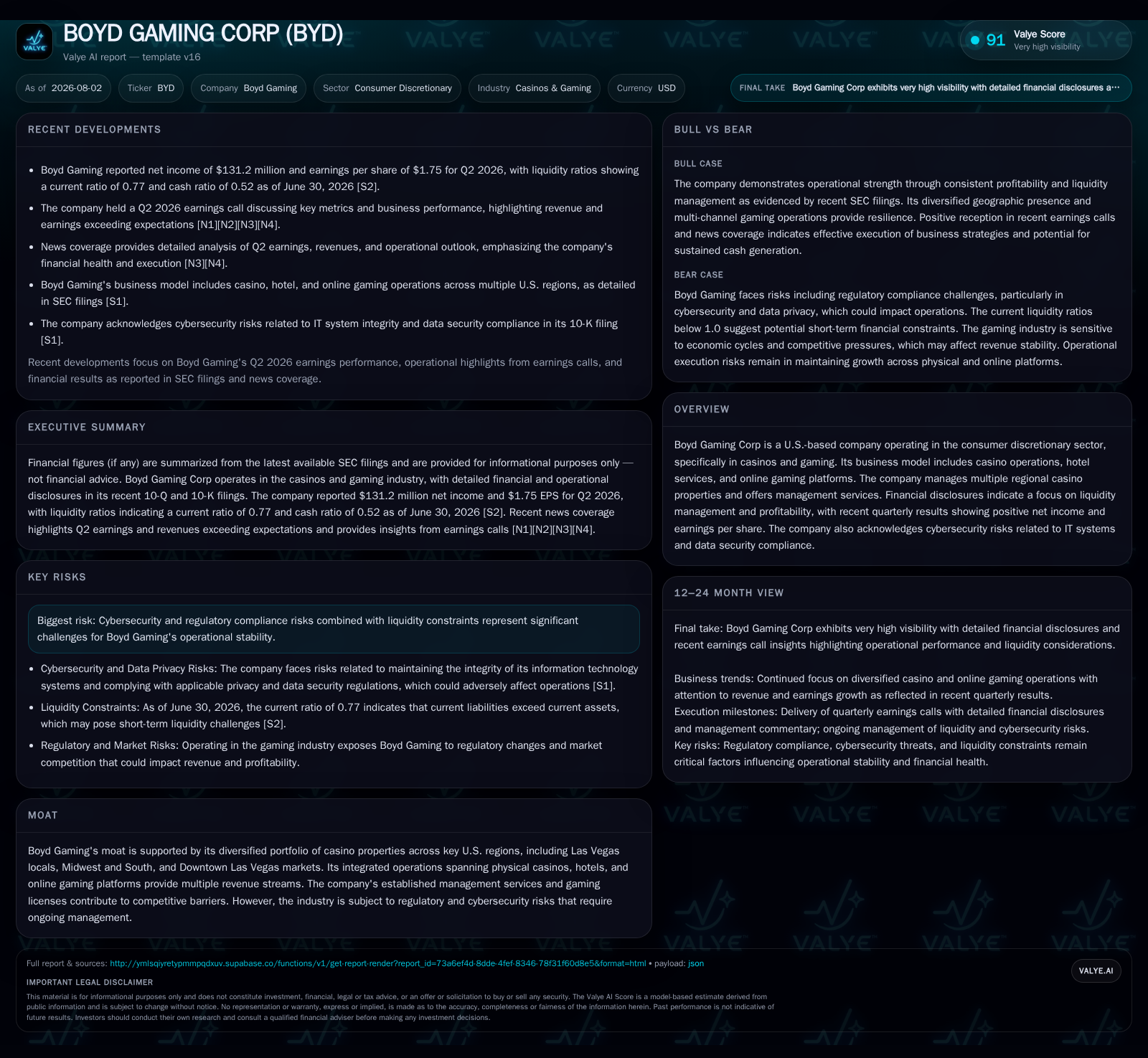
Boyd Gaming Corp reported solid second-quarter 2026 results anchored by its diversified portfolio of casino resorts, hotels, and online gaming platforms. The company benefits from geographic diversification across Las Vegas locals, Downtown Las Vegas, Midwest, and Southern U.S. markets, supporting stable gaming revenue streams and hospitality services. However, regulatory compliance and cybersecurity risks remain material challenges in the evolving gaming landscape. Boyd's liquidity position shows a moderate current ratio with high leverage typical for capital-intensive casino operators. Growth appears tied to integrating online gaming expansion and effective management of operational costs.
Recent Operating Update
Furthermore, Boyd continues to emphasize prudent liquidity management given the capital-intensive nature of casino operations. Its Q2 disclosures reflect a manageable working capital profile but a current ratio under unity (0.77), signaling that short-term liabilities exceed readily available assets as of June 30, 2026 — a common scenario in this sector due to timing of receivables and payable cycles [F1]. The company holds roughly $323 million in cash equivalents against total debt exceeding $2 billion measured at year-end 2025 [F1]. Despite this leverage level typical of large gaming operators requiring significant fixed asset investments, Boyd maintains covenants that mandate deleveraging schedules tied to EBITDA coverage ratios per its credit facilities [S15].
Business Model Specifics
Boyd Gaming’s business model spans three primary revenue components: physical casino operations including slot machines and table games; hospitality services encompassing hotel rooms and food & beverage outlets; and digital channels via online gaming platforms [S1]. The company monetizes these through direct customer spending on gaming floors facilitated by extensive customer loyalty programs designed to increase visitation frequency and spend per customer. Revenue mechanics rely heavily on gross gaming revenue (GGR) derived from casino floors combined with net revenue per available room (RevPAR) capturing hotel performance nuances.
Management services form a secondary but strategic source of income whereby Boyd leverages its licensed expertise to run third-party properties under contractual agreements creating fee income insulated somewhat from direct gaming volatility [S1]. This diversification is structurally important given the intensive regulatory oversight applied to gaming licenses which represent significant competitive barriers to entry.
Cost dynamics are shaped by high fixed expenses inherent in property maintenance, labor costs especially in food & beverage segments, gaming taxes levied by various state jurisdictions, as well as marketing outlays linked to loyalty programs. Capital expenditures remain elevated due to ongoing property refurbishments and technology system enhancements aimed at improving customer experience both onsite and via digital channels [S1].
Industry Structure and Competitive Positioning
The U.S. casinos and gaming industry is highly regulated across federal and state levels with licensing requirements constraining new entrants while shaping competitive dynamics among existing players [S9][S28]. Boyd Gaming occupies the integrated casino resort operator position along the value chain — managing the entire customer experience from interactive gaming floors to comprehensive hospitality offerings plus online platforms creating multiple touchpoints for engagement.
Peers such as MGM Resorts International and Caesars Entertainment parallel Boyd's scale in integrated resorts but tend toward more resort-centric or luxury-focused products including full-scale entertainment complexes. Meanwhile regional operators like Penn National Gaming compete more directly with Boyd’s footprint emphasizing local market dominance over luxury positioning. Online-focused peers such as DraftKings highlight the growing segment importance but currently constitute a smaller portion of traditional casino operators’ revenue pools.
Boyd’s strength lies in its regional diversification strategy across Las Vegas locals—a segment known for resilient local patronage—and expanding presence in Midwest/South markets which face fewer tourism fluctuations than destination resorts. Additionally, management service contracts deepen competitive moats by leveraging regulated licenses that restrict competitor access easily replicable elsewhere.
Growth Drivers
The primary growth vectors for Boyd include expanding its online gaming offerings coupled with sports betting integration as jurisdictions liberalize regulatory frameworks—a trend accelerating industry digital adoption rates [S1]. Enhancements in customer loyalty programs aimed at increasing repeat visitation and cross-property spending underpin broader revenue expansion opportunities.
Tourism recovery post-pandemic continues bolstering hotel occupancy rates especially within Las Vegas markets complemented by modest ADR improvements driven by targeted marketing strategies aligned with consumer discretionary rebound cycles. Strategic property renovations maintain fresh amenities attracting higher-spend clientele while diversifying entertainment options shield against purely gaming-driven competition.
Moreover, Boyd pursues selective acquisitions or new management service agreements extending its geographical reach without immediate capital-heavy expansion—a capital-efficient pathway supporting cash conversion sustainability amidst high capex needs elsewhere.
Risks and Watchpoints
Regulatory compliance remains paramount with changing state-level legislation impacting licensing fees, tax structures, and permissible game types requiring agile operational adjustments to avoid sanctions or license revocations [S9][S28]. Cybersecurity risks escalate alongside rising reliance on IT systems throughout physical casinos and online platforms exposing sensitive data—requiring continuous investment in defense capabilities given potential reputational damage or operational outages [S1][S9].
Liquidity constraints linked to elevated leverage levels pose medium-term refinancing risks particularly if economic headwinds suppress discretionary spending leading to EBITDA contraction affecting covenant thresholds within credit facilities [F1][S15]. Capital expenditure demands necessitate disciplined allocation choices balancing growth initiatives versus maintenance obligations.
Monitoring quarterly KPIs such as gross gaming revenue fluctuations—especially slot machine handle trends—and hotel RevPAR changes provides early indication of demand shifts affecting earnings momentum. Additionally, tracking enhancements or setbacks in online active user engagement signals success in digital transformation efforts underpinning future scaling potential.
What to Watch Next
Near-term analysis should focus on quarterly gross gaming revenue segmented by geographic region revealing resilience or softening amid macroeconomic variables including inflationary pressures on consumer leisure budgets. Hotel occupancy rate trends aligned with average daily rate (ADR) shifts will clarify hospitality segment pricing power trajectory.
Online platform usage metrics—though not explicitly disclosed—are crucial forward indicators often discussed during earnings calls providing qualitative insights into digital adoption curves. Debt reduction progress measured against leverage targets dictated by credit agreement covenants will signal financial flexibility while cybersecurity incident disclosures or risk mitigations will shed light on operational risk management effectiveness.
Upcoming updates on strategic acquisitions or new management contracts would further indicate Boyd’s commitment to leveraging both organic growth levers plus external optionality amidst industry consolidation dynamics.
Financial Profile Discussion
As of June 30, 2026 Boyd Gaming reported cash and cash equivalents totaling approximately $322.7 million juxtaposed against current liabilities near $623 million resulting in a current ratio near 0.77—a common characteristic reflective of timing mismatches between short-term receivables inflows versus payables outflows for large-scale operators in this capital-heavy sector [F1]. Total debt stood around $2.06 billion at year-end 2025 highlighting material leverage consistent with significant fixed asset bases requiring ongoing depreciation expense recognition alongside capital reinvestment needs [F1]. Net debt approximates $1.74 billion after adjusting for cash balances reflecting financial commitments carrying potential refinancing implications contingent upon EBITDA coverage ratios stipulated within loan covenants [F1][S15].
Operating margins benefit from diversified revenue streams but remain subject to margin pressure from labor inflation, increased cybersecurity expenditures, rising gaming tax rates in certain states, and marketing investments directed at retaining customer loyalty amidst intensifying competition [S2][S9]
Liquidity management strategies incorporating revolving credit facility options alongside scheduled term loan amortizations structured progressively through fiscal years provide a blueprint for orderly deleveraging consistent with recent refinancing activity reaffirming lender confidence in Boyd's credit profile despite the intrinsic cyclical nature of consumer discretionary spending relevant to gambling venues [S15]
This analysis synthesizes publicly filed SEC documents up through Q2 2026 augmented by recent earnings call commentary without supplying investment opinions or forward-looking forecasts. It aims to elucidate operational nuances unique to Boyd Gaming situated within the highly regulated U.S. casinos and gaming industry characterized by capital intensity combined with evolving cybersecurity challenges.
Disclaimer: This is research-only, informational analysis and not investment advice. It may include AI-generated interpretation and general industry context. Always verify important details using primary sources.

Comments