
EShallGo Inc. Advances Equipment-Led Growth While Maintenance Revenues Contract
Two consecutive registered direct offerings bolster EShallGo’s liquidity as equipment sales surge amid declining maintenance revenues and persistent pricing pressures.
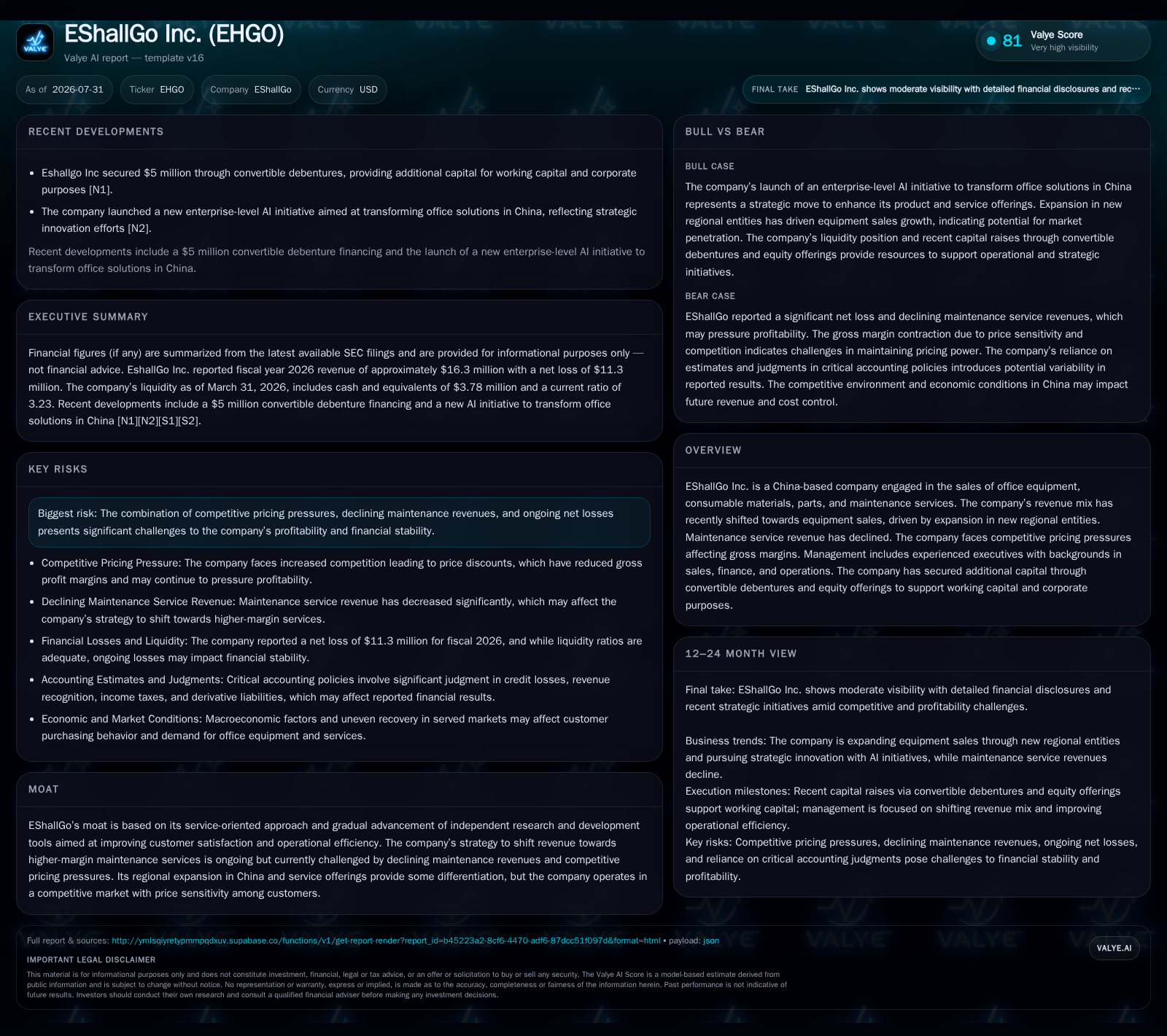
EShallGo's recent quarter highlights a strategic pivot with equipment sales increasingly fueling revenue growth while maintenance service income continues to shrink, pressuring gross margins and overall profitability. The company raised about $2.2 million through two registered direct offerings in late June and early July 2026, underscoring reliance on equity capital to support working capital amid ongoing operating losses. Regional expansion in China contributes volume but strains operational efficiency, while competitive pricing challenges across equipment and services undermine margin recovery efforts. Management’s service-oriented direction supported by R&D investment faces headwinds as maintenance revenues decline, raising execution and profitability risks.
Recent Capital Raises Address Liquidity Amid Margin Pressures
In the last week of June and first day of July 2026, EShallGo completed two registered direct offerings raising approximately $2.2 million in gross proceeds by issuing Class A ordinary shares and pre-funded warrants at prices of $3.25 and $1.00 per share respectively [S2][S3]. These transactions were underwritten exclusively by Univest Securities with a 7% placement fee plus legal expense reimbursements, indicating financing costs that add pressure on net proceeds [S2][S3]. The company allocated these funds primarily for working capital and general corporate purposes, signaling ongoing liquidity demands driven by persistent operating losses and competitive market dynamics [N1][S2]. The rapid sequence of offerings reflects urgency in extending cash runway amid margin headwinds.
Equipment Sales Growth Masks Declining Maintenance Revenues Impacting Margins
Maintenance services typically provide steadier cash flows and enhance customer retention through contract renewals, which also supports parts replacement revenue streams. The contraction in this segment raises concerns about revenue quality and earnings durability until service penetration improves or pricing power recovers. This pattern is consistent with industry peers where managed services stabilize earnings compared to pure equipment vendors.
Competitive Pricing Pressures Limit Profitability Across Product Lines
Operating mainly within China’s highly competitive office equipment distribution market exposes EShallGo to intense pricing pressure that compresses average selling prices (ASPs) across hardware, consumables, and parts replacement products [S1][F1]. Rising input costs from inflationary labor expenses and inventory procurement exacerbate cost-of-goods-sold (COGS) challenges despite efforts to improve operational efficiency [S1].
Parts replacement—a critical segment supporting both equipment sales and maintenance contracts—is vulnerable to commoditization trends prevalent among mid-tier peers such as Canon or Ricoh. Without significant scale advantages or technological differentiation, sustaining pricing power remains difficult.
Regional Expansion Drives Volume but Increases Operational Complexity
EShallGo’s geographic expansion across multiple Chinese regions has boosted equipment sales volumes but introduced greater operational complexity including logistics decentralization, staffing challenges, and competition variations by locality [S1]. While expanding customer reach may enhance cross-selling opportunities for consumables and improve retention potential, it also raises administrative overheads impacting operating expense ratios.
Labor cost inflation coupled with difficulties retaining skilled technical staff may delay service response times—an important factor for customer satisfaction critical to converting equipment buyers into maintenance contract clients. This challenge aligns with experiences of regional operators scaling without fully integrated infrastructure.
Service-Oriented Strategy Supported by R&D Faces Execution Challenges
Management aims to transition from a traditional sales-led model toward a more comprehensive service-oriented approach leveraging independent research and development tools intended to enhance customer satisfaction and operational efficiency [S1][S26]. Research and development expenses increased modestly to about 0.6% of revenue but have yet to reverse the decline in maintenance service revenues [S6][S26].
This gap highlights execution risk inherent in evolving business models amid competitive pressures; success will depend on improving renewal rates for service contracts which underpin margin expansion over time.
Risks: Macroeconomic Uncertainty, Price Sensitivity, Internal Controls Weaknesses
The company faces external risks including a slowing Chinese economy compounded by geopolitical tensions, factors that could reduce discretionary corporate spending on office infrastructure upgrades including new equipment purchases and contracted services [S1]. Price competition combined with limited ability to pass through cost increases poses ongoing threats to profitability.
On the governance front, material weaknesses persist in internal control over financial reporting related primarily to inadequate U.S. GAAP expertise among accounting staff and IT security controls around logical access [S1]. Management plans remedial actions such as hiring experienced personnel; however these issues increase investor risk regarding financial statement reliability alongside operational challenges.
Additionally, labor retention difficulties for skilled technicians create operational risks that could degrade service quality—critical for boosting maintenance revenue penetration.
Outlook: Key Milestones To Monitor Execution Progress
Investors should watch quarterly updates for signs that maintenance service revenues stabilize or recover alongside sustained top-line growth post-regional expansion efforts [S2][S3]. Improvements in gross margins would indicate successful pricing or cost control initiatives.
Progress on remediation of internal control weaknesses will also be important given their implications for financial reporting integrity. Given recent reliance on equity raises for liquidity support, future financing activity will provide insight into market confidence in the company’s turnaround prospects [N1].[N1]
Improved service contract renewal rates reflecting enhanced customer satisfaction would be a positive indication; conversely continued large net losses would signal persistent challenges.
Financial Profile Discussion: Solid Liquidity Backed by Equity Raises Amid Operating Losses
The recent registered direct offerings augment cash reserves but underscore dependence on external equity financing absent positive operating cash flow generation. Reduced convertible debt balances following repayments suggest some deleveraging; however sustained net losses raise questions about long-term capital raising feasibility without clear profit improvements.
In summary, EShallGo navigates a pivotal phase balancing volume-driven growth against margin compression fueled by shifts in revenue mix amid challenging market conditions compounded by internal control remediation needs.
Disclaimer: This is research-only, informational analysis and not investment advice. It may include AI-generated interpretation and general industry context. Always verify important details using primary sources.

Comments