
Robot Consulting’s Revenue Shift Highlights Subsidy Dependency and Outsourcing Tradeoffs
The company’s fiscal 2026 results show strong software sales growth offset by consulting declines amid subsidy sensitivities and rising SG&A costs.
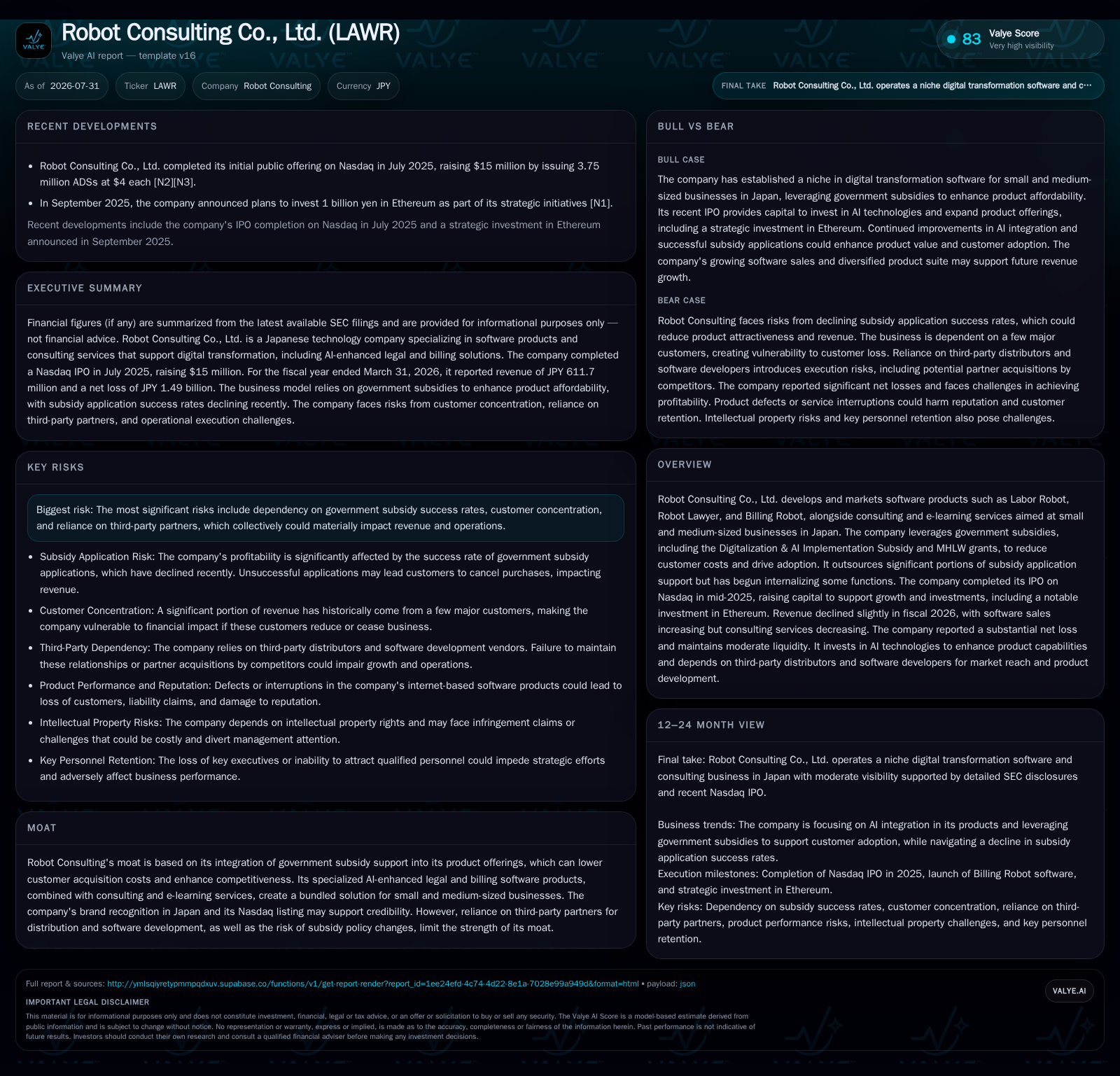
Robot Consulting Co., Ltd. reported a 9.5% revenue decrease in fiscal 2026 driven by a near 40% drop in consulting and support services, despite a 95% surge in software product sales propelled by its new Billing Robot launch [S1]. Its business model hinges on leveraging Japanese government subsidies to reduce customer acquisition costs, yet subsidy application success rates have declined and outsourcing for subsidy consulting remains significant, affecting margins. The firm is navigating increased SG&A expenses from IPO-related costs and outsourcing, while aggressively investing in AI-powered offerings. Financially, the company maintains moderate liquidity but reported a substantial net loss of approximately JPY1.49 billion for the year [F1]. Key risks include subsidy policy changes, customer concentration, and execution challenges as it seeks to internalize outsourced functions.
Recent Operating Developments
Robot Consulting Co., Ltd.’s latest fiscal year ended March 31, 2026, revealed notable shifts in its operating performance that sharpen the picture of its evolving business model and associated risks. Total revenue declined by 9.5% year-over-year to JPY611.7 million (approximately $3.85 million), trailing a substantial rebound in software sales against an outsized contraction in consulting and support services [S1]. This dynamic underscores the company's pivot toward scalable SaaS product monetization alongside challenges inherent in its consulting-heavy legacy segment.
The introduction and commercial launch of Billing Robot during this period drove a vigorous 95.1% increase in software revenue to nearly JPY294.5 million, reflecting strong market reception for this AI-enhanced billing automation solution tailored for Japanese SMEs [S1]. However, consulting revenue dropped by almost 40%, primarily because fewer customers engaged with its e-learning programs and the discontinuation of higher-margin e-commerce store set-up service lines depriving the top line and compressing gross profit contribution from these segments [S1]. This mixed performance indicates both growth potential from disruptive products and pressure on traditional service lines that may warrant strategic reassessment.
Cost of revenue more than doubled to approximately JPY8.76 million driven by higher expenditures associated with subsidy application consulting services related to the Digitalization & AI Implementation Subsidy sponsored by Japan's Ministry of Economy, Trade and Industry (METI) [S1]. This subsidy integration underpins the firm's go-to-market approach by materially lowering customer acquisition costs yet imposes operational complexities due to outsourced processes that bear substantial cost load relative to revenue.
SG&A expenses escalated sharply by about 86%, reaching JPY2.08 billion, fueled predominantly by increased outsourcing fees, public company advertising outlays post-Nasdaq IPO, and stock-based compensation recognized upon listing completion mid-2025 [S1]. The rise in overhead dilutes operating leverage potential—a critical factor for SaaS firms targeting scalable profitability through efficient customer acquisition and retention dynamics.
Interestingly, research and development expenses vanished compared with the prior fiscal year total of JPY86 million, reflecting completed investment phases for core products like Robot Lawyer and Billing Robot [S1]. This absence suggests a transitional lull in active R&D spending but raises questions about sustaining innovation momentum amid rapid technological shifts in AI software markets.
Business Model Specifics
Robot Consulting operates at the intersection of AI-powered SaaS solutions and specialized consulting/e-learning services tailored mainly for small-to-medium enterprises (SMEs) within Japan—a group increasingly embracing digital transformation initiatives yet sensitive to upfront technology adoption costs.
Its portfolio includes Labor Robot (labor management), Robot Lawyer (legal consultation chatbot), Billing Robot (billing automation), complemented by consulting support particularly aimed at helping clients successfully access government subsidies such as METI's Digitalization & AI Implementation Subsidy and grants from the Ministry of Health, Labour and Welfare (MHLW) for e-learning programs [S1]. These subsidies serve as vital levers reducing effective pricing for customers, thereby lowering Customer Acquisition Cost (CAC) substantially compared to peers lacking such integrated subsidy facilitation.
Sales channels mix direct sales with significant engagement via third-party distributors like Nac; however, the company obtains lower margins on sales routed through partners than on direct transactions due to revenue-sharing agreements [S1]. Furthermore, the firm outsources much of its subsidy application consulting workload but is beginning to internalize certain functions aiming at better cost control and quality oversight—a balance that affects both operating expense structure and service delivery credibility.
Revenue mechanics rest on a combination of one-time license fees for products like Labor Robot—primarily sold as single purchases ranging between approximately JPY3 million–JPY5 million—and recurring usage fees from newer offerings including Billing Robot's pay-as-you-go consumption model with partners like Infurcion generating contractual usage-based income streams [S10]. Consulting revenues are largely variable based on successful subsidy applications where fees often depend on contingency arrangements tied to actual subsidies granted, embedding inherent revenue volatility linked directly to government policy execution outcomes.
Industry Structure and Competitive Position
As a Japanese SaaS operator specializing in AI-integrated legal, billing, and labor management applications complemented by bundled consultancy leveraging governmental subsidies, Robot Consulting occupies a niche within the broader software-as-a-service ecosystem traditionally dominated by enterprise-grade global providers like Salesforce or Atlassian focusing on CRM or collaboration tools.
Its moat chiefly derives from embedding direct government subsidy facilitation into its go-to-market strategy—a compelling differentiator that can materially reduce CAC for price-sensitive SME customers while enhancing value proposition beyond standalone software functionalities. However, reliance on external cloud infrastructure providers for hosting combined with extensive outsourcing introduces execution risk contrasting favorably against pure-play SaaS vendors who maintain tighter operational control.
Moreover, the competitive landscape includes pure SaaS vendors targeting digital transformation needs without subsidy intermediation but possessing deeper pockets for customer success teams or broader international footprints—increasing pressure on local players like Robot Consulting whose growth ambitions hinge considerably on domestic policy environments remaining favorable.
Growth Drivers
Key long-term enablers include expanding adoption among SMEs seeking affordable digital transformation tools enhanced by AI capabilities embedded into legal advisory chatbots (Robot Lawyer) and automated billing systems (Billing Robot), segments witnessing rising demand due to labor shortages and compliance complexities across Japan.
Government incentives act as potent accelerants: METI’s Digitalization & AI Implementation Subsidy directly subsidizes customer purchases if applications succeed while MHLW grants offset portions of e-learning investments—jointly lowering economic barriers to entry for prospective users while increasing stickiness through integrated service bundles offering both software utility plus applied consulting supports [S1].
Additionally, Nasdaq listing bolsters credibility potentially easing future capital raises or partnership formations necessary for sustained R&D investments around AI integration—critical as iterative improvements dictate retention rates typical within subscription models underpinning ARR growth trajectories.
Cross-selling bundled offerings that combine core SaaS licenses with adjunct consulting/e-learning further broaden lifecycle monetization opportunities while systemic shifts away from one-off licensing towards more usage-based or subscription fee structures promise steadier recurring revenue streams aligned with best-practice SaaS economics.
Risks and Watchpoints
Reliance on government subsidies represents a double-edged sword: although they effectively reduce CAC granting competitive advantage versus peers absent such funding channels, volatility in subsidy application success rates represents a material risk affecting top-line visibility. Reported success rates dropped notably from highs near 90+% down to roughly 73.5%, signaling either stricter review standards or process inefficiencies with direct implications for customer willingness to proceed absent guaranteed subsidies [S1]. Falling success rates could drive cancellations pre-sale as customers reassess net economic benefits.
Customer concentration also merits scrutiny; major accounts contribute sizable portions of revenues rendering the company vulnerable should key clients churn or renegotiate contracts unfavorably. Coupled with heavy reliance on third-party distributors who erode margin per transaction due to resharing agreements creates margin pressure headwinds potentially limiting free cash flow conversion despite improved scale.
Operational complexity increases as Robot Consulting internalizes previously outsourced subsidy application functions aiming at lowering dependency-related cost risks; insufficient execution here could disrupt service quality or operational cadence adversely impacting renewals or net retention metrics critical within SaaS frameworks.
Finally, sustained SG&A inflation post-IPO driven partially by elevated stock-based compensation expense alongside necessary marketing investments required to maintain growth momentum challenge profitability pathways necessitating close monitoring against metrics such as CAC payback duration or gross margin trends relative to peers with more streamlined cost bases.
What To Watch Next
Further quarterly disclosures will reveal whether revenue diversification away from consulting continues alongside sustainable ARR expansion driven principally through Billing Robot’s usage-based model plus Labor Robot license renewals.
Close tracking of subsidy application success rates will provide early signals regarding regulatory tightening or operational disruptions impacting customer economics—an essential demand marker given current dependency.
Operational execution benchmarks stemming from efforts to internalize key outsourced functions should emerge via changes in cost ratios or client satisfaction scores if disclosed.
Continued progress integrating AI enhancements smoothly into its SaaS offerings without escalating complexity-induced support burdens will affect differentiation sustainability versus emergent AI-enabled SaaS competitors targeting similar SME verticals domestically.
Financial Profile Discussion
Overall financial data confirm an early-growth stage SaaS profile balancing aggressive product rollout investments against emerging scale economies tempered by newly public-company overheads requiring careful operational discipline amidst uncertain regulatory subsidy landscapes influencing primary demand drivers.
This analysis is based solely on publicly disclosed SEC filings up to July 31, 2026. It does not constitute investment advice nor endorse any transaction related to shares mentioned herein.
Disclaimer: This is research-only, informational analysis and not investment advice. It may include AI-generated interpretation and general industry context. Always verify important details using primary sources.

Comments