
Yatra Online Leverages Loyalty and Corporate Scale in India's OTA Market
Yatra Online’s latest quarterly results highlight a strong demand rebound alongside margin pressures driven by competitive pricing and promotional spending.
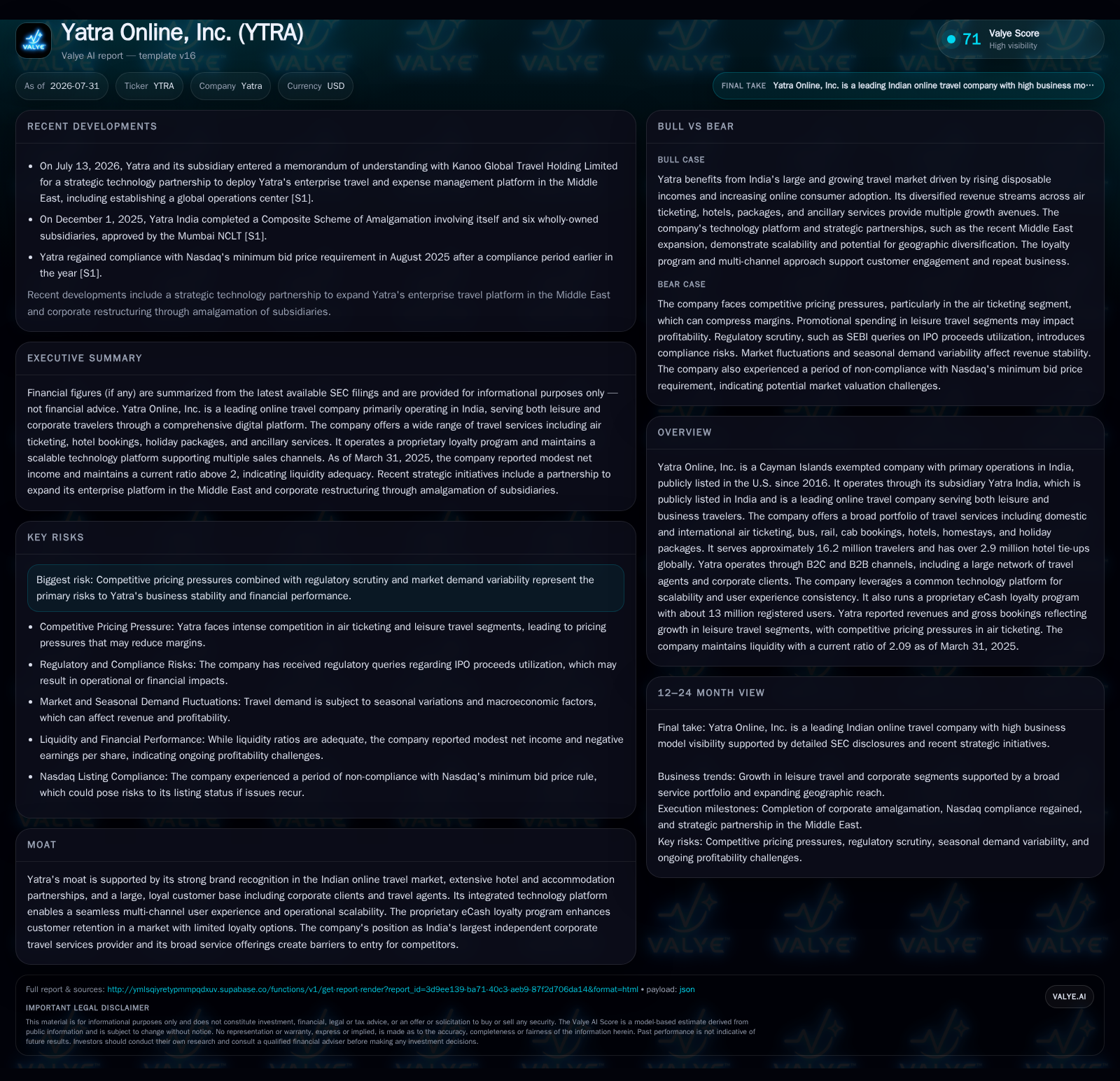
In its May 2026 quarter, Yatra Online capitalized on India’s travel recovery with a 129.2% surge in service revenues propelled by an integrated multi-channel platform. The company’s dual B2C and expansive B2B travel agent network combined with its corporate client scale supported robust customer acquisition. However, stiff competition in the Indian OTA market led to margin compression due to aggressive pricing and higher promotional investments, particularly in hotels and packages. Yatra’s sizable loyal customer base and large hotel tie-ups underpin its market positioning, but ongoing pricing pressures and regulatory scrutiny represent key risks to watch.
Demand Rebound Drives Service Revenue Growth But Pressures Margins
Yatra Online’s fiscal year ended March 31, 2026 showcased a marked recovery in travel demand, reflected in a 129.2% increase in service revenue from INR 7,383.5 million in fiscal 2025 to INR 9,539.2 million [S1]. This surge was driven primarily by pent-up consumer demand returning post-pandemic alongside the company’s ability to scale its integrated multi-service platform efficiently across both leisure and business traveler segments. However, despite top-line acceleration, the report highlights margin contraction pressures during the same period linked to aggressive pricing strategies, especially within air ticketing services where net commissions form the revenue base. Additionally, heightened promotional spending in hotel bookings and holiday package segments further diluted adjusted margins as Yatra sought to retain market share amid intensified competition [S1].
These dynamics illustrate a classic tradeoff familiar within online travel agencies (OTAs): balancing growth-driven volume gains against margin-sensitive marketplace economics exacerbated by competitor discounting. Confirmation of easing margin pressure would require evidence of stabilized or improving adjusted EBITDA margins alongside sustained or improved gross booking value (GBV) growth supported by reduced promotional intensities.
Business Model Leverages Integrated Multi-Channel Booking Ecosystem
Yatra’s operating model is anchored on a sophisticated digital ecosystem combining direct business-to-consumer (B2C) user engagement through websites and mobile applications with an extensive business-to-business (B2B) channel involving approximately 55,800 travel agents spanning roughly 1,400 cities across India [S1]. This layered approach allows Yatra to aggregate broad demand among both urban educated consumers and smaller enterprise clients cost-effectively.
Revenue streams are primarily segmented into three categories: air ticketing (net revenue from airline commissions and incentives), hotels and packages (where Yatra acts as primary obligor on gross bookings covering tours inclusive of hotel and flight arrangements), and other ancillary travel services such as bus, rail, cab bookings, advertising revenues, and coupon sales [S1]. This diversification mitigates concentration risk while catering to varied traveler preferences.
Importantly, Yatra leverages a unified technology platform deployed across all channels to provide consistent user experience enhancing scalability and operational efficiency—a crucial moat given Indian travelers’ increasing shift toward mobile-first digital engagement.
The company also operates a proprietary eCash loyalty program boasting about 13 million registered users, which supports customer retention across its multi-channel offerings amidst relatively limited loyalty options in the Indian OTA landscape [S1]
Competitive Dynamics Shape Promotional Spending and Pricing Tradeoffs
India’s online travel sector is intensely competitive with peers such as MakeMyTrip exerting substantial pressure on pricing strategies. Yatra acknowledges that this competitive intensity necessitates ongoing high marketing and sales promotion expenditures aimed at customer acquisition, retention incentives, including cash promotions linked to its eCash loyalty program [S1]. These initiatives manifest as increased variable costs that weigh down gross margins despite topline growth.
While total marketing spend decreased marginally year-over-year after optimization efforts—down by about 1.7% to INR 2,417.2 million excluding consumer promotions—the necessity for aggressive discounting persists due to competitors vying aggressively for market share in segments like air ticketing where margins are thinnest [S20],[S21]. Moreover, regulatory scrutiny regarding commission caps or consumer protection laws could constrain such aggressive promotional activities further impacting profitability.
Continued monitoring of marketing expense ratios relative to net revenue will be essential to assess whether Yatra can sustain growth without escalating cost burdens diminishing financial returns.
Growth Engines Anchored in Corporate Scale and Loyalty Program Expansion
A notable driver underpinning Yatra’s growth story is its commanding presence in India’s corporate travel arena where it serves over 1,340 large corporates alongside a vast SME base totaling roughly 60,750 clients as of March 2026 [S1]. This segment delivers more stable booking volumes compared to highly volatile leisure travelers through contractual relationships often managed via travel management company (TMC)-style offerings.
This sizeable corporate footprint coupled with technology-enabled service delivery facilitates cross-selling opportunities into allied verticals like expense management offerings recently extended into the Middle East via strategic partnerships [S19]. Additionally, the loyalty program helps lock-in frequent users driving repeat booking rates—a critical metric for lifetime value enhancement within OTAs.
India’s expanding middle class with rising disposable incomes combined with fast-growing smartphone penetration continues to enlarge the addressable online consumer market—a tailwind expected to support incremental growth for years ahead.
Risk Factors: Pricing Pressures, Regulatory Oversight, Supply Dependence
Despite strong growth momentum, Yatra faces inherent risk from precarious margin structure susceptible to disruptive price competition from larger incumbents with deeper pockets. Escalating promotional discounts could erode profitability if unchecked.
Regulatory vigilance evaluating commission fees or permissible advertising may further limit pricing flexibility or increase compliance costs. The reliance on third-party airline inventories and hotel supply chains also exposes Yatra to supplier-related risks around availability or contract terms.
Technological uptime remains crucial; prolonged platform disruptions could drive customer churn given low switching costs among OTAs. Finally, currency fluctuations impacting outbound international bookings add macro-financial uncertainty.
What to Watch: Customer Acquisition Trends, Margin Stabilization Signals, Platform Enhancements
Key indicators for near-term monitoring include quarterly trends in gross booking value (GBV) reflecting underlying demand robustness alongside increases in active customers that denote traction across both B2C direct channels and B2B agent-driven segments [S2],[S13].
EBITDA margin evolution will reveal whether strategic pricing moderation or more effective marketing investments start translating into profitability improvement.
Further announcements around technology platform upgrades or distribution channel expansions—such as partnerships extending geographic reach—would signal progress in operational scalability.
Moreover, regulatory developments impacting commission rules or promotional tactics will be critical for recalibrating business strategies.
Engagement metrics from the eCash loyalty program could provide insights into customer stickiness enhancements if disclosed subsequently.
Financial Profile Discussion: Recent Liquidity Position and Profitability Context
The group reported modest net income of $274 thousand during this period reflecting ongoing investment absorption typical within growth-oriented OTAs prioritizing scale over short-term profits.
It does not constitute investment advice or research views.
Disclaimer: This is research-only, informational analysis and not investment advice. It may include AI-generated interpretation and general industry context. Always verify important details using primary sources.

Comments