
Weyerhaeuser Integrates Timberland Stewardship and Wood Product Sales to Weather Housing Market Cycles
Weyerhaeuser's Q2 2026 results highlight its strategic integration of timberlands and wood products amid cyclical housing demand and commodity volatility.
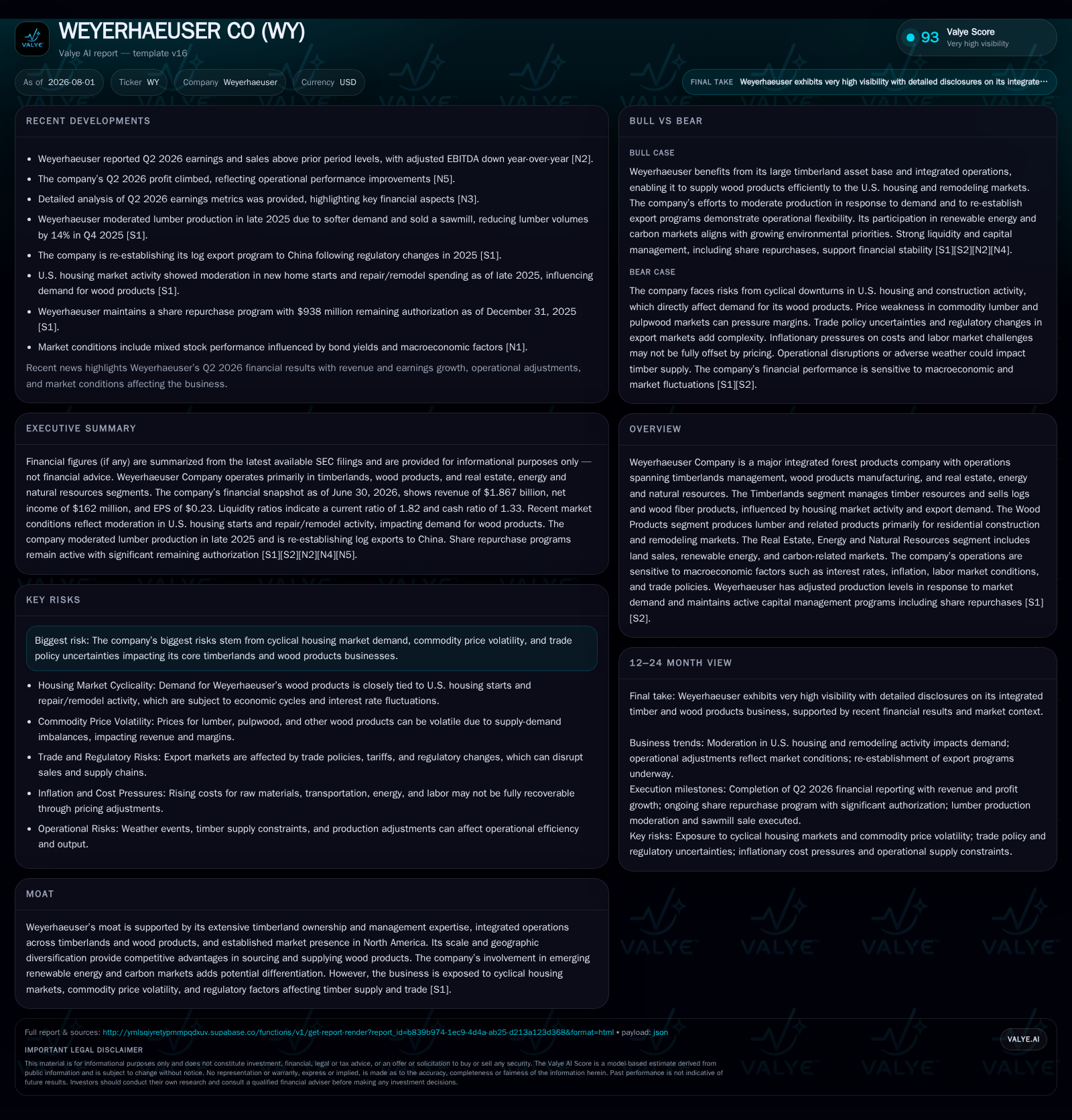
In its latest quarterly filing, Weyerhaeuser reported operational adjustments reflecting the cyclical downturn in residential construction demand, notably moderating timber harvest volumes and managing wood product output. The company's vertically integrated model, anchored in extensive timberland ownership, provides supply stability but faces margin pressures from fluctuating lumber prices and trade uncertainties. Growth initiatives in renewable energy and carbon credit markets are emerging avenues that may partially offset housing market cyclicality. Capital allocation remains disciplined with ongoing share repurchases supported by a strong liquidity position.
Latest Quarterly Operational Shifts Reflect Cyclicality Response
Importantly, actual lumber production saw recalibrations aiming to optimize inventory levels amid volatile commodity price environments. These production adjustments showcase Weyerhaeuser’s nimbleness managing capacity utilization at sawmills within its integrated operations network to mitigate margin compression risks [S3][N3]. These measures illustrate careful orchestration between upstream timber harvesting decisions and downstream manufacturing throughput—essential levers in cushioning earnings against cyclical supply-demand imbalances.
Integrated Timberlands Ownership Anchors Raw Material Supply Stability
A key structural strength for Weyerhaeuser lies in its stewardship of an estimated approximately 12 million acres of timberlands across North America—the vast majority under sustainable management protocols designed for regulated yield harvesting [S1][S2]. This asset base acts as a reliable log supply source insulating the company from more pronounced spot-market volatilities frequently impacting industry peers reliant on third-party log purchases. By controlling the primary raw material supply chain directly through its timberlands segment, Weyerhaeuser reduces procurement risk while capturing value earlier in the forest products value chain.
Furthermore, sustainable forestry practices supported by regulatory compliance not only preserve long-term timberland productivity but also enable participation in environmental markets such as carbon credit sales—adding an emergent quasi-recurring revenue stream tied to ecosystem services rather than commodity cycles alone [S1]. Such integration affords both operational quality enhancement and strategic optionality uncommon among pure-play manufacturers or land investors.
Wood Product Segment Experiences Pricing Pressure Amid Lumber Market Volatility
The Wood Products segment remains highly exposed to fluctuations in average selling prices driven by broader economic conditions affecting residential construction pace. Lumber prices have exhibited notable volatility recently linked to shifts in interest rates, inflationary pressures, and international trade policies restricting export channels or imposing tariffs [S2][N2]. While end-market pricing ideally passes through increased input costs such as logs or fiber, practical limitations exist due to competitive pressures from alternative building materials and cautious buyer spending during market slowdowns.
Consequently, margins on finished products like dimensional lumber or panel goods face compression risks exacerbated by uneven demand recovery dynamics. Comparatively, peers in specialized wood product niches may maintain steadier margins due to differentiated product portfolios; however, Weyerhaeuser’s broad exposure ties earnings closely to mainstream homebuilding metrics. The firm's scale permits some cost efficiencies at sawmills but does not entirely immunize it from global commodity price swings [N4].
Growth Vectors in Renewable Energy and Carbon Credit Markets Build Optionality
Beyond core timberlands and traditional wood products manufacturing, Weyerhaeuser is advancing its engagement in renewable energy projects situated on owned land assets alongside participation in carbon credit markets [S1]. These activities provide partial detachment from cyclical housing demand dependence by generating cash flows related to environmental attributes rather than physical goods.
Specifically, development of biomass energy facilities utilizing residual forest materials contributes incremental revenue while enhancing resource recovery efficiency. Simultaneously, monetization of carbon sequestration offers growing opportunities reflecting increased societal and regulatory emphasis on carbon neutrality frameworks. Though these segments currently remain modest relative to total revenues, they represent strategic portfolio diversification that could gain prominence under favorable climate policy trajectories.
Risks from Housing Cycle, Commodity Prices, and Trade Policies Remain Central Challenges
Weyerhaeuser’s operations inherently depend on macroeconomic factors predominantly tied to residential construction trends driven by mortgage rates, labor availability, and consumer confidence. Risk disclosures emphasize vulnerabilities stemming from potential downturns in housing starts that directly curtail demand for lumber and related wood products [S19][S1].
Additionally, commodity price volatility introduces earnings variability as lumber prices respond rapidly to global economic cues including inflation dynamics or currency fluctuations impacting export competitiveness. Trade policy uncertainties—such as tariff impositions or quota adjustments—further complicate forecasting revenues from international sales channels granted that exports constitute meaningful portions of wood fiber shipments.
Environmental regulations governing timber harvesting methods or land use present additional compliance burden risks with potential cost implications. Severe weather events or natural disasters could also disrupt timber supply chains sporadically.
What to Watch: Production Levels, Pricing Trends, Capital Allocation Execution, and Regulatory Signals
Key upcoming milestones include Q3 guidance disclosures regarding planned timber harvest volumes alongside trajectory for average selling price per unit of lumber—both critical barometers of operational health amid evolving housing fundamentals [S2][S3]. Monitoring production capacity utilization rates across sawmills will further illuminate adjustments in manufacturing agility responding to demand signals.
On capital deployment fronts, pace of share repurchases under the existing $1 billion authorization initiated mid-2025 merits close attention as it reflects management balancing shareholder returns against investing prudently given sector cyclicality [S21]. Regulatory developments particularly around sustainable forestry rules or expansions in carbon credit schemes could materially influence cost structures or revenue profiles if enacted.
Collectively these elements serve as early indicators validating whether current cyclical headwinds deepen or begin abating toward normalized operating leverage gains.
Financial Profile Discussion: Current Liquidity Position Supports Flexible Capital Management
As of June 30, 2026, Weyerhaeuser holds approximately $527 million in cash and equivalents supported by total current assets near $1.64 billion against liabilities just over $900 million yielding a current ratio around 1.82—signaling sound short-term liquidity for operational needs or proactive capital moves [F1]. Total debt stands roughly at $5.61 billion (as of December 31, 2025), which combined with cash translates into net debt about $5.08 billion consistent with manageable leverage levels common across integrated forest products operators.
This analysis is based solely on publicly available filings and news as of August 2026 without offering investment advice.
Disclaimer: This is research-only, informational analysis and not investment advice. It may include AI-generated interpretation and general industry context. Always verify important details using primary sources.

Comments