
Donnelley Financial Solutions Advances Software Growth Amid Compliance Volume Pressure
DFIN’s latest quarter shows improving software revenue offsetting print and compliance service declines, highlighting strategic shifts in a complex regulatory technology market.
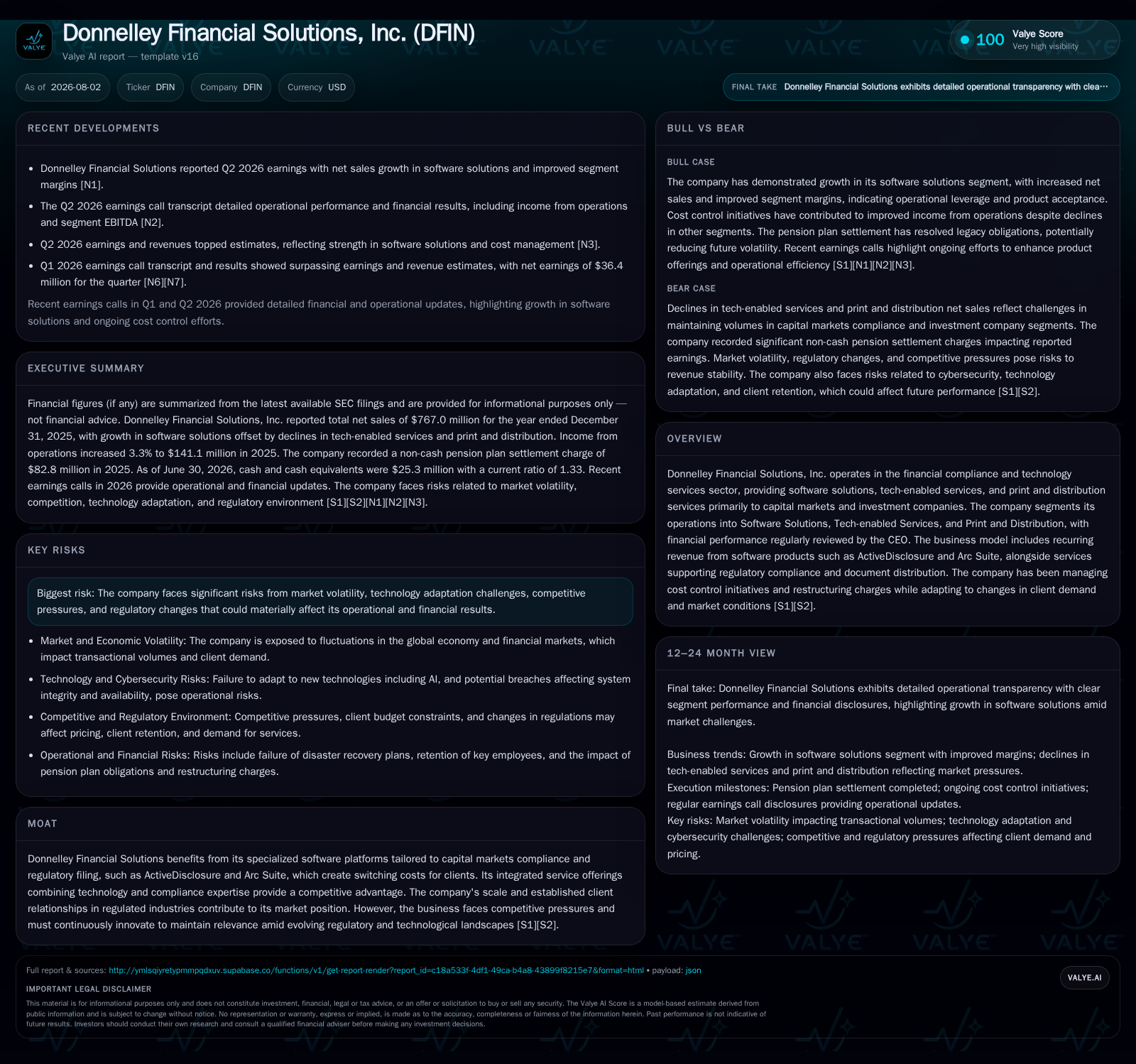
Donnelley Financial Solutions (DFIN) reported in its Q2 2026 filing continued headwinds from declining regulatory compliance volumes impacting its tech-enabled services and print segments. However, the company’s software solutions grew revenue notably, driven by platforms like ActiveDisclosure and Arc Suite, offsetting overall sales pressure. Ongoing cost control measures and restructuring efforts have improved profitability metrics despite volume volatility. DFIN operates in a competitive financial compliance sector requiring innovation amid evolving client needs and regulatory complexity. Its capital structure remains manageable with ample liquidity, supporting strategic investments in SaaS and digital capabilities.
Recent Operating Update: Q2 2026 Performance
Donnelley Financial Solutions’ second-quarter 2026 Form 10-Q filing reveals a continuation of opposing trends across its core segments. While the company’s software solutions unit grew net sales — buoyed by stronger demand for flagship platforms such as ActiveDisclosure® and Arc Suite® — its tech-enabled services and print/distribution businesses declined due to lower volumes of statutory regulatory filings [S2]. This bifurcation highlights the ongoing shift from traditional compliance services toward SaaS-based solutions with recurring revenue characteristics.
The company called out cost containment initiatives that partially offset the revenue softness. Restructuring charges have been recorded during efforts to right-size the operational footprint consistent with declining print volumes and fluctuating transaction activity [S2][S3]. Management continues to emphasize segment adjusted EBITDA as a key performance measure, reflecting how cost reductions help sustain operating margins despite top-line pressures.
Business Model: Revenue Mechanics and Strategic Positioning
DFIN operates primarily within financial compliance and regulatory technology services directed at capital markets participants and investment companies. Its business model encompasses three categories: software solutions, tech-enabled services, and print and distribution. Software revenues derive from subscription licenses for platforms that facilitate SEC EDGAR filing preparation, tagging, validation, document collaboration, and digital deal management. Notable products include ActiveDisclosure® for transactional disclosure management and Arc Suite®, designed for investment companies’ regulatory filings [S1][S23].
Tech-enabled services cover document composition, electronic filing agent duties, iXBRL tagging services, and other outsourced compliance work that supplement the technology offerings. Print and distribution primarily involves producing physical or digital regulatory documents mandated by clients’ regulatory obligations.
Revenue depends on client activity levels (transactional volume), contract renewals of SaaS subscriptions generating recurring fees, plus additional usage or service fees tied to complex filings or printing requirements. Switching costs arise due to integration of proprietary platforms into clients’ workflows — especially for regulated companies where error avoidance is paramount — supporting relatively high retention rates.
Margins on software are higher than on tech-enabled compliance or print distribution due to scalability benefits inherent in SaaS models. Volume declines in transactional submissions reduce tech-enabled service revenues sharply but do not directly impact software subscription fees unless churn or non-renewal accelerates.
Industry Structure and Competitive Position
DFIN competes in a specialized segment of the broader financial technology ecosystem centered on compliance with securities regulations across capital markets and investment funds. Peers include Broadridge Financial Solutions (broker-dealer communications), SS&C Technologies (investment fund operations), Workiva (compliance reporting automation), Thomson Reuters Regulatory Intelligence (regulatory data), IHS Markit (financial data analytics), and Nasdaq Corporate Solutions (corporate governance tools).
DFIN’s competitive moat stems from its tailored compliance-focused platforms addressing nuanced SEC requirements combined with embedded tech-enabled services creating sticky client relationships [S1]. However, competition is intense due to industry fragmentation, evolving client budgets influenced by macroeconomic cycles, rapid technological advancements like AI-driven automation, and shifting preferences from traditional prints to cloud-native digital delivery.
Client adoption dynamics favor integrated end-to-end compliance suites offering seamless preparation through submission workflows plus distribution capabilities. The mix shift favoring subscription-based software enhances revenue visibility but hinges on continuous product innovation to maintain differentiation.
Growth Drivers
Regulatory complexity continues climbing globally with more intricate filing standards pushing demand for advanced compliance software capable of automation beyond manual document assembly. Rising ESG disclosure mandates also swell requirements for standardized reporting frameworks — an emerging opportunity for players like DFIN.
Digital transformation imperatives among investment companies drive upgrades from legacy systems to next-generation SaaS models emphasizing cloud scalability, real-time collaboration tools, secure virtual data rooms (Venue®), and mobile access.
Capital markets transaction activity fluctuations cause cyclical effects on deal-related tech-enabled service volumes but generally bolster longer-term software platform adoption as firms seek efficiencies amid tighter regulatory scrutiny.
Artificial intelligence presents a transformative lever by augmenting document review speed, error detection accuracy, natural language processing for tagging metadata, and predictive analytics on filing trends. Early-stage AI integration offers growth runway if execution matches client trust expectations around security/compliance [S2].
Global expansion remains constrained by jurisdiction-specific regulations but selective geographic diversification could unlock incremental recurring revenue streams over time.
Risks and Growth Constraints
Market volatility exerts meaningful pressure on DFIN’s tech-enabled services linked to transactional volume; sustained downturns could erode these higher-throughput segments disproportionately [S2]
Rapid evolutions in SEC rules or unexpected legislative changes may require expensive platform enhancements or disrupt incumbent process flows temporarily affecting client renewals or usage intensity.
Competitive threats arise from newer fintech entrants delivering modular point solutions or larger integrated enterprise vendors bundling compliance within broader financial software ecosystems.
Cybersecurity breaches constitute critical operational risks given sensitive financial data involved; any material failure could damage reputation and lead to costly remediation or litigation.
Client budget constraints during economic slowdowns tighten pricing flexibility even as DFIN tries to maintain margins through efficiency gains.
Employee retention within high-specialization roles remains vital given intellectual property embedded in platform development plus technical consulting expertise required.
Finally, transition pace away from print toward purely digital workflows hinges on factors such as residual client preference for hard copies driven by regulation or shareholder demands — flattening print declines could delay full margin benefit realization.
What to Watch Next
Key execution milestones include quarterly tracking of recurring revenue growth within ActiveDisclosure®/Arc Suite® products relative to overall net sales trends to gauge success in offsetting service volume weakness via software expansion [N1][N3]. Monitoring churn rates will inform whether switching costs continue insulating renewal predictability.
Margin improvement trajectory will be important as cost control actions mature versus lingering restructuring charges; how SG&A evolves against expanding software sales will reveal operating leverage potential [S2]
Industry-wide regulatory announcements impacting SEC filing formats or frequencies could serve as catalysts influencing demand patterns; particularly noting ESG/transparency regulation developments that might drive new client use cases.
Technological innovation adoption—especially rollout timelines for AI-driven features—will be indicative of competitiveness over coming years [S2].
On the capital structure front, observing debt leverage trends alongside free cash flow generation is crucial given $204 million debt reported mid-2026 balanced against moderate cash reserves of approximately $25 million supporting liquidity [F1][S15]
Financial Profile Discussion
As of June 30, 2026, Donnelley Financial Solutions held $25.3 million in cash equivalents against current liabilities of $192.5 million providing a current ratio near 1.33x — indicating adequate short-term liquidity [F1]. Total debt stood around $204 million combining Term Loan A Facility reductions ($107.8 million) with revolving facility borrowings ($96.5 million) at weighted-average interest rates declining modestly compared to prior periods [S15][S17].
On an annual basis for the fiscal year ended December 31, 2025 income from operations rose slightly despite modest net sales declines due largely to successful cost reductions in sales expenses alongside restructuring initiatives aimed at adjusting capacity aligned with declining transaction volumes [S1][S20]. Improving adjusted EBITDA margins remain a target metric balancing mix shifts toward higher-margin SaaS versus volume-variable services.
Overall financial health reflects disciplined capital stewardship essential in a sector where technology investments must be balanced against cyclical revenue sensitivity tied to client market activity profiles.
This analysis integrates publicly filed disclosures through July 30, 2026, combining recent quarterly updates with annual context while situating Donnelley Financial Solutions within the evolving financial compliance technology landscape characterized by shifting regulatory demands amid digitization trends. No specific investment research views are expressed herein.
Disclaimer: This is research-only, informational analysis and not investment advice. It may include AI-generated interpretation and general industry context. Always verify important details using primary sources.

Comments