
CoStar Group Boosts Revenue with Matterport and Domain Acquisitions While Managing Integration Costs
Q2 results show subscription growth and rising expenses from acquisitions as CoStar prepares for Zonda regulatory review and focuses on expense discipline.
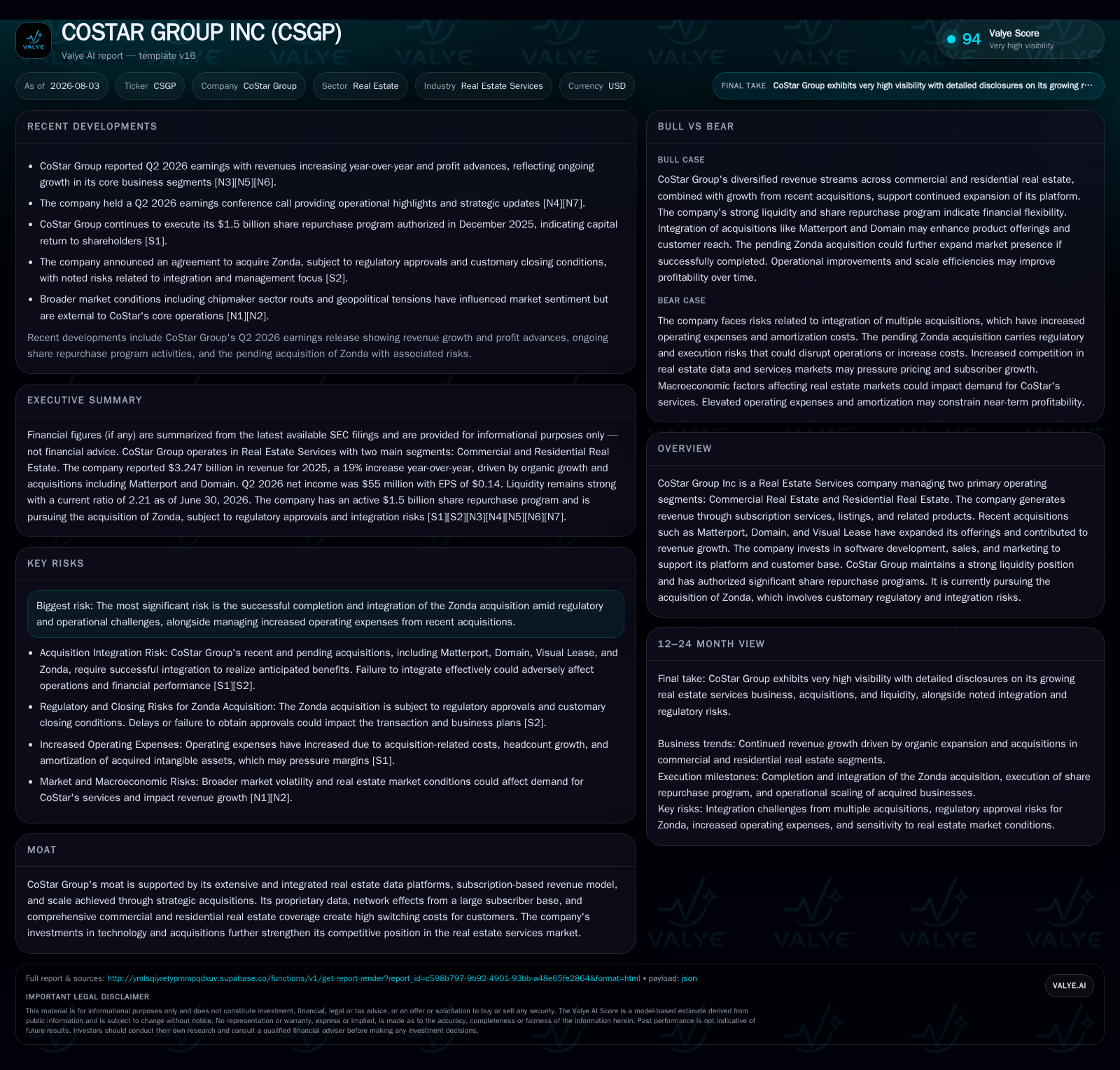
In Q2 2026, CoStar Group demonstrated resilience in its real estate services platform with ongoing revenue growth fueled by acquisitions such as Matterport and Domain. The company continues to expand its commercial and residential real estate subscription bases while managing elevated operating costs tied to integration and sales initiatives. The pending acquisition of Zonda introduces regulatory uncertainty, and operating expense control remains critical to restoring profitability. CoStar’s robust data network and SaaS model underpin its competitive moat in a sector marked by high switching costs and cyclical market demand.
Recent Operating Update: Q2 2026 Earnings Reflect Growth Amid Integration
CoStar Group's latest quarterly filing for the period ended June 30, 2026 presents a narrative of continuing top-line expansion driven largely by strategic acquisitions combined with solid organic growth [S2][S3][S1]. Revenue acceleration in both the commercial and residential real estate segments aligns with the company's expanded portfolio following the acquisitions of Matterport (February 2025), Domain (August 2025), Visual Lease (November 2024), and OnTheMarket (December 2023). These transactions have not only broadened CoStar’s product suite but also increased subscriber counts, a core driver of its subscription-based revenue model
Despite this growth momentum, CoStar faces challenges related to elevated operating expenses. Notably, increased sales and marketing spend aimed at customer acquisition and retention—and heightened software development outlays to support platform integration—continue to weigh on operating income [S1]. This pattern is particularly pronounced in the Residential Real Estate segment where aggressive marketing has resulted in adjusted EBITDA losses persisting into 2026. However, the Commercial Real Estate segment remains a profit center with increased adjusted EBITDA compared to prior periods
Additionally, pending regulatory approvals for the cash acquisition of Zonda introduce near-term uncertainty [S2]. Management acknowledges risks including potential talent attrition, cost overruns on integration efforts, and distraction from core business activities that could adversely affect performance until the transaction is consummated
Business Model: Subscription-Centric SaaS Anchored by Proprietary Data Platforms
CoStar operates primarily through a subscription model providing access to proprietary commercial and residential real estate data platforms complemented by analytical tools, listings marketplaces, and value-added services like digital twin technology via Matterport. Customers—including brokers, agents, property managers, investors, and corporate clients—subscribe under contracts typically spanning one year or more with automatic renewals driving recurring revenue stability [S1]. Revenue expands through increases in subscriber counts (volume), price inflation reflecting platform enhancements or market adjustments (price), and cross-selling associated products stemming from acquisitions (mix).
Subscription renewal rates coupled with net retention metrics are pivotal indicators reflecting customer satisfaction and marketplace competitiveness. Elevated churn would signal weakening pricing power or competitive incursion given alternatives like Zillow or Redfin in residential markets or LoopNet in commercial listings [S1]. Meanwhile, CoStar leverages significant network effects; the breadth of its data assets creates high switching costs due to the integral role of accurate property data in transaction facilitation.
Acquisition strategy forms a critical pillar of CoStar’s growth framework. The integration of complementary platforms such as Matterport's advanced 3D property visualization technology fortifies the company’s technological differentiation while Domain deepens residential coverage internationally. However, as evidenced in recent periods, these expansions entail large upfront incremental costs—personnel increases for sales organizations, enhanced marketing budgets targeting new user adoption, plus general administrative expenses latterly driven by hosting costs and professional services—pressuring near-term margins [S1][S10]
Industry Structure and Competitive Position
The Real Estate Services industry comprises data aggregation firms alongside online marketplaces offering analytical tools and transaction support primarily across commercial and residential sectors. Firms differentiate via scale of proprietary data accumulation, depth of market analytics, platform usability, breadth of property type coverage, geographic reach, contractual relationship durability (subscription stickiness), and innovation pace.
Within this ecosystem, CoStar stands out given its integrated platform approach combining extensive commercial real estate datasets with residential listing capabilities post-Domain acquisition. Peers include Zillow Group for residential-focused listing platforms with strong consumer emphasis; Redfin integrating brokerage with technology; LoopNet concentrating on commercial listings; Matterport specializing in tech-enabled property visualization; each competitor addresses niches along adjacent value chains.
CoStar’s competitive strengths derive from comprehensive property data proprietary networks spanning multiple property types; substantial installed subscriber base fostering network effects that raise switching costs; SaaS delivery model optimizing recurring revenue predictability; plus ongoing technology investments enhancing platform scalability and user experience. The combined effect establishes high barriers to entry despite emergent digital disruptors offering freemium or low-cost alternatives stressing customer acquisition cost efficiency industry-wide.
Growth Drivers: Acquisition-Fueled Expansion Supported by Organic Demand
Growth is cultivated through multiple levers:
- Subscriber Growth: Adding agents, brokers, investors expanding license seats or subscriptions directly scales ARR.
- Price Increases: Inflationary pricing on legacy platforms coupled with upsells from enhanced listings or data products nurtures ARPU gains.
- Cross-Selling: Integrating acquired capabilities such as visual technology strengthens portfolio offering compelling broader adoption.
- Market Penetration: Geographic expansion via international acquisitions like Domain positions CoStar advantageously for rising global real estate digitization demand.
- Rising Demand for Market Analytics: Increasing reliance on data-driven insights for leasing/sales decisions fuels willingness-to-pay premium pricing.
- Technology Development: Ongoing investments augment user engagement metrics enhancing renewal probability.
Importantly, these drivers manifest in KPIs such as net retention rates exceeding 100%, modest churn rates consistent with SaaS norms, steady expansion in paid listing volumes especially within LoopNet/Domain channels, and sustained increases in average price per listing supported by differentiated content quality [S1][N1][N2]
Risks / Watchpoints / Growth Constraints
Integration risk remains paramount given multiple large-scale acquisitions closed within a short timeframe. Failure to efficiently consolidate operations—systems infrastructure harmonization delays or employee departures—could impair anticipated synergies impacting profitability longer term [S2]. Regulatory approvals especially around Zonda add complexity with uncertain timing that may delay realization of benefits or force deal modifications.
Operating costs associated with sales force expansion and marketing investments continue rising faster than revenue gains historically resulting in negative operating income at times. Balancing expenditure discipline against competitive pressure for market share preservation poses an ongoing challenge.
Market cyclicality inherent in real estate impacts demand elasticity for subscription-based services: recessionary environments deter leasing activity thereby reducing paid listings volume and suppressing price appreciation potential [N1]. Competition from free or lower-cost platforms could pressure customer acquisition cost dynamics if competitors effectively capitalize on network gaps or undercut pricing schemes.
Customer churn remains an essential KPI to monitor since substantial attrition erodes revenue visibility undermining valuation multiples typical for subscription SaaS businesses [N2]. Data quality issues or technical disruptions could compromise trustworthiness hence retention.
What to Watch Next
Upcoming milestones pivotal to investor insight include:
- Completion status of Zonda acquisition regulatory review along with disclosed timelines for closing.
- Quarterly disclosures tracking subscriber additions net of churn within both commercial and residential segments.
- Evolution in net retention percentages indicating success/failure in cross-selling acquired products.
- Trends in sales & marketing efficiency ratios capturing whether incremental spend translates into sustainable ARR growth.
- Operating margin improvement trajectories signaling effective cost control post-acquisition ramp-up phases.
- Key competitive developments from peers affecting pricing strategies or platform innovations potentially influencing market share dynamics.
Financial Profile Discussion
As of June 30, 2026, CoStar Group holds a cash balance approximating $1.27 billion alongside current assets totaling $1.65 billion against current liabilities near $747 million yielding a healthy current ratio around 2.21—a liquidity buffer supportive amid ongoing integration activities [F1]. Total debt is modest relative to cash reserves indicating net cash position favoring financial flexibility despite sizeable goodwill/intangible assets accrued through acquisitions reported previously [F1][S4].
In conclusion, CoStar’s positioning evidences durable competitive advantages underpinned by proprietary data ecosystems harnessed via scalable SaaS delivery across vital commercial/residential real estate verticals. Its suite expansion through strategic acquisitions opens new cross-selling avenues but requires careful orchestration to avoid dilution of profitability while sustaining robust subscription economics under cyclically sensitive end markets.
Disclaimer: This is research-only, informational analysis and not investment advice. It may include AI-generated interpretation and general industry context. Always verify important details using primary sources.

Comments