
W. P. Carey Fortifies Portfolio and Capital Structure in Q2 2026 Amid Market Dynamics
The company’s latest quarter shows robust acquisition activity and a refined debt profile that support its stable net-lease REIT model.
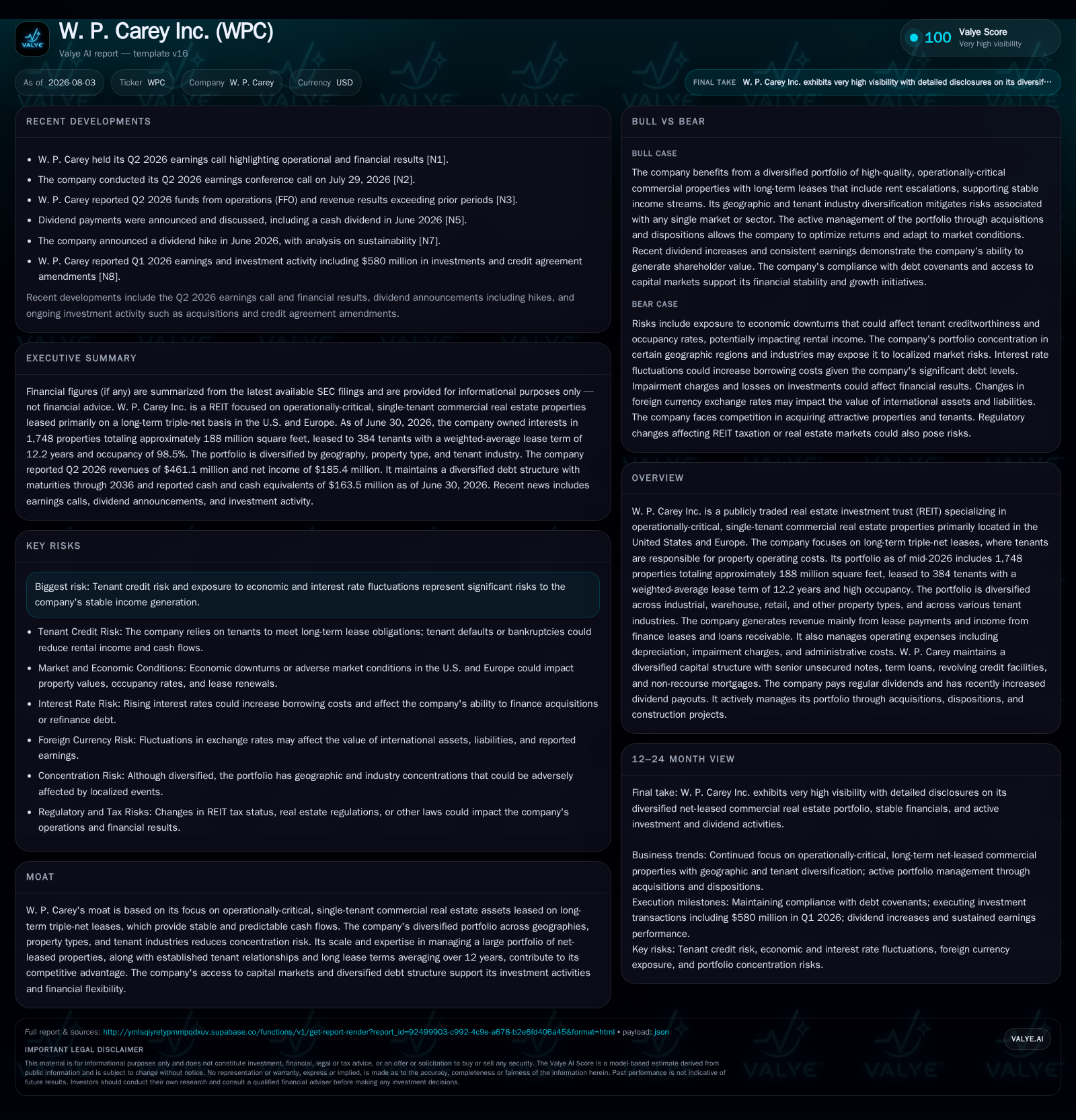
W. P. Carey's Q2 2026 highlights emphasize continued growth through $1.3 billion in new investments, including construction and portfolio acquisitions, paired with disciplined debt management featuring a recent senior note issuance and early prepayments. The REIT’s core business remains centered on operationally-critical, single-tenant properties under long-term triple-net leases with a well-diversified tenant base and a weighted average lease term exceeding 12 years, underpinning predictable cash flows. Challenges include tenant credit risk and interest rate fluctuations, but the company’s access to capital markets and liquidity position provide flexibility to fund acquisitions and sustain dividends.
Recent Operating Update
W. P. Carey’s second quarter of 2026 reinforced its strategic focus on expanding and optimizing its portfolio of net-leased commercial properties through significant acquisition activity amounting to $1.3 billion across 15 investments [S18]. This includes purchasing a large portfolio of 19 properties previously held by an unconsolidated equity method investment, signaling consolidation and control over high-quality assets formerly partially owned [S18]. Simultaneously, the company committed capital to four construction projects totaling approximately $66 million with an anticipated new project slated for completion in 2027, maintaining steady development momentum [S18]. Disposition initiatives also continued with the sale of 28 properties generating net proceeds of $232.7 million, which included all remaining self-storage operating assets—streamlining property types toward higher-margin net leases [S18].
On the financing front, W. P. Carey improved its debt maturity profile by issuing $350 million of new Senior Notes bearing a fixed coupon of 5.20%, maturing in 2036—a notably long tenor providing interest expense stability over the next decade [S18][S23]. The company simultaneously prepaid $350 million of higher-coupon Senior Notes (4.25%), illustrating proactive liability management during fluctuating market rates [S18]. As of June 30, 2026, cash & equivalents stood at $163.5 million [F1]. This financial flexibility supports ongoing acquisition spend, dividends, and scheduled principal repayments totaling approximately $353 million in the remainder of 2026 and $584 million in 2027 [S8].
Business Model Overview
W. P. Carey operates as a publicly traded REIT specializing predominantly in operationally-critical single-tenant commercial real estate leased under long-term triple-net structures [S1][N1]. This model shifts operating expenses—property taxes, maintenance, insurance—to tenants, significantly lowering landlord operating risk while generating highly predictable rental income streams. Its portfolio encompasses roughly 1,748 properties aggregating close to 188 million square feet primarily located across the U.S. and Europe [N1], spread among industrial, warehouse, retail, and specialized commercial types.
A key feature is the weighted-average lease term (WALE) exceeding 12 years (12.2 years noted mid-2026), emphasizing durable tenancy and stable cash flow visibility fundamental for dividend coverage [N1][S1]. Revenues derive mainly from lease payments structured often with contractual rent escalations reflecting inflation or market adjustments plus income from finance leases and loans receivable related to real estate investments [S2]. The company also actively manages tenant credit risk via diversification; its tenant roster comprises over 384 entities across multiple industries to mitigate concentration vulnerabilities [N1].
Capital deployment follows a rigorous strategy balancing acquisitions focused on high-quality stabilized properties or build-to-suit developments aligned with tenant needs against tactical dispositions that prune lower-yielding or non-core holdings like self-storage facilities [S18][N5]. Liquidity management is central—balancing operational cash flow generation (AFFO was approximately $305 million in Q2), along with access to public debt markets for note issuances at competitive rates and equity offerings executed via accelerated share repurchase frameworks or forward sales programs [S11].[S25]
Industry Context and Competitive Position
Within the net lease REIT sub-sector, W. P. Carey compares broadly alongside peers such as Realty Income Corporation, National Retail Properties, and STORE Capital which employ similar business models focusing on single-tenant triple-net leased assets offering predictable income streams. These peer groups typically benchmark portfolio WALE (often near or above a decade), tenant diversification metrics, FFO/AFFO growth trends indicative of recurring operational performance stability, as well as disciplined capital structures minimizing refinancing risks.
WPC distinguishes itself through a deep geographical footprint spanning both U.S. domestic assets and significant European holdings—this geographic spread reduces region-specific market risk common among more concentrated peers [N1][S29]. Further competitive advantage accrues from scale; managing nearly 188 million square feet leased to hundreds of tenants provides negotiation leverage for financing terms and tenant relationships fostering higher lease renewal rates.
Interest rate exposure remains a sector-wide challenge given the capital-intensive nature of REITs balanced against fixed income investors’ demand for steady dividends in rising-rate environments.
Growth Drivers
The primary levers driving WPC’s growth include targeted acquisitions comprising operationally-critical properties that align with long-term tenant business operations—securing stable lease revenue backed by creditworthy tenants [N1][S18]. Additional drivers are expansion into build-to-suit development projects where WPC funds initial construction costs securing customized assets paired with long-term clients prior to project completion [S18]. These strategies enhance rent escalation potential as tenants commit to tailored spaces that reduce churn risk.
Portfolio optimization through disposition of non-core assets (e.g., self-storage operating properties) enables redeployment capital into higher-yielding sectors or geographies supporting rental revenue growth [S18]. Inflation-linked rent escalations embedded in many leases serve as an organic revenue accelerator offsetting rising property-related costs without adversely impacting net income margins substantially.
Access to diversified capital markets supports investment scale-up; demonstrated by recent senior note issuance coupled with prudent prepayments reduces refinancing risk while ensuring capacity for opportunistic deals enhancing market share over time [S18][S23]
Risks and Watchpoints
Tenant credit risk remains foremost among operational risks: adverse macroeconomic shifts could impair tenants’ ability to meet lease obligations leading to potential defaults impacting cash flow continuity—and thus dividend sustainability [S1]. While diversification across industries reduces impact concentration risk, continued monitoring of tenant financial health is critical.
Interest rate environment volatility poses challenges by escalating borrowing costs despite hedges; sharp rate increases could pressure AFFO if refinancing occurs at wider spreads or variable-rate debts rise unexpectedly even with swap protection mechanisms. WPC’s substantial fixed-rate debt coverage diminishes but does not eliminate this exposure.
Lease expirations clustered within certain periods require effective rollover strategies; failure to renew leases at market rents may reduce net operating income (NOI). Although WALE is healthy at over 12 years indicating staggered expirations smoothing income shocks[^N], any significant cluster triggered by economic shifts requires careful performance tracking.
Geopolitical risks affecting European portfolio components—such as regulatory changes around tax treatment or environmental compliance—may add unforeseen liabilities or costs potentially reducing asset valuations or requiring additional capital expenditures [S1]. Liquidity constraints could arise if capital markets tighten abruptly limiting access to financing needed for acquisitions or debt maturities.
What To Watch Next
Key upcoming milestones include monitoring closing progress on announced acquisitions such as the industrial facility in Noblejas, Spain expected in calendar year 2027 which will test execution capabilities on international development projects [S18]. The timeline and ROI implications from four ongoing construction projects versus the newly committed one will reveal capital allocation effectiveness.
Tracking scheduled debt maturities including €500 million senior notes due April 2027 will indicate balance sheet management discipline given maturity volumes approaching approximately $584 million next year encompassing multiple tranches [S8][S14]. Observing AFFO per share stability through subsequent quarters will reflect whether rental income growth offsets higher interest expenses incurred recently from expanded borrowings.
Financial Profile Discussion
As of June 30, 2026, W. P. Carey reported total real estate investments net of depreciation at approximately $16.17 billion alongside equity method investments valued near $280 million—indicating substantial asset backing earning rent streams underpinned by intangible lease-related assets valued over $3 billion that contribute accounting recognition beyond physical property values.
The company's balance sheet carries nearly $8.85 billion in total debt dominated by senior unsecured notes ($7.38 billion) supplemented by unsecured term loans ($1.16 billion) and minor non-recourse mortgages (~$194 million), reflecting a well-layered capital structure designed for long-term stability [F1]. Cash reserves stood at $163.5 million [F1]. Operating results reflect revenues over $460 million for Q2 (+7%), driven primarily by net investment activity gains mixed with rental escalations offset by reductions from strategic divestitures such as self-storage properties withdrawn from operation portfolios which carry lower yields impacting total property revenue composition but improve margin quality long-term [S15]. Adjusted funds from operations rose to approximately $305 million indicating effective conversion of rental revenue into distributable cash flow despite one-time non-cash mark-to-market valuation swings related to equity securities holdings influencing net income variability—but these do not affect core AFFO metrics widely used by REIT investors assessing performance consistency [S15].
Overall leverage metrics remain supported by strong operating cash flows maintaining credit covenant compliance providing ample headroom under credit agreements—all essential for preserving investment-grade status critical for cost-effective capital access sustaining acquisition-driven growth agenda [F1]
This analysis synthesizes public SEC filings and recent earnings commentary without offering investment research views or price forecasts.
Disclaimer: This is research-only, informational analysis and not investment advice. It may include AI-generated interpretation and general industry context. Always verify important details using primary sources.

Comments