
Diebold Nixdorf Balances Hardware Sales with Growing Recurring Services Amid Operational Challenges
Q2 2026 results highlight steady revenue with modest profitability in a capital-intensive financial technology hardware sector.
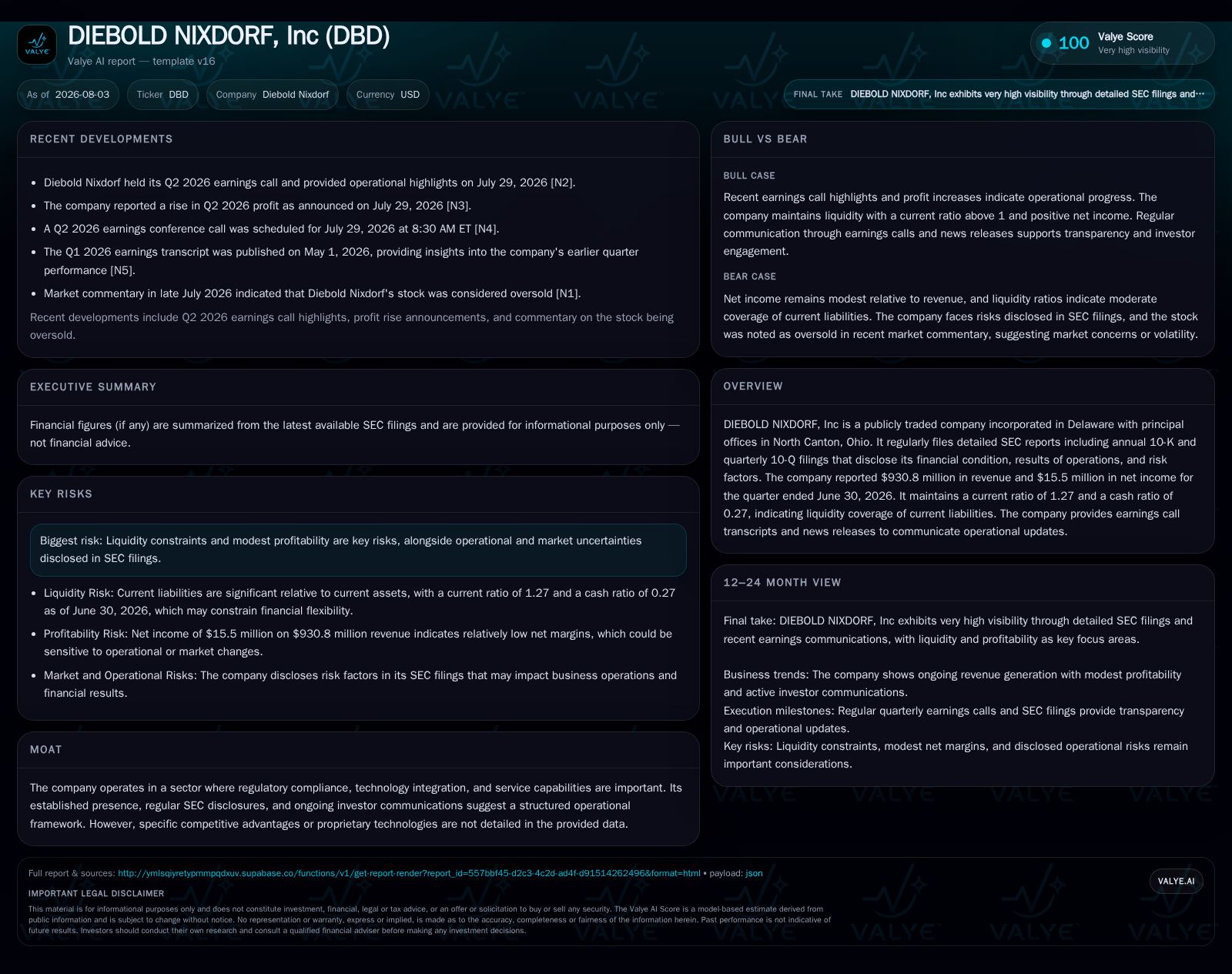
Diebold Nixdorf reported $930.8 million revenue and $15.5 million net income for Q2 2026, reflecting stable demand for its ATM and POS hardware balanced against ongoing margin pressures and operational costs [S2]. The company’s business model comprises a mix of hardware sales, software licensing, and managed services targeting banks and retailers, with recurring service revenue critical for margin stability [S1]. Industry dynamics emphasize regulatory compliance, technology integration, and supply chain management as key to competitive positioning, with peers like NCR Corporation facing similar structural challenges. Diebold Nixdorf’s liquidity ratios indicate sufficient short-term coverage but moderate leverage remains a watchpoint [F1]. Key growth drivers include digital payment ecosystem expansion and increasing demand for cash automation; however, risks persist around technological obsolescence, contract renewals, and market volatility.
Recent Operating Update
Diebold Nixdorf’s Q2 2026 earnings revealed revenues totaling $930.8 million alongside net income of $15.5 million [S2]. This reflects relatively stable sales in its core products—automated teller machines (ATMs) and point-of-sale (POS) terminals—offset by ongoing investment in service operations and cost pressures typical for the industrial hardware sector. The slight profitability despite high capital intensity indicates disciplined cost controls but also highlights margin compression risks when hardware sales volumes fluctuate.
The company maintains liquidity coverage supportive of operational needs with a current ratio of 1.27 and a cash ratio of roughly 0.27 as of the quarter end, demonstrating sufficient buffers against its short-term obligations [F1]
Business Model Overview
Diebold Nixdorf operates as an original equipment manufacturer (OEM) specializing in financial technology hardware such as ATMs and POS terminals integrated with proprietary software platforms [S1]. Revenue streams derive from three primary sources: direct sales or leasing of hardware units to banks and retailers; software licensing enabling transaction processing and security compliance; and managed service contracts providing maintenance, upgrades, remote monitoring, and installation services.
This hybrid monetization strategy is critical because while hardware sales often face cyclical demand fluctuations linked to infrastructure upgrade cycles or capital expenditure patterns by customers, recurring services create more stable revenue flows that enhance customer retention through long-term contracts with agreed-upon Service Level Agreements (SLAs). As such, the percentage of recurring service revenue relative to total revenue is a pivotal KPI reflecting durable demand and margin stability.
Channel partners and direct multimodal sales channels enable the company to reach diverse client segments globally. The business also hinges on strict adherence to regulatory requirements governing transaction security and data protection—factors influencing product design complexity and ongoing certification costs.
Industry Structure and Competitive Position
The industrial hardware market serving financial services is characterized by high barriers to entry due to stringent regulatory compliance obligations, technical integration challenges in complex legacy banking environments, and intensive R&D demands for security enhancements like biometric authentication.
Diebold Nixdorf competes alongside peers such as NCR Corporation (a notable ATM and POS supplier) and Hyosung (ATM manufacturer), all fighting commoditization pressures in hardware pricing while simultaneously expanding software-enabled solutions. This competition extends beyond traditional OEMs to include fintech companies offering software-first or cloud-based transaction processing platforms challenging incumbents' market shares.
Because customers weigh both upfront acquisition costs for hardware versus total cost ownership including service reliability, uptime guarantees, contract length, and responsiveness of managed services teams are critical competitive levers. Diebold’s scale in installed base devices provides some advantage for cross-selling service extensions but sustaining this requires continuous technological innovation.
Growth Drivers
Several structural growth drivers underpin Diebold Nixdorf’s business outlook:
- The ongoing demand from banks globally for cash automation via ATMs as financial institutions seek efficiency gains amid evolving cash usage patterns supports steady hardware replacement cycles.
- Expansion of digital payment ecosystems necessitates integrated POS modernizations capable of omnichannel commerce including contactless payments.
- Increasing regulatory scrutiny on secure transaction processing propels investments into advanced security standards embedded in new device generations.
- Growth in managed services adoption reflects customer preference shifting towards outsourcing operational maintenance in exchange for predictable costs and improved uptime.
- Emerging markets expansion creates new opportunities where banking infrastructure modernization remains nascent but growing.
Tracking KPIs like order backlog strength (indicative of future hardware sales), contract renewal rates (proxy for customer satisfaction), installed device counts, and recurring revenue contribution ratios help gauge these growth vectors’ traction over time.
Risks and Watchpoints
Diebold Nixdorf faces several risks common to its industry:
- Rapid fintech innovation risks rendering existing hardware platforms obsolete if not complemented by timely upgrades; delays can erode market relevance.
- Regulatory changes requiring frequent compliance adjustments impose costs that potentially squeeze margins unless effectively managed.
- Customer concentration risk exists given a limited number of large financial institutions driving significant portions of orders; loss or delayed renewal can materially impact revenues.
- Supply chain constraints continue to challenge manufacturing throughput capacity affecting fulfillment timing especially amid global component shortages.
- Cybersecurity vulnerabilities represent reputational threats if breaches occur within installed bases affecting customer trust.
- Competitive pressures from software-centric fintech companies may accelerate migration away from traditional OEM offerings unless Diebold successfully integrates innovative software capabilities.
Close attention to customer retention metrics alongside operational execution efficacy during deployments will be necessary to mitigate these factors.
What to Watch Next
Stakeholders should monitor upcoming quarterly disclosures for evidence on:
- Trends in recurring service revenue as a share of overall sales providing insight into successful transition towards higher-margin contracts.
- Backlog levels which signal near-term hardware demand shifts especially around major banking infrastructure refresh cycles.
- Gross margin trajectories distinguishing between improving profitability from services growth versus persistent pressure on hardware margins.
- Any new strategic partnerships or channel expansions enhancing footprint or technological capabilities.
- Updates on cybersecurity enhancements or regulatory compliance certifications securing competitive differentiation.
Operational cadence around efficiently deploying new product offerings without elongating deployment cycle times will also be instructive regarding scaling challenges faced by management.
Financial Profile Discussion
Diebold Nixdorf’s financial stance shows liquidity metrics surpassing minimum thresholds offering reassurance regarding working capital sufficiency, with current assets at approximately $1.71 billion versus liabilities around $1.35 billion, yielding a current ratio near 1.27 as of June 30, 2026 [F1]. Net debt stands at about $607 million as of March 31, 2025, after considering available cash of approximately $359 million [F1]. Profitability remains modest with Q2 net income at $15.5 million concurrent with the revenue base cited earlier [S2], mirroring wider sectoral trends where investment into R&D plus service infrastructures temper earnings despite scale advantages. To enhance operating income margins materially would likely necessitate augmenting recurring revenues faster than hardware unit volatility dampens top-line consistency.
Capital allocation priorities that balance R&D investments targeting technology leadership against debt reduction efforts will be determinants for longer-term financial health in this asset-heavy segment.
The analysis herein draws solely upon publicly filed SEC documents from February through July 2026 alongside pertinent industry context without speculative assumptions beyond evidenced facts. It aims to provide informed insight into Diebold Nixdorf’s strategic positioning within the financial technology industrial hardware market while flagging relevant operational milestones moving forward.
Disclaimer: This is research-only, informational analysis and not investment advice. It may include AI-generated interpretation and general industry context. Always verify important details using primary sources.

Comments