
Waystar Holding Corp. Accelerates Revenue Cycle Automation with Steady Retention and Cybersecurity Vigilance
Waystar’s Q2 2026 update highlights robust recurring revenue growth supported by customer loyalty, reinforced by strategic cybersecurity measures amid evolving threats.
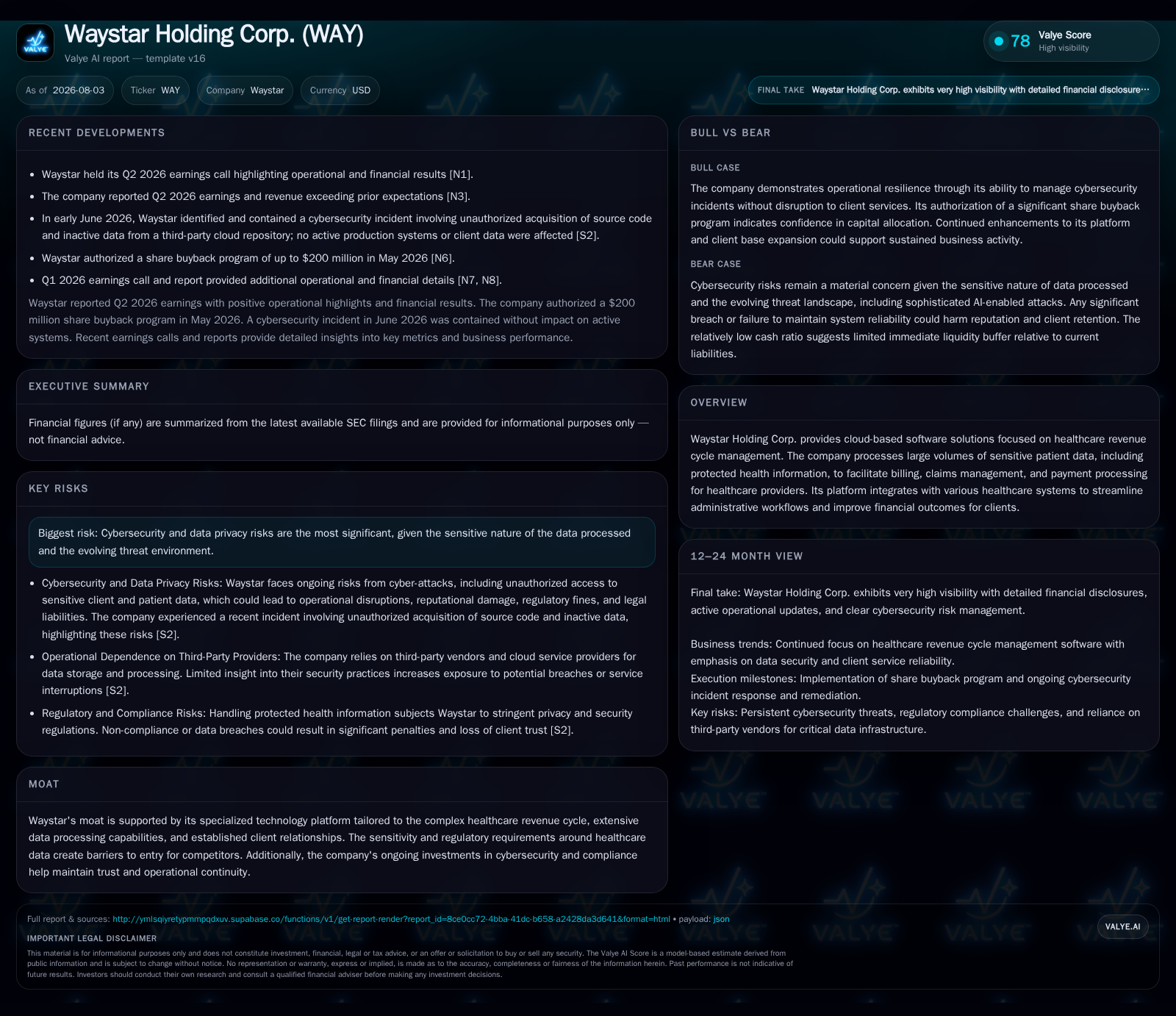
Waystar Holding Corp.'s second-quarter 2026 results reaffirm its strong foothold in healthcare revenue cycle management SaaS, driven by durable net revenue retention and low churn. The company managed a June cybersecurity breach involving limited inactive data without disrupting operations or client access, underscoring resilience critical in healthcare SaaS. Multi-year subscription contracts combined with integrated billing automation and payer connectivity underpin predictable cash flows and competitive positioning. Key risks remain tied to ongoing cyber threats and integration complexities amid sector regulatory shifts. Upcoming contract renewals and continued investment in cybersecurity will be vital to sustaining growth momentum.
Q2 Operational Update Highlights: Sustained ARR Momentum Amid Elevated Cyber Risk
Alongside financial highlights, Waystar disclosed a June 2026 cybersecurity incident involving unauthorized acquisition of point-in-time copies of testing source code from a third-party cloud repository, coupled with four files of inactive application data containing protected health information (PHI) affecting fewer than 1% of its client base [S2],[S29]. Crucially, the breach did not touch active production environments or live client data streams supporting mission-critical billing operations. Prompt containment efforts and engagement of external cybersecurity experts prevented service disruption while ongoing investigations have yet to reveal any misuse of compromised data. This event exemplifies the persistent cyber threat landscape confronting healthcare SaaS providers managing sensitive PHI and trade secrets.
Subscription Dynamics and Platform Integration Strength Fuel Recurring Revenue
From the longer-term perspective outlined in the February 2026 annual filing, Waystar’s business model centers on a cloud-based SaaS platform delivering comprehensive RCM capabilities including claims processing automation, billing reconciliation, payment posting, and reporting tools tailored for healthcare providers [S1]. Customers typically enter multi-year subscription agreements averaging around two years’ term with revenue models combining fixed contractual charges plus usage-based pricing tiered on volume of claims processed or billing transactions executed. This hybrid pricing aligns incentives for customers to scale usage while providing Waystar predictable cash flow backed by contractual visibility.
The platform’s strategic strength lies in seamless integration via APIs with electronic health record (EHR) systems and payer adjudication platforms. These integrations reduce manual intervention points by automating complex rules-based claims adjudication workflows which are notoriously error-prone in legacy systems. Such integrations reinforce switching costs by embedding Waystar deeply within provider administrative operations—further supporting high gross retention rates and expanded seat/usage growth when clients upgrade or cross-sell additional modules.
Healthcare Software Industry Benchmarks: Customer Retention & Contract Profiles
Peer benchmarking provides further insight into Waystar’s competitive positioning. Healthcare SaaS providers focused on RCM like Change Healthcare and Athenahealth typically target net revenue retention rates above 100% reflecting upselling potential offsetting any churn losses; Waystar’s reported net retention aligns well within this range indicating stable platform value perception [N2],[S2]. Customer churn remains low reflecting both the regulatory friction involved in shifting PHI-handling vendors as well as entrenched workflow benefits.
Sales cycles in this industry often extend due to clinical stakeholder involvement, security vetting requirements, and integration complexity—averaging months between initial engagement and contract signing [S1]. Waystar’s ability to secure multi-year contracts reduces renewal risk while providing extended revenue visibility fundamental to its valuation moat. A critical KPI is average contract length near two years supported by filings confirming durable client commitments
Balancing Cybersecurity Investments Against Increasing Data Threats
The June cyber incident underscores an ever-escalating risk environment where attackers employ AI-enabled phishing campaigns, polymorphic malware adapting during deployment, and sophisticated reconnaissance tactics that amplify threat actor efficiency beyond human scale [S24]. Healthcare-generated PHI presents an attractive target not only for identity theft but also for ransomware schemes leveraging operational disruption as leverage.
Waystar has responded with heightened investments in HIPAA compliance frameworks, continuous monitoring systems, employee training programs targeting social engineering vectors, and rapid incident response capabilities documented across filings [S20]. While defensive spending may pressure operating margins modestly over time, it serves as a key trust enabler—without which client retention could suffer materially given the sensitivity of the data entrusted.
Growth Prospects Driven by Automation Demand & Regulatory Tailwinds
Long-term secular tailwinds support continued expansion opportunities for Waystar’s RCM software offerings [N5],[S1]. The healthcare sector’s growing complexity due to evolving reimbursement modalities — including value-based care models requiring analytics-enabled billing accuracy — favors advanced automation solutions over manual workarounds. Migrating from on-premise legacy IT towards cloud-based platforms also drives demand aligned with Waystar’s pure-play SaaS model.
Additionally, regulatory mandates enforcing stricter data privacy requirements such as HIPAA enhance the competitive moat for compliant providers investing early in privacy-enhancing technologies. The increasing claim volume generated by an aging population further fuels total addressable market growth potential.
Operational Risks: Client Concentration, Integration Complexity, & Policy Volatility
Notwithstanding strengths, several risks warrant attention per recent disclosures [S29],[S8]. Cybersecurity breaches remain an omnipresent threat that could impose remediation costs or reputational damage if future incidents impact active systems or live PHI flows. Integration challenges persist given fragmented healthcare IT landscape featuring myriad legacy EHRs requiring ongoing tailored development effort.
Customer concentration can amplify revenue volatility if large provider groups reduce spend or delay renewals. Rapid shifts in federal or payer reimbursement policies risk compressing demand for RCM services or altering contract economics unpredictably. These factors require continuous monitoring given their capacity to affect near-term operating results.
Forward View: Milestones for Contract Renewal Cycles and Threat Mitigation
Looking ahead, key variables include renewal conversion rates on expiring contracts consistent with the referenced average two-year duration framework alongside ability to extend platform footprint through upsells or cross-sells during these windows [S1],[N3]. Progress on tightening cybersecurity defenses post-June breach including vendor risk assessments will be another critical barometer impacting client confidence and potential insurance cost trajectories.
Sales execution cadence also warrants watchfulness relative to broader macroeconomic conditions affecting provider capital expenditure appetite for IT solutions. Transparency around these metrics in forthcoming quarters should provide clearer directional cues regarding sustainability of ARR growth trajectories.
Financial Profile Discussion: Leverage Considerations and Liquidity Position
As of June 30, 2026, Waystar held $12.6 million in cash and equivalents against $237.7 million in current liabilities resulting in a healthy current ratio around 1.85 that signals comfortable near-term liquidity cover [F1]. Total debt stood at approximately $1.47 billion with net debt around $1.46 billion after considering cash balances—a level commonly observed among mature SaaS firms balancing acquisition-fueled expansion with steady operating cash flow generation capabilities.
This capital structure suggests prudent management maintaining solvency amid operational scale while preserving flexibility for working capital requirements or potential bolt-on acquisitions relevant to augmenting platform capabilities or market reach [F1]. The steady operating income profile reported annually further supports capacity to service debt obligations sustainably.
This analysis uses publicly available SEC filings dated through July 29, 2026 ([S1], [S2], [S3]) alongside company financial snapshots ([F1]) and credible news coverage ([N1], [N2], [N3], [N5]). It emphasizes factual interpretation without offering investment advice or speculative projections.
Disclaimer: This is research-only, informational analysis and not investment advice. It may include AI-generated interpretation and general industry context. Always verify important details using primary sources.

Comments