
Dyne Therapeutics Advances Clinical Pipeline Amid Financial Burn and Strong Liquidity
Dyne is progressing key muscle disease therapies toward regulatory milestones while managing net losses and extending cash runway through financing.
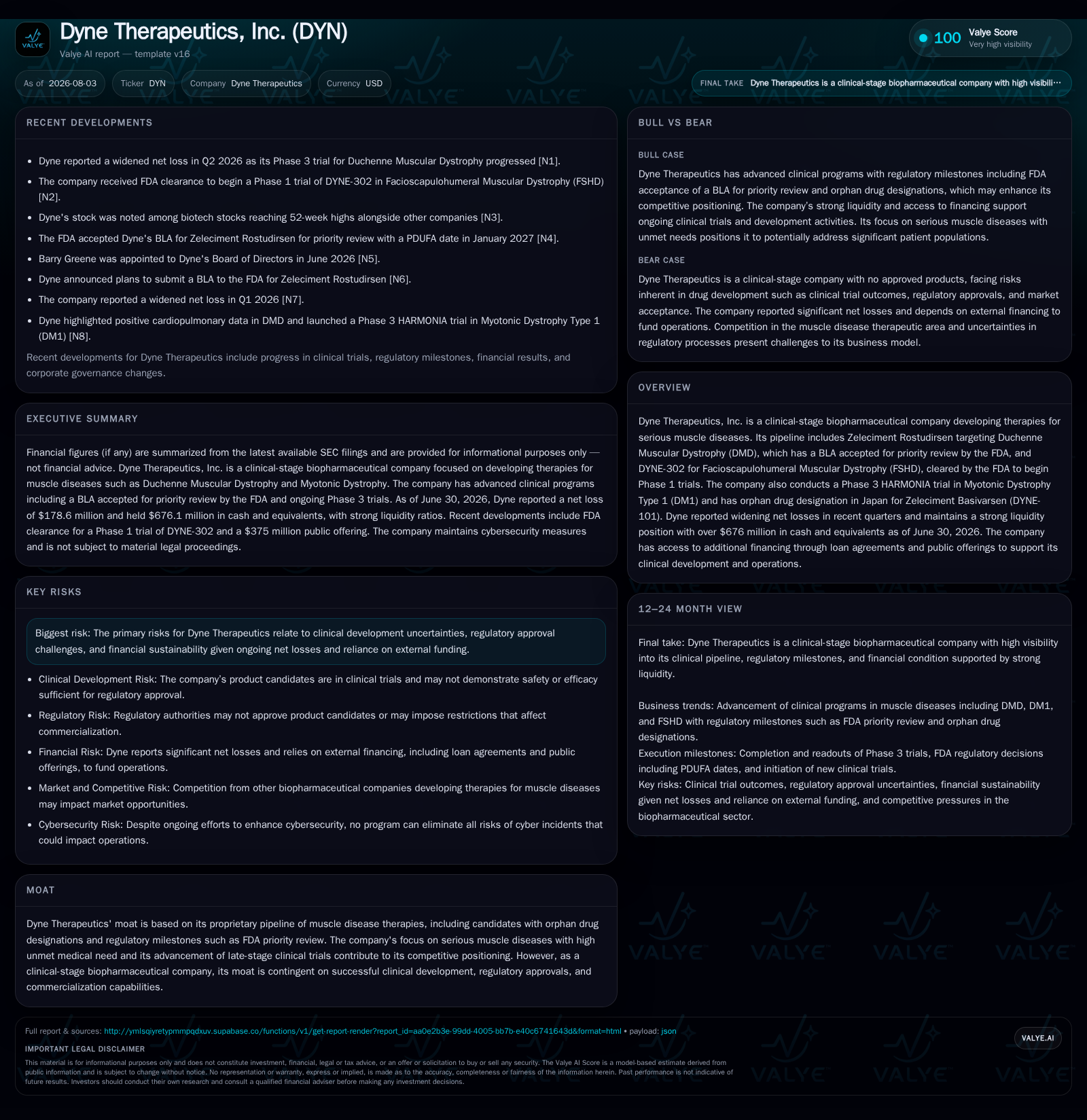
Dyne Therapeutics is a clinical-stage biopharmaceutical focused on muscle diseases, notably Duchenne Muscular Dystrophy (DMD), Facioscapulohumeral Muscular Dystrophy (FSHD), and Myotonic Dystrophy Type 1 (DM1). Its lead candidate Zeleciment Rostudirsen has received FDA priority review with a PDUFA date in early 2027, while the company recently initiated a Phase 1 trial for DYNE-302 in FSHD. These regulatory advancements underpin its competitive moat in orphan indications. Despite widening net losses reflecting ongoing R&D investment, Dyne maintains a strong liquidity position, bolstered by a recent $375 million equity offering and expanded debt facility, providing runway into mid-2028. The core challenges remain clinical trial enrollment pace and eventual regulatory approvals needed to validate its platform.
Recent Operating Update
Dyne Therapeutics’ latest quarterly filing for Q2 ended June 30, 2026, reveals continued progress on its core clinical programs alongside increased operating expenditures typical of a clinical-stage biotech advancing multiple late-phase trials [S2]. Its biologics license application (BLA) submission for Zeleciment Rostudirsen targeting Duchenne Muscular Dystrophy (DMD) was accepted by the FDA for priority review, setting a Prescription Drug User Fee Act (PDUFA) date in January 2027 [N7][N8]. This milestone represents a critical near-term catalyst since regulatory approval would shift Dyne from an asset development company to a commercial biopharma, significantly changing its revenue model.
In parallel, Dyne advanced DYNE-302 into Phase 1 testing for Facioscapulohumeral Muscular Dystrophy (FSHD) following FDA clearance, marking diversification within its pipeline targeted at serious muscle diseases [N3]. Additionally, the ongoing Phase 3 HARMONIA trial for Myotonic Dystrophy Type 1 (DM1) remains a pivotal program; orphan drug designation has also been granted for DYNE-101 in Japan, underscoring strategic international regulatory positioning [S1]. These concurrent developments illustrate Dyne’s multi-indication strategy aimed at rare muscular dystrophies where unmet medical need creates high barriers for competitors.
Business Model Analysis
Dyne Therapeutics operates primarily as a clinical-stage biopharmaceutical entity focused on delivering novel muscle-targeted therapies employing its proprietary biologic delivery platform. Revenue generation is nascent—typical of companies at this stage—with value primarily tied to milestone payments from licensing deals (if any), grants, or future therapeutic sales contingent upon regulatory approvals. The company monetizes through development-stage asset progression, culminating in commercial-scale launches that require manufacturing partnerships and payor engagement strategies post-approval.
Its lead product candidate, Zeleciment Rostudirsen, if approved, would be marketed to patients with genetically confirmed DMD—an ultra-rare pediatric neuromuscular disorder characterized by progressive muscle degeneration. The payer ecosystem here includes specialized specialty pharmacies and insurance providers familiar with orphan disease coverage. Dyne’s revenue mix will be sensitive initially to patient treatment volumes driven by diagnostic rates and physician adoption coupled with pricing dynamics influenced by reimbursement policies targeting rare diseases.
Margins are expected to be negative currently due to R&D spend; however, a successful product launch could shift operating income positive over time assuming scale economies in manufacturing and stable supply chains. Additionally, orphan drug exclusivity provides pricing leverage and limited direct competition initially. The company’s operating model depends heavily on effective patient enrollment in trials, securing regulatory milestones efficiently, preparing manufacturing infrastructure to meet potential demand, and ultimately executing commercialization.
Industry Structure and Competitive Position
Dyne sits within the clinical-stage therapeutics biotech sub-industry focusing on rare muscle disorders—a niche segment characterized by high technical complexity and significant unmet medical needs. The value chain role centers on novel biologic development leveraging proprietary delivery technology platforms designed to enhance delivery efficacy into muscle tissue.
Peers include Sarepta Therapeutics and Vertex Pharmaceuticals, both of which have developed antisense oligonucleotide or gene therapy platforms targeting muscular dystrophies [N4][N10]. Compared to peers, Dyne’s differentiation rests on its pipeline breadth across multiple indications (DMD, FSHD, DM1) and its achievement of orphan drug designations plus accelerated FDA pathways like priority review for some candidates. Yet, all face common challenges related to patient enrollment difficulty given small patient populations, rigorous endpoint demonstration requirements in progressive diseases, and scaling manufacturing capabilities.
The orphan drug status secured by Dyne’s candidates enhances exclusivity windows post-approval and can facilitate regulatory interactions but does not eliminate inherent clinical risk. Competitive pressure could arise if other gene-modifying therapeutics demonstrate superiority or gain earlier approvals; thus maintaining efficient trial progression is vital for sustaining an edge.
Growth Drivers
Key growth levers hinge on advancing late-stage clinical assets toward regulatory approval milestones [N7]. The imminent FDA decision on Zeleciment Rostudirsen’s BLA constitutes the most significant catalyst expected to reframe Dyne’s commercial viability.
Further expansion potential lies in successful Phase 1 progression of DYNE-302 for FSHD and positive data from the HARMONIA study in DM1 patients. Winning broader orphan designations or expanding indications within muscular dystrophies could extend market opportunity further.
Additional capital from licensing or partnership agreements may fuel development beyond current assets. Investment in manufacturing scale-up will enable readiness for commercialization upon approval which is essential for capturing value from approvals swiftly.
Risks and Watchpoints
Clinical trial risks predominate given the uncertainty of demonstrating sufficient safety and efficacy endpoints amid small patient cohorts prone to variability. Delays or failures in any pivotal program could impair valuation severely.
Regulatory hurdles linger despite priority review status—FDA rejection or requests for additional data remain possible risks affecting timelines.[S12]
Financial sustainability is tied to ongoing external funding given widening net losses reported with increasing R&D expense.[F1][S2] Failure to raise capital at favorable terms may constrict ability to complete trials or prepare launch infrastructure.
Enrollment pace is another watchpoint due to the rarity of target populations; slow recruitment can delay data readouts impacting projected milestones.[S2] Manufacturing scale-up poses operational risk if supply chains or quality controls falter during transition from clinic batches.
Finally, commercial execution risk post-approval includes payer reimbursement challenges common to orphan drugs along with provider adoption dynamics.
What to Watch Next
Investors should monitor:
- The FDA's PDUFA decision anticipated January 2027 on Zeleciment Rostudirsen’s BLA as it will decisively impact near-term company outlook [N7].
- Interim data updates from ongoing Phase 3 HARMONIA trial and initial safety/tolerability reports from DYNE-302 Phase 1 trial [S2][N3].
- Patient enrollment rates across active studies as early indicators of trial momentum.
- Updates on manufacturing scale-up activities relevant to pivotal programs’ commercial readiness.
- Additional financing or partnership announcements that could cushion cash runway or facilitate commercialization.
- Any adverse safety signals or regulatory communications affecting development timelines [S12].
Financial Profile Discussion
Dyne Therapeutics’ latest balance sheet shows a robust liquidity position with $676 million in cash and equivalents as of June 30, 2026 against total current liabilities of roughly $78 million resulting in a strong current ratio above 12x [F1]. This liquidity cushion supports heavy investment across multiple late-stage clinical programs without imminent solvency concerns.
However, the company reported substantial net losses reflecting deepening R&D expenses necessary at this stage: operating income was negative $468 million as of year-end December 31, 2025 [F1]. Given this burn profile accompanied by capital-intensive trials—including Phase 3 execution—the company must effectively manage cash flow projections.
Recently completed equity offerings raised $375 million at $20.50 per share which combined with its amended loan agreement increasing facility size up to $400 million enhances financial flexibility considerably [S6][S9]. Total debt stands at approximately $200 million drawn so far under this facility [F1], implying manageable leverage relative to cash reserves but necessitating milestone achievements linked to future drawdowns.
Overall financial health enables sustained development activity into the second quarter of 2028 based on management guidance factoring current resources plus committed financing access [S8]. Monitoring cash burn against execution deliverables remains critical throughout upcoming milestone periods.
This analysis incorporates Dyne Therapeutics’ recent filings alongside industry context specific to clinical-stage rare disease biotechnology companies. It refrains from forward-looking judgment beyond documented plans or results ensuring rigor aligned with available evidence.
Disclaimer: This is research-only, informational analysis and not investment advice. It may include AI-generated interpretation and general industry context. Always verify important details using primary sources.

Comments