
Strategic Education Navigates Regulatory and Enrollment Pressures While Maintaining Financial Stability
Recent quarterly results reveal steady income and liquidity amid evolving regulatory challenges in the federally-funded post-secondary education sector.
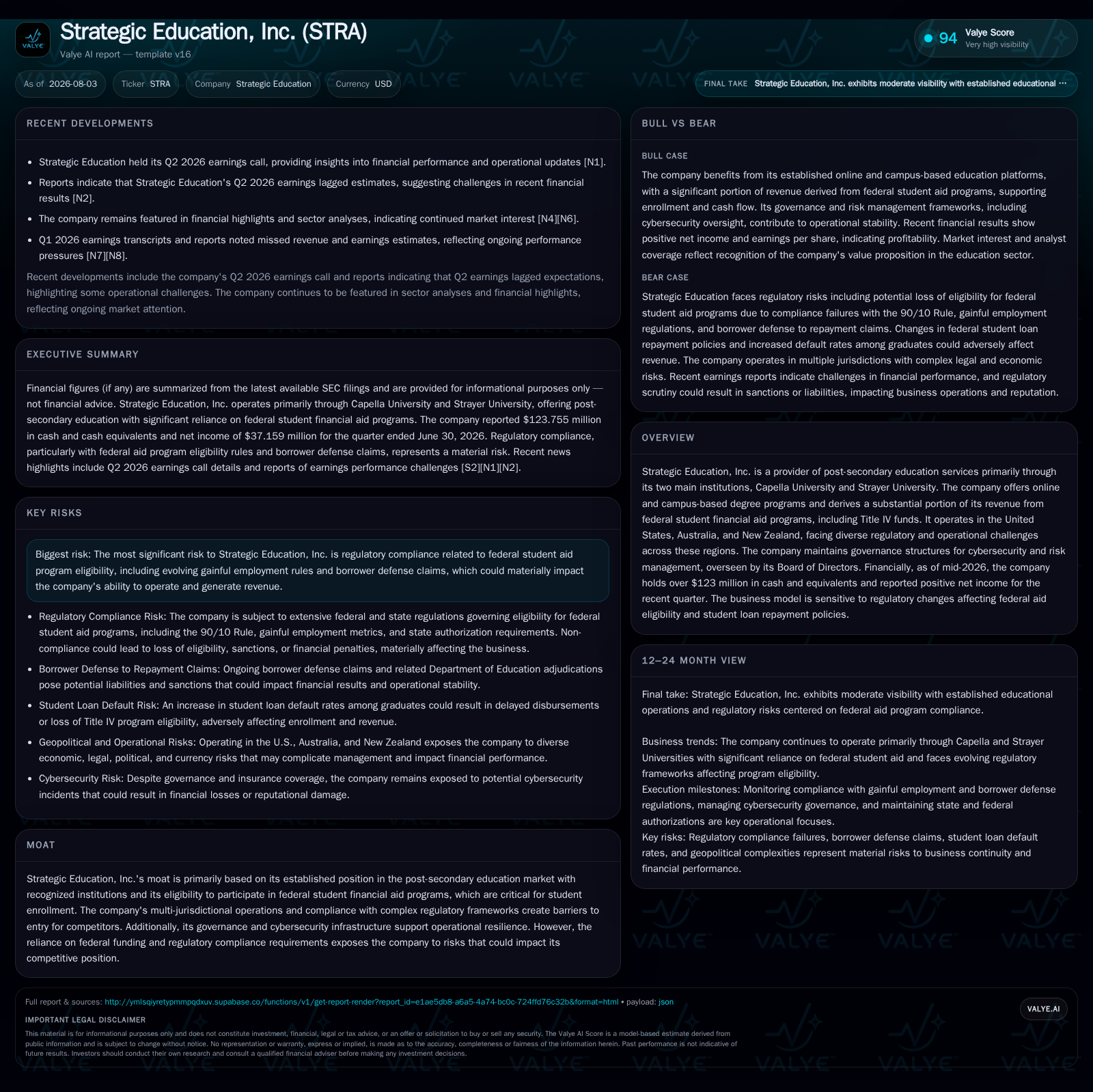
Strategic Education, Inc. (STRA), operating primarily through Capella University and Strayer University, reported positive net income and maintained strong liquidity in Q2 2026 despite persistent regulatory risks linked to federal student aid funding. The company’s business model hinges on federal Title IV funding, which requires strict compliance with regulations such as the 90/10 Rule and gainful employment mandates. Multi-jurisdictional operations across the U.S., Australia, and New Zealand introduce further complexity in regulatory adherence and operational risk. Growth levers focus on expanding online education programs and managing enrollment quality. Key risks remain tied to potential loss of federal aid eligibility, state authorization challenges, and borrower defense claims.
Recent Operating Update: Q2 2026 Financials
Strategic Education’s latest 10-Q for Q2 ended June 30, 2026, reports positive net income supported by $123.8 million in cash and equivalents alongside current assets of approximately $290.1 million against current liabilities of $264.8 million—yielding a current ratio near 1.1, indicative of stable short-term liquidity [F1][S2]. The firm continues to execute active share repurchases, deploying $32.8 million during the quarter under a program increased to $250 million authorization running through year-end 2026 [S17].
While total revenue figures are last available for calendar year-end 2019 at $263.8 million [F1], recent filings underscore the ongoing operational focus on maintaining positive profitability and cash conversion amid external pressures.
Business Model: Federal Aid Dependency within a Dual Delivery Framework
Strategic Education operates primarily through Capella University and Strayer University, which provide accredited post-secondary degree programs delivered via both online platforms and physical campuses across the U.S., Australia, and New Zealand [S1][S24]. Tuition revenue constitutes the primary income source—with a significant proportion funded through federal student financial aid mechanisms under Title IV programs.
Capella University's revenue consists of roughly 68.3% federal education assistance on a cash basis for fiscal year 2025, while Strayer's dependency is notably higher at approximately 88%, reflecting intense sensitivity to federal funding policies [S2]. This concentration underscores strategic emphasis on compliance with the federal 90/10 Rule that mandates proprietary institutions receive less than 90% of revenue from federal funds over two consecutive years.
Non-compliance with these thresholds can trigger provisional certification statuses or outright loss of Title IV eligibility—a material risk that informs enrollment, pricing strategy, and program mix decisions [S22]. Additional revenue streams include state programs and institutional aid; however, changes like the introduction of Workforce Pell Grants effective July 2026—aimed at short-term career-focused credentials—offer opportunities for diversification aligned with labor market demand
Operationally, strategic management balances the cost structure associated with online education platforms versus more capital-intensive campus-based programs to optimize margins. Student enrollment volumes, retention rates, and graduation outcomes directly influence tuition capture, while regulatory accreditation status governs eligibility for government funding—making compliance management both a competitive moat and vulnerability.
Industry Structure and Competitive Position
The post-secondary education sector wherein Strategic Education competes straddles traditional non-profit universities, for-profit providers like Grand Canyon Education and Adtalem Global Education, as well as digital-first platforms such as University of Phoenix. Regulatory oversight by federal agencies shapes competitive dynamics heavily; institutions approved under Title IV command access to subsidized tuition payments fueling enrollment.
Strategic Education’s foothold is buttressed by recognized accreditation across jurisdictions coupled with intricate governance frameworks addressing compliance risks such as borrower defense claims and cohort default rates—which influence continued participation in government-funded aid programs [S29]. Its geographical footprint spanning U.S., Australia, and New Zealand presents both opportunity via broad market access and challenge given heterogeneous regulatory regimes impacting curriculum approval processes and operational mandates [S24][S29].
Compared with peers leaning more extensively into online models or exclusively domestic operations, Strategic Education manages a diversified portfolio but must continuously invest in compliance infrastructure and cybersecurity oversight against emerging threats that could damage reputation or disrupt operations—as reviewed quarterly by its Board Audit Committee [S1].
Growth Drivers
Key growth stems from rising demand for higher education credentials accessible through flexible delivery modes. Expansion of online degree programs enables broader geographic reach without incremental campus capital expenditure constraints—critical given demographic growth trends among college-age populations. Additionally, expanding workforce development-focused offerings qualifying under new Pell Grant frameworks opens avenues for enrollment from non-traditional students seeking rapid reskilling.
International student recruitment efforts align with multi-jurisdictional presence but also depend heavily on maintaining local accreditation standards amid political or economic volatility [S24]. Enhanced student support services aim to improve retention metrics—a vital margin lever given the fixed costs associated with course delivery platforms.
Capital reinvestment strategies balance technology upgrades supporting digital learning experiences against disciplined share repurchases reflecting confidence in sustainable free cash flow generation absent large debt burdens [S17][F1]
Risks and Watchpoints
The foremost risk remains regulatory uncertainty around eligibility for Title IV funds—particularly related to evolving gainful employment standards governing graduate outcomes—and the borrower defense rule that could expose the company to contingent liabilities from past enrollments [S29][S2]
Capella’s proximity to the 90/10 threshold signals ongoing vigilance is necessary lest provisional status impacts marketing or enrollment capacity; similarly, certain states have enacted stricter enrollment funding limits potentially impairing market access if thresholds are exceeded [S2][S29]. Failure to maintain necessary state or foreign authorizations could further constrain operations or Title IV participation locally
Additionally, cybersecurity threats pose enterprise-wide risks due to sensitive student data holdings; governance structures including an experienced CISO reporting lines aim to mitigate incidents but residual exposure persists given evolving threat landscapes [S1]. Political or economic instability abroad adds layers of complexity impacting vendor relationships and currency fluctuations that may affect bottom-line results [S29][S24].
Finally, fluctuations in student loan default rates above federally mandated ceilings would provoke Title IV sanctions limiting tuition revenue inflows—mandating continuous monitoring of loan performance metrics as key operating KPIs [S29]
What to Watch Next
Milestones that will shed light on execution include Q3 enrollment tallies showing impact of Workforce Pell Grant adoption; any announced changes or clarifications around federal funding rules affecting eligibility percentages; updates on state authorization renewals or legislative developments tightening funding thresholds; alongside reported borrower defense claim volumes.
Financial markers such as sequential margin trends reflective of mix shifts between online versus on-campus modalities; changes in retention or graduation statistics signaling academic quality improvements; cyber incident reports handled transparently at board level are also critical indicators.
Management commentary during earnings calls around capital allocation priorities amidst emerging regulation will gauge strategic adaptability.
Financial Profile Discussion
As of June 30, 2026, Strategic Education maintains approximately $123.8 million in cash and equivalents against current liabilities totaling about $264.8 million yielding a current ratio near 1.1—suggesting stable near-term liquidity despite sizeable operational scale represented by current assets just north of $290 million [F1]
Share repurchase activity demonstrates management’s prioritization of returning capital within an environment where alternative uses are weighted against investment needed for regulatory compliance systems or technology upgrades enhancing program delivery efficiency [S17]. Operating income last reported annually through calendar-year-end 2025 stood healthy at $174.2 million with net income at $126.6 million validating profitability amidst these industry headwinds [F1].
These metrics corroborate an operational profile balancing scale economics against federally-influenced regulatory constraints typical among peer publicly-traded for-profit education providers—underscoring the crucial importance of sustaining eligibility for government financial aid as a cornerstone to revenue durability.
Disclaimer: This is research-only, informational analysis and not investment advice. It may include AI-generated interpretation and general industry context. Always verify important details using primary sources.

Comments