
Kforce Advances Flex Staffing Amid AI-Driven Demand Shifts in Q2 2026
Kforce’s Q2 2026 results reveal resilience in temporary staffing despite macroeconomic pressures and evolving AI impacts on client hiring.
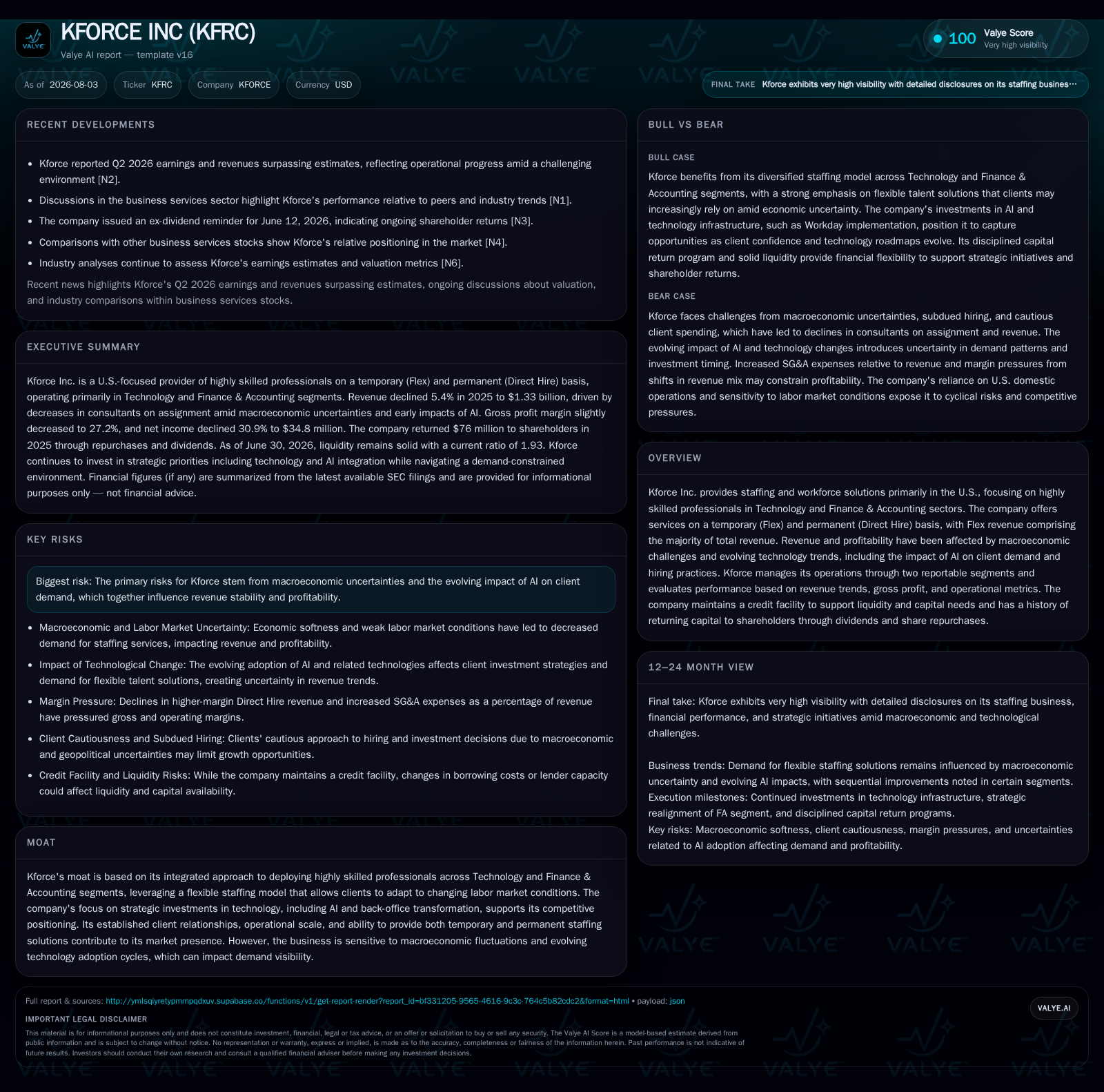
In the second quarter of 2026, Kforce Inc. demonstrated moderate recovery in its core flex (temporary) staffing revenue segments, offsetting some pressure from lingering macroeconomic uncertainty and technology adoption cycles, including AI influences on workforce demand. The company’s dual focus on Technology and Finance & Accounting professionals sustains its competitive role as a provider of skilled workforce solutions, although revenue softness and margin compression persist from prior quarters. Kforce’s capital structure remains stable with a strong current ratio, supporting liquidity as it continues returning capital to shareholders. Key growth drivers include growing client preference for flexible talent amid ongoing technology shifts, while risks stem chiefly from demand volatility tied to economic conditions and AI-related business model changes.
Recent Operating Update and Why It Matters
This recent update is critical because it suggests that while macroeconomic pressures remain salient—affecting demand visibility—Kforce's pivot towards highly skilled flex staffing in Technology and Finance & Accounting sectors maintains relevance as clients seek agility during workforce transformation. The firm’s statements emphasize strategic investments in technology-driven capabilities which should help preserve or grow market share even as some clients reassess long-term hiring plans.
Business Model: How Kforce Makes Money
Kforce operates primarily as an intermediary supplying skilled professionals to corporate clients on two fronts: temporary placements (Flex) billed on hourly rates, and permanent placement services (Direct Hire) generating one-time placement fees. The vast majority of revenue derives from flex contracts—temporarily embedding consultants onsite or virtually within client operations—which provides recurring billing streams highly sensitive to consultant utilization and average billing rates [S1]. Direct Hire placements despite their much lower contribution serve as a complementary solution for clients seeking permanent talent acquisition.
The company segments its operations into Technology and Finance & Accounting verticals, reflecting distinct skill sets and client bases. Given Technology roles’ premium pricing power due to high specialization, this segment tends to yield higher gross profit margins. Kforce manages candidate sourcing, payroll compliance, benefits administration, and contractor management—functions adding operational complexity but creating switching costs and embedding client relationships over time.
From a monetization perspective, key revenue drivers include:
- Number of consultants on assignment (volume)
- Average hourly billing rate or placement fees (price/mix)
- Utilization rate of deployed consultants (efficiency)
Margins are impacted by the mix shift between flex and direct hire revenues (direct hires typically carry higher margin but lower volume), pricing pressures from competition or market supply/demand imbalances, and SG&A costs needed to attract talent and support client service.
Industry Structure and Competitive Positioning
The staffing services industry is marked by sensitivity to economic cycles: during downturns or uncertainty phases, companies cut or slow hiring especially permanent roles while leaning more heavily on flexible labor models. This cyclical nature exposes firms like Kforce to volatile revenues tied to billable hours trends.
Competition is intense; Kforce competes against large diversified firms such as Robert Half International and ManpowerGroup that leverage global scale and diversified services portfolios as well as other specialized pure-play providers focusing on Technology or Finance staffing niches. Unlike generalists who serve broader industries or labor categories, Kforce’s focused approach enhances its ability to target high-demand skill sets but also requires continuous investment in talent networks and technology platforms to maintain competitive edge.
Importantly, rapid adoption of AI tools affects skill requirements fundamentally—reducing demand for some legacy IT roles while amplifying new specialized technical needs such as data science or machine learning engineering—posing both challenges for talent supply management and opportunities for differentiation through expert matching.
Growth Drivers
Several tailwinds underpin growth prospects:
- Increasing Client Adoption of Flexible Workforce Models: As businesses prioritize agility amid ongoing economic uncertainty, temporary staffing offers an attractive alternative to fixed employment commitments.
- Technology Sector Demand: Growth in cloud computing, cybersecurity, artificial intelligence deployments continually fuels requirement for high-skilled IT professionals where Kforce focuses.
- Strategic Investments in Back-Office Transformation: Enhancements in digital sourcing platforms streamline recruitment cycles improving consultant fill-rates and client satisfaction.[S2]
- Regulatory Complexity: Companies outsourcing intricate employment compliance demands can rely more heavily on external staffing partners like Kforce.
- Cost-Control Imperatives: Clients increasingly seek efficient staffing spend optimized via variable workforces rather than full-time hiring.
Monitoring KPIs such as Technology segment flex revenue growth rates, billable hours utilization improvements, increasing average billing rates without margin erosion will be crucial indicators of execution success.
Risks and Watchpoints
Key risks tempering upside potential include:
- Macroeconomic Downturns: Persistent economic uncertainty can trigger cutbacks in discretionary IT projects directly impacting consultant demand.
- AI-Induced Skill Disruptions: While AI drives new demand areas it simultaneously subjects legacy roles to obsolescence pressure reducing associated staff placements.[S2]
- Pricing Pressure: Elevated competition combined with wage inflation can compress gross profit margins if not offset by price increases or productivity gains.
- SG&A Expense Leverage: Declining revenue coupled with fixed overhead costs can pressure operating margins absent efficient cost management.[S1]
- Client Concentration: Overreliance on specific large clients or vertical markets may amplify exposure if those accounts reduce spend suddenly.
- Regulatory Compliance Risks: Changes in labor laws or tax legislation could increase operational complexity or costs.[S1]
- Talent Supply Constraints: Scarcity of highly skilled candidates complicates rapid fulfillment impacting client satisfaction.[S2]
What To Watch Next
Stakeholders should track several milestones:
- Quarterly updates on flex versus direct hire revenue trends reflecting shifts in hiring preferences.
- Progress against strategic investments articulated around digital sourcing platforms and AI-enabled recruiting enhancements.
- Changes in gross profit margins within Technology vs Finance & Accounting segments signaling pricing power or cost pressures.
- Billable hours utilization rates indicating efficient deployment of consultants versus bench periods.
- Client retention statistics reflecting relationship stability amid competitive poaching risk.
- SG&A expense controls relative to topline changes showcasing operating leverage scalability.
- Potential updates on credit facility usage or refinancing affecting financial flexibility given industry cyclicality.
Financial Profile Discussion
Kforce's financial foundation reflects a solid liquidity position with approximately $330 thousand in cash and equivalents as of June 30, 2026, supported by current assets of about $231 million against current liabilities near $120 million, yielding a current ratio of approximately 1.93x [F1]. This liquidity buffer supports operational continuity amid typical staffing industry fluctuations. While total debt figures have not been updated recently, prior disclosures indicated moderate leverage around $100 million; however, no current net debt or leverage metrics are available to provide a precise assessment [F1].
Marginal deterioration in gross profit margins amid top-line softness coupled with SG&A rising from earlier periods led to compressed operating income results in fiscal 2025—a pattern likely persisting into early 2026 requiring careful cost management. Despite earnings volatility influenced by restructuring charges recognized late last year ($3.4 million non-recurring charge impacting EPS), Kforce has sustained regular capital returns through dividends and share buybacks totaling $76 million during the latest fiscal year period underscoring commitment towards shareholder returns aligned with free cash flow generation capacity [S1]. This balance between reinvestment into strategic priorities (e.g., technological infrastructure) alongside prudent capital distribution remains critical given macro environment unpredictability.
Conclusion
Kforce exhibits resilience navigating macroeconomic turbulence compounded by transformative technological developments reshaping labor demand within its primary sectors—the combination positioning its flexible staffing model as relevant amidst shifting corporate workforce strategies. The company’s continued emphasis on Technology segment expansion along with operational digitization investments signals adaptive management aligned with evolving market realities. However, persistent risks including uncertain AI impacts on consultative roles, margin pressures from competitive forces/wage inflation, plus cyclicality inherent to staffing services validate ongoing vigilance over core KPIs such as billable utilization rates, segmental flex revenues, gross profit dynamics, and SG&A efficiencies.
As competitors concurrently enhance scale or diversify service offerings (Robert Half among peers), Kforce’s specialized niche focus balanced offering presents distinct advantages yet also demands accelerated innovation velocity coupled with disciplined financial stewardship—especially managing working capital needs prudently while supporting capital returns initiatives. Tracking execution against these priorities across upcoming quarters will illuminate whether improving labor market sentiment materializes into durable growth or if structural headwinds require strategic recalibration.
This analysis is intended for informational purposes only without any investment advice or research views regarding securities transactions involving Kforce Inc.
Disclaimer: This is research-only, informational analysis and not investment advice. It may include AI-generated interpretation and general industry context. Always verify important details using primary sources.

Comments