
MiMedx Group Accelerates Strategic Transformation and Merger with Sanara MedTech in Q2 2026
MiMedx’s second quarter of 2026 highlights operational restructuring aimed at cost efficiencies alongside a material merger agreement with Sanara MedTech.
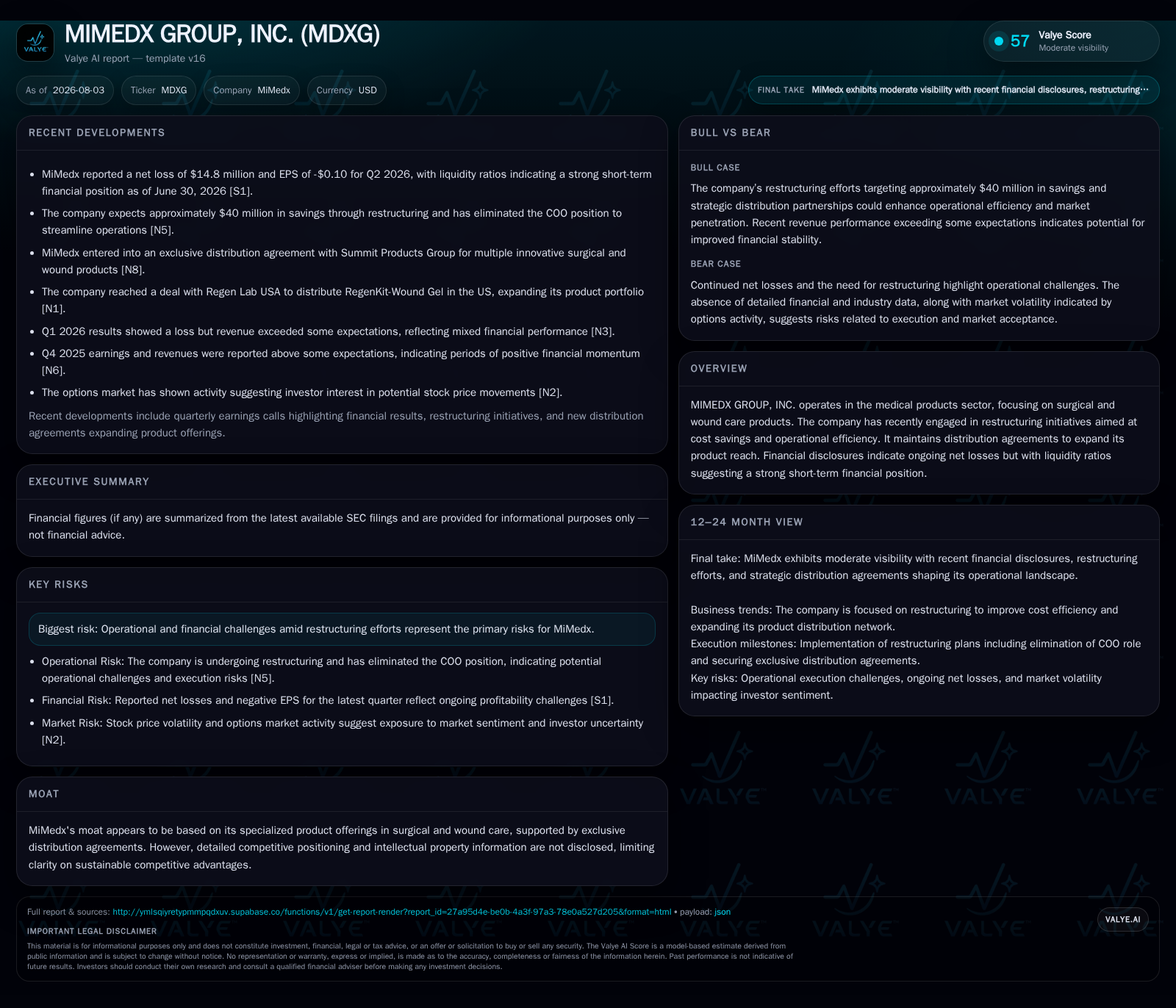
In Q2 2026, MiMedx Group, Inc. maintained focus on operational efficiency through ongoing restructuring initiatives amid sustained net losses but reported a robust liquidity position. The company entered a definitive merger agreement with Sanara MedTech featuring a $300 million debt financing commitment, signaling strategic consolidation in the surgical and wound care segment. While MiMedx’s product specialization in biologic grafts and wound care materials offers a defensible niche, execution risks related to integration and reimbursement pressures remain. Key near-term milestones include regulatory approvals for the merger and monitoring clinical adoption rates which underpin revenue growth.
Recent Operating Update: Q2 2026 Filing and Merger Agreement
MiMedx Group’s latest reported quarterly filing (10-Q dated July 29, 2026) underscores a continuation of its operational restructuring efforts designed to drive cost savings and improve operating leverage within its medical products segment specializing in surgical biologics and wound care products [S2]. While the filing confirms no material shifts in previously disclosed risk factors [S15], it reveals strategic moves manifesting beyond internal cost controls.
Most notably, MiMedx announced an Agreement and Plan of Merger with Sanara MedTech Inc. on July 29, 2026 [S3]. The transaction involves MiMedx’s wholly-owned subsidiary merging into Sanara with Sanara surviving as a subsidiary under MiMedx control. Both boards approved the transaction unanimously signaling strong governance alignment. Financing for this deal includes a newly committed $300 million senior secured term loan facility that will refinance existing credit lines upon consummation [S25]. This decisive capital structure move suggests management's confidence in transformative scale benefits from combining operations.
An attached investor presentation outlines expected synergistic outcomes centered on complementing surgical biologics product portfolios and boosting market penetration especially in placental tissue-related therapeutics [S26].
Business Model: Specialized Biologics with Distribution Leverage
MiMedx operates primarily within manufacturing and distribution roles along the medical products value chain focused on advanced surgical tissue grafts and regenerative medicine solutions such as amniotic membrane products used in acute or chronic wound care contexts. Customers typically comprise hospitals, outpatient clinics, surgical centers, and third-party distributors contracted on either direct sales or volume-based terms.
Revenue generation stems directly from product sales where pricing power hinges on reimbursement policies—particularly Medicare—and clinical efficacy supporting faster wound healing or surgical outcomes [N1]. Maintaining exclusive or preferential distribution agreements helps expand geographic reach and solidify competitive positioning by enhancing customer retention rates
Operationally, margins are influenced by product mix evolution towards higher-value placental tissue offerings combined with tight supply chain management for sensitive biologic raw materials.
Industry Structure and Competitive Position
Within the surgical and wound care products segment, MiMedx faces competition from firms such as Organogenesis, Integra LifeSciences, and Acelity/KCI which also offer biologic implants or advanced wound dressings. Unlike peers who may have diversified portfolios including other device categories or international presences, MiMedx’s strength rests heavily on its amniotic membrane product line coupled with selective distribution agreements that limit direct substitution threats.
Barriers to switching are moderate due to clinical adoption reliance; surgeons’ preference for proven regenerative products plus verified reimbursement pathways provide modest pricing durability but also expose the firm to payer-driven pricing pressure risks. Regulatory scrutiny remains intense given the nature of human tissue-based products requiring FDA clearance or compliance protocols that can lengthen time-to-market for innovations.
Growth Drivers
Several tailwinds drive MiMedx’s addressable market expansion: rising prevalence of chronic wounds driven by aging demographics; increasing volume of surgical procedures demanding superior healing aids; technological progress in regenerative medicine enhancing product efficacy; expansion of distribution channels domestically; incremental clinical evidence publication fostering broader physician adoption; reimbursed therapy frameworks especially under Medicare policy improvements; partnerships facilitating new care settings like outpatient wound centers; and growing awareness of optimized wound management best practices among clinicians.
Each factor influences key operating variables — net sales growth tracks increased unit volumes plus broader portfolio penetration while adjusted EBITDA margin reflects efficiency gains from scaling operations post-restructuring initiatives [N1][S3]
Risks and Watchpoints
Despite the promising strategic trajectory marked by the merger deal, several risks warrant close attention:
- Potential delays or failure to meet regulatory conditions could postpone or derail merger completion
- Integration challenges might disrupt sales continuity or inflate operating expenses temporarily
- Medicare reimbursement adjustments remain volatile potentially compressing revenues or shifting product demand
- Supply chain risks for sourcing human-derived tissues could impair fulfillment capability affecting customer satisfaction
- Macroeconomic headwinds including inflationary pressures might raise cost of goods sold against limited pricing flexibility
- Clinical evidence supporting therapeutic claims remains an evolving landscape subject to competitor innovation
- Litigation risks pertaining to product safety or IP disputes could arise given sector sensitivity
- Market acceptance is partially contingent on evolving surgeon preferences amid alternative technologies or non-biological substitutes
Continuous monitoring of these factors alongside management communication on mitigation strategies will prove vital.
What to Watch Next
Near-term milestones comprise closing of the merger transaction pending shareholder votes and regulatory approvals, anticipated during late 2026 or early 2027 based on typical timelines for such deals [S3][S25]. Observers should follow developments about post-merger integration plans focusing on efficiency gains realization as well as capital deployment from newly committed debt facilities.
On the commercial front, tracking net sales momentum—especially within placental tissue markets—and margin improvement trends via quarterly disclosures will provide insight into restructuring effectiveness. Additionally, updates concerning Medicare reimbursement policies relevant to amniotic membrane therapies will materially impact revenue outlook.
Management’s success in broadening distribution agreements domestically or internationally will also serve as critical growth indicator while ongoing clinical data releases supporting product adoption can sustain competitive defensibility.
Financial Profile Discussion
MiMedx holds a solid balance sheet position as of June 30, 2026 with approximately $136 million in cash & equivalents against current liabilities near $38.5 million yielding a strong current ratio above 5.3 — indicative of robust short-term liquidity buffers useful in absorbing operational volatility [F1]. Total debt stood near $50 million based mainly on prior reporting periods but is slated for full repayment concurrent with the new $300 million debt funding tied to the pending merger [F1][S25].
Though historically operating at net losses reflecting heavy restructuring costs common in medical product transformations [N1], sustained investment into R&D alongside focused expense controls targets adjusted EBITDA margin enhancement over time.
Disclaimer: This analysis is intended solely for informational purposes reflecting data available as of August 2026 without providing any investment advice. Readers should perform their own due diligence respecting forward-looking uncertainties inherent in corporate transactions and medical product markets.
Disclaimer: This is research-only, informational analysis and not investment advice. It may include AI-generated interpretation and general industry context. Always verify important details using primary sources.

Comments