
Preformed Line Products Strengthens Order Momentum with Energy Sector Demand Surge
PLPC’s Q2 results reveal robust growth in energy infrastructure product orders amid ongoing raw material and tariff challenges.
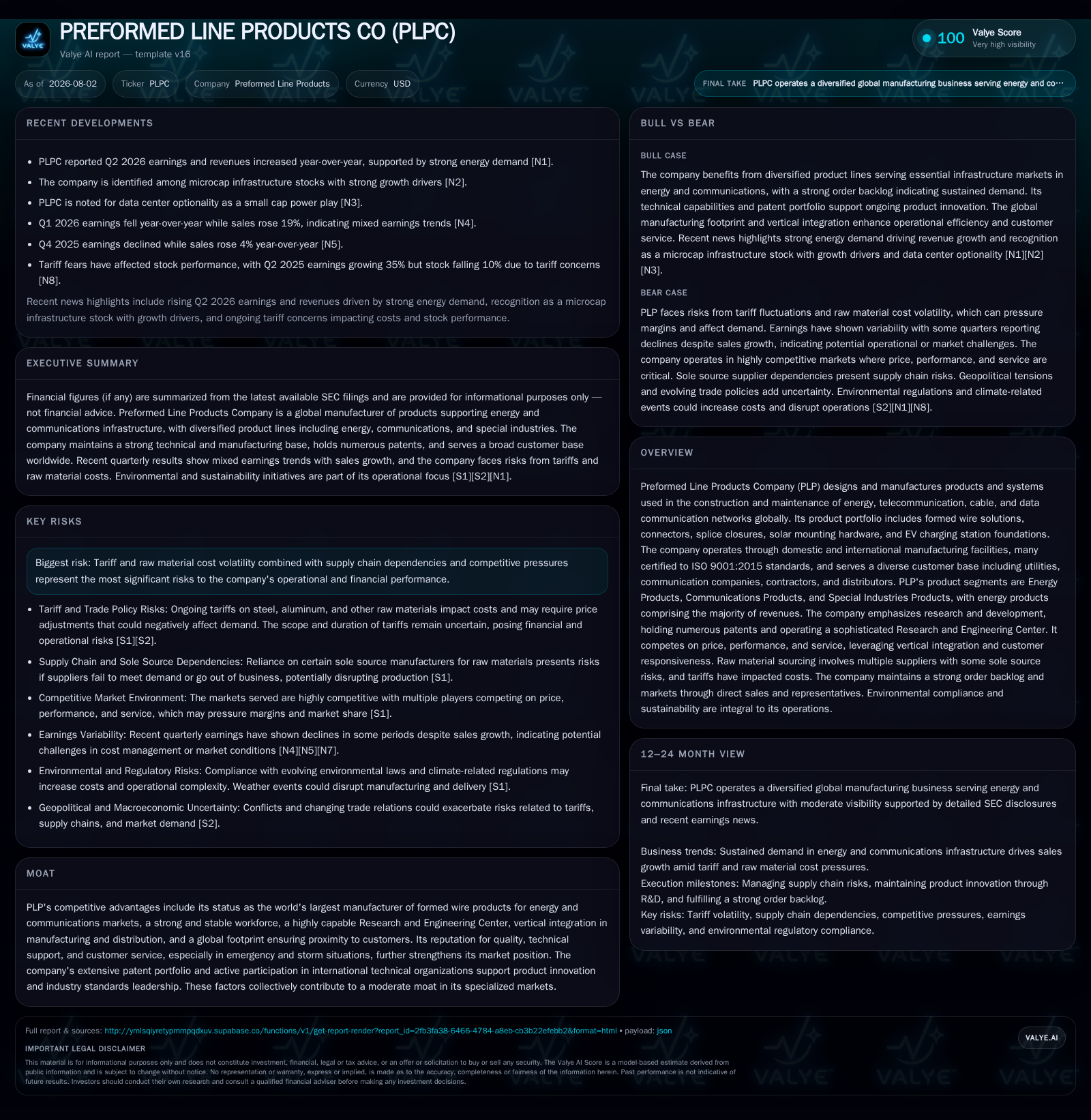
Preformed Line Products Company (PLPC) reported a significant year-over-year revenue increase in Q2 2026 driven by strong demand for formed wire products serving the energy transmission and distribution sector. The company’s vertically integrated manufacturing and distribution model, supported by globally ISO 9001:2015 certified facilities, enhances operational resilience in the face of raw material cost volatility and tariff uncertainties. PLPC’s sustained investment in R&D and its patent portfolio underpin a competitive moat, while emerging opportunities in communications infrastructure and special industries add diversification. Key risks remain around steel and polymer price fluctuations and competitive pricing pressures.
Q2 Demand Uptick Reinforces Energy Product Leadership
Integrated Manufacturing Fuels Operational Stability Amid Cost Pressures
PLPC’s vertically integrated business model—spanning from raw material processing through finished product distribution—is a critical factor enabling the company to better navigate persistent supply chain disruptions and raw material price volatility [S1][S2]. This end-to-end control improves manufacturing capacity utilization rates by reducing reliance on third-party suppliers subject to longer lead times or inflated costs. Additionally, all key domestic and international plants maintain ISO 9001:2015 certification status, reinforcing consistent process quality that supports customer retention especially among regulated public utilities [S1]. While tariffs on steel and polymers remain an ongoing challenge, PLPC's tight operational controls have helped preserve gross margins amid inflationary pressures.
Innovation and Patent Portfolio Sustain Competitive Differentiation
A defining attribute of PLPC’s competitive positioning is its substantial ongoing investment in research and development conducted at a dedicated Research & Engineering Center [S1]. This commitment sustains a robust patent portfolio mainly covering proprietary formed wire technologies, connectors, and splice closures that raise switching costs for customers and limit commoditization risk. The innovation pipeline enables differentiation through improved product performance such as enhanced durability or installation efficiency—key criteria for infrastructure operators managing complex networks under tight regulatory scrutiny. In comparison to general industrial hardware peers like Hubbell Incorporated or nVent Electric plc, PLPC demonstrates above-average R&D intensity relative to revenue, supporting sustained pricing power despite mature market segments.
Quality Certifications Bolster Market Access and Customer Confidence
The breadth of ISO 9001:2015 certifications across PLPC's manufacturing footprint plays a pivotal role in securing business from large utility clients that require stringent adherence to quality standards globally [S1]. Compliance with these internationally recognized protocols facilitates smoother regulatory approvals, consistent product specifications across markets, and increases trust among contractors deploying mission-critical infrastructure components. Such certifications also act as barriers to entry for smaller competitors lacking the scale or process rigor necessary to serve heavily regulated industries efficiently.
Expanding End Markets: Communications and Special Industries Set to Accelerate
Beyond traditional energy transmission products comprising roughly seven out of ten dollars in revenue [S1], PLPC is strategically expanding its presence in communications infrastructure hardware such as rugged outside plant (OSP) splice closures for fiber optic cable networks [S1][N3]. Growth here benefits from accelerating fiber deployments supporting next-generation broadband rollouts worldwide. Additionally, the nascent but promising Special Industries segment—including solar mounting hardware and precision-engineered EV charging station foundations—provides avenues for margin enhancement alongside diversification away from cyclical energy construction spending patterns. These trends tally with broader infrastructure modernization themes embracing renewable energy and electric vehicle adoption bolstered by government stimulus programs [N3].
Risks to Watch: Tariffs, Raw Material Volatility, and Competitive Pricing
Despite operational strengths, PLPC continues to face significant headwinds related to input cost inflation predominantly driven by steel and polymer commodity price swings combined with tariff uncertainties impacting supply chains [S1][S2]. Fluctuations in these raw materials can compress operating leverage particularly if price hikes cannot be fully passed onto customers without weakening demand. Furthermore, intensified competition among industrial component suppliers may constrain pricing flexibility or delay projects indirectly affecting order timing. Monitoring tariff developments particularly involving U.S. trade policy will be important as any new measures could alter cost structures materially.
Growth Catalysts: Infrastructure Modernization, Renewable Energy, and EV Deployments
Looking ahead, secular drivers underpinning sustained capital investments support an optimistic medium-term outlook for PLPC’s end markets [N3]. The global push for smart grid upgrades necessitates advanced formed wire solutions integrated with optical monitoring cables (e.g., OPGW and ADSS cable). Simultaneously expanding fiber optic broadband networks boost demand for rugged communication closures where PLPC holds technical expertise. The rapid rise of renewable power installations requiring specialized mounting hardware coupled with the burgeoning EV charging station rollout further diversify demand channels. Government infrastructure stimulus programs across major markets are likely to reinforce these trends creating multi-year visibility into core components provided by PLPC.
Financial Profile Discussion: Liquidity Strong While Margin Pressure Persists
At quarter-end June 30, 2026, Preformed Line Products maintained a current ratio near 3.0x with current assets significantly exceeding current liabilities—$397 million versus $133 million respectively—indicating solid short-term liquidity able to absorb working capital fluctuations typical in industrial manufacturing cycles [F1]. Total debt stood at approximately $41 million while net debt after cash was roughly $10 million [F1], reflecting manageable leverage supportive of ongoing investment in capacity expansion or R&D initiatives without jeopardizing financial flexibility. However, gross margin compression stemming from raw material inflation remains an area to watch closely as this will moderate operating profit growth despite strong top-line trends.
What Investors Should Monitor Next
Key milestones for subsequent quarters include verifying if order backlog growth sustains across both domestic and international markets given continuing macroeconomic volatility [S2]. Close attention should be paid to any shifts in manufacturing capacity utilization rates signaling operational tightening or expansion tied to demand projections. Management commentary on tariff evolutions will provide critical insights regarding input cost outlooks while updates on new product introductions from the R&D pipeline could foreshadow incremental margin improvement potential. Lastly, efforts toward further geographic penetration enabled by ISO certification expansions or service footprint broadening will illustrate progress toward diversified revenue streams beyond traditional energy sectors [S3].
This analysis synthesizes company-reported information from the latest SEC quarterly filings combined with recent news coverage within the context of industrial hardware sector dynamics focused on energy transmission/distribution network components. It highlights how Preformed Line Products leverages vertical integration alongside innovation-driven differentiation strategies enabling it to capitalize on robust infrastructure investment trends despite supply chain challenges common across manufacturing peers.
Disclaimer: This document is for informational purposes only and does not constitute investment advice or research views.
Disclaimer: This is research-only, informational analysis and not investment advice. It may include AI-generated interpretation and general industry context. Always verify important details using primary sources.

Comments