
Solstice Advanced Materials Advances Innovation and Integration Ahead of Element Solutions Merger
Solstice reports operational expansions and innovation milestones in Q2 2026 while navigating merger-related integration complexities.
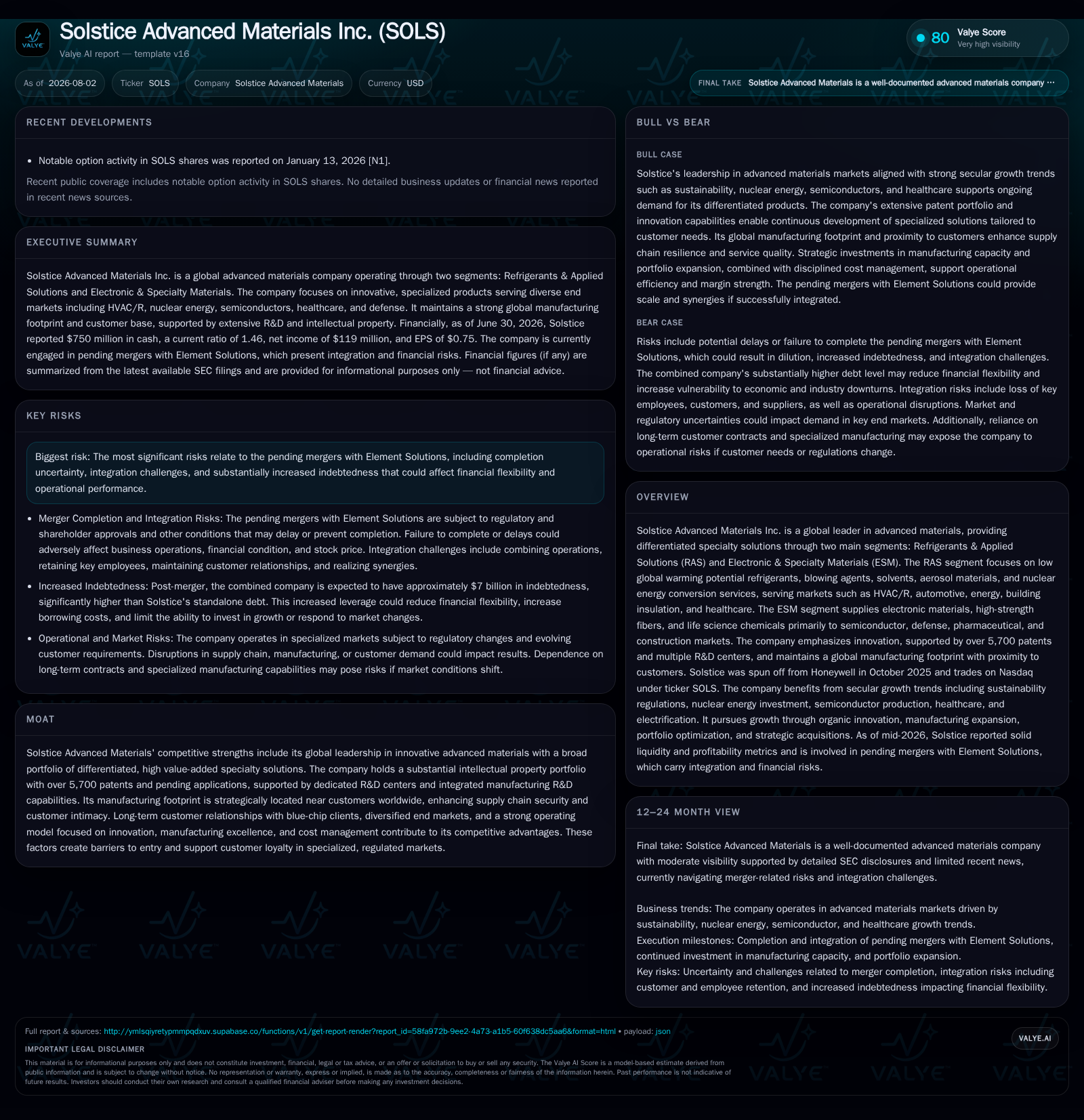
In its latest quarterly filing, Solstice Advanced Materials confirms ongoing capacity expansions across both Refrigerants & Applied Solutions and Electronic & Specialty Materials segments, aligning supply with structural demand growth driven by sustainability regulations and semiconductor market dynamics. The company’s robust patent portfolio and investment in R&D continue to underpin differentiated specialty product offerings essential for customer retention and pricing power. Meanwhile, Solstice faces merger execution risks as it prepares to combine with Element Solutions, potentially impacting shareholder dilution and operational integration. Industry secular trends in climate-driven refrigerant demand, electronics materials growth, and defense applications support the company’s diverse segment exposure.
Q2 Operating Momentum: Capacity Expansion Aligning with Demand Growth
Solstice Advanced Materials reported continued operational progress in Q2 2026 with strategic capacity expansions in both its Refrigerants & Applied Solutions (RAS) and Electronic & Specialty Materials (ESM) segments [S2][S3]. The expansions aim to address anticipated long-term customer demand exceeding current production capabilities—a pattern consistent with supply chain tightening seen industry-wide in specialty chemicals. These moves bolster Solstice's ability to serve industrial end markets such as HVAC/R systems benefiting from evolving environmental regulations pushing demand for low global warming potential (LGWP) refrigerants, alongside rising needs for semiconductor materials amid ongoing advanced node investments. The company's emphasis on situating manufacturing close to customers further enhances supply chain security and responsiveness, crucial in mitigating disruption risk common in specialty chemical manufacturing.
Innovation Leadership Driving Differentiated Specialty Product Lines
A cornerstone of Solstice's competitive advantage lies in its intensive investment in research and development (R&D), supporting an intellectual property portfolio exceeding 5,700 patents and pending applications as of year-end 2025 [S1][F1]. This robust patent base enables a product differentiation strategy centered on proprietary chemical formulations like LGWP refrigerants, blowing agents, specialty solvents, sputtering targets for semiconductors, and ultra-high molecular weight polyethylene (UHMWPE) fibers branded under the Spectra name. The company targets a diverse set of high-growth markets where specialized performance parameters allow premium pricing and foster durable customer relationships through technical collaboration. R&D expenditure as a percentage of sales remains elevated relative to peers, reflecting Solstice’s commitment to innovation-driven value creation.
Complex Industry Structure: Dual Segments Serving Diverse High-Value Markets
Solstice operates through two principal reportable segments that strategically diversify exposure across technology-led industrial markets. The RAS segment focuses on low GWP refrigerants, blowing agents, aerosol propellants, solvents, nuclear energy conversion services, and healthcare packaging materials distributed predominantly via contracts spanning one to ten years depending on the sub-market [S1][S25]. These longer-duration contracts often contain fixed pricing mechanisms or cost recovery clauses enhancing revenue visibility. On the other hand, the ESM segment supplies high-purity electronic chemicals such as etchants and wafer-thinning agents along with high-strength fibers particularly relevant to semiconductor fabrication cycles, defense armor applications through Spectra fibers, pharmaceutical manufacturing chemicals, construction chemicals, and life science solutions [S1]. This segmentation provides balance between the somewhat cyclical semiconductor-driven ESM demand—which is sensitive to economic fluctuations—and more defensive healthcare packaging within RAS.
Secular Growth Catalysts: Sustainability, Semiconductor Demand, Defense Applications
Several structural industry tailwinds underpin Solstice's growth outlook. Regulatory pressure globally mandates transition away from high global warming potential refrigerants toward LGWP alternatives—a trend directly fueling RAS sales expansion [S1][S2]. In ESM, the enduring growth in semiconductor fabrication capability necessitates increasingly pure sputtering targets and specialty wet chemicals aligned with advanced device nodes. Additionally, the rise in defense spending augments demand for lightweight but ultra-strong UHMWPE fibers used in protective armor systems; these fibers offer significant advantages over conventional steel counterparts [S1]. Healthcare packaging benefits from rising pharmaceutical output emphasizing barrier materials that combine durability with regulatory compliance. These converging sustainability mandates and technological upgrades create robust demand streams that shape segment revenue growth patterns.
Merger Implications: Integration Readiness Amid Ownership Dilution Concerns
Solstice disclosed a pending merger with Element Solutions initiated July 2026 that would issue approximately 126 million new common shares potentially diluting existing shareholders’ ownership stakes from pre-merger levels [S2]. Post-merger share ownership is projected at roughly 56% for Solstice holders versus about 44% for Element shareholders as of signing. This transaction hinges on multiple conditions including securing regulatory reviews without prohibitive legal restraints—introducing uncertainty around timing or completion [S2]. While management anticipates synergies arising from combined operations expanding the adjusted EBITDA margin profile and free cash flow capability [S4], integration complexity remains a key execution risk factor given operational overlap between companies active in specialty chemical markets. Control dilution also signals reduced influence for legacy Solstice investors which may impact governance dynamics.
Risk Factors Spotlight: Regulatory Dynamics, Supply Chain Security & Merger Uncertainty
The company’s most material risks center on regulatory shifts particularly those governing refrigerant formulations that may necessitate costly reformulations or capital outlays [S1]. Supply chain disruptions borne from raw material price volatility or delivery delays pose concrete production challenges given complex chemical processing requirements—a risk partially mitigated by the company's strategically dispersed global manufacturing footprint encompassing approximately 20 plants worldwide [S1][S11]. Integration challenges following the proposed Element Solutions merger add further potential hurdles; any delays or cost overruns could negatively affect operating performance. Additionally noteworthy are typical sector risks including geopolitical trade restrictions impacting international operations, exposure to currency fluctuations due to significant overseas sales presence (~120 countries served), environmental compliance liabilities inherent in chemical manufacturing processes alongside cyber-security threats affecting operational continuity.
Monitoring Milestones: Order Backlog Progress, Regulatory Approvals & Integration Updates
Key near-term indicators tracking Solstice’s trajectory include order backlog measurements that reflect forward demand strength especially as major contract renewals roll out—anchored by multi-year agreements providing revenue visibility [S1][S2]. Regulatory approvals for new or reformulated products—particularly within LGWP refrigerants—will be vital markers validating innovation pipeline execution. Progress on merger milestones such as regulatory clearances or shareholder approvals will shape investor sentiment around integration feasibility [S2][S3]. Additional cues will emerge from ongoing disclosure around synergy realization targets post-merger alongside updates on capital deployment aligned with incremental manufacturing capacity projects.
Financial Profile Discussion
Although detailed financial analysis is constrained by policy scope limitations here, it is pertinent to note from the latest quarter ending June 30, 2026 that Solstice maintains a solid liquidity position evidenced by cash and equivalents totaling approximately $750 million against total debt near $2.06 billion—a net debt figure of roughly $1.31 billion—with a current ratio of about 1.46 indicating adequate working capital coverage [F1][S2]. These metrics suggest reasonable short-term financial flexibility allowing continued investment in innovation and capacity expansion ahead of merger closing while managing leverage levels prudently amidst pending transaction-related uncertainties.
This analysis integrates recent quarterly disclosures with annual reporting context to delineate Solstice Advanced Materials’ business model grounded in innovation-driven specialty chemical formulations across two broad segments serving regulated and technologically sophisticated markets. The company’s extensive patent portfolio combined with geographically diversified manufacturing enables it to maintain pricing power amid shifting regulatory environments emphasizing sustainability mandates particularly within refrigerants markets. While secular growth drivers remain favorable through expanding demand for environmental solutions, semiconductors, defense fibers, and healthcare packaging materials, the impending merger with Element Solutions introduces notable integration risks that require close observation alongside operational execution benchmarks such as capacity utilization improvements and order backlog trends.
Readers should monitor quarterly updates for confirmation of positive order growth signals alongside regulatory progress on new product approvals while assessing merger integration developments carefully given their material impact prospects on ownership structure and operating synergies. Risks linked to raw material cost volatility, supply chain constraints, evolving government regulations particularly environmental policies impacting product portfolios remain persistent variables influencing operating results moving forward.
This report does not provide investment advice but aims to clarify key business drivers shaping Solstice Advanced Materials’ ongoing evolution within the specialty chemicals and advanced materials industry context.
Disclaimer: This is research-only, informational analysis and not investment advice. It may include AI-generated interpretation and general industry context. Always verify important details using primary sources.

Comments