
Fulcrum Therapeutics Restructures Amid Clinical Setbacks and Strategic Review
Clinical-stage biotech Fulcrum Therapeutics confronts key pipeline disruptions while pursuing strategic alternatives and capital preservation.
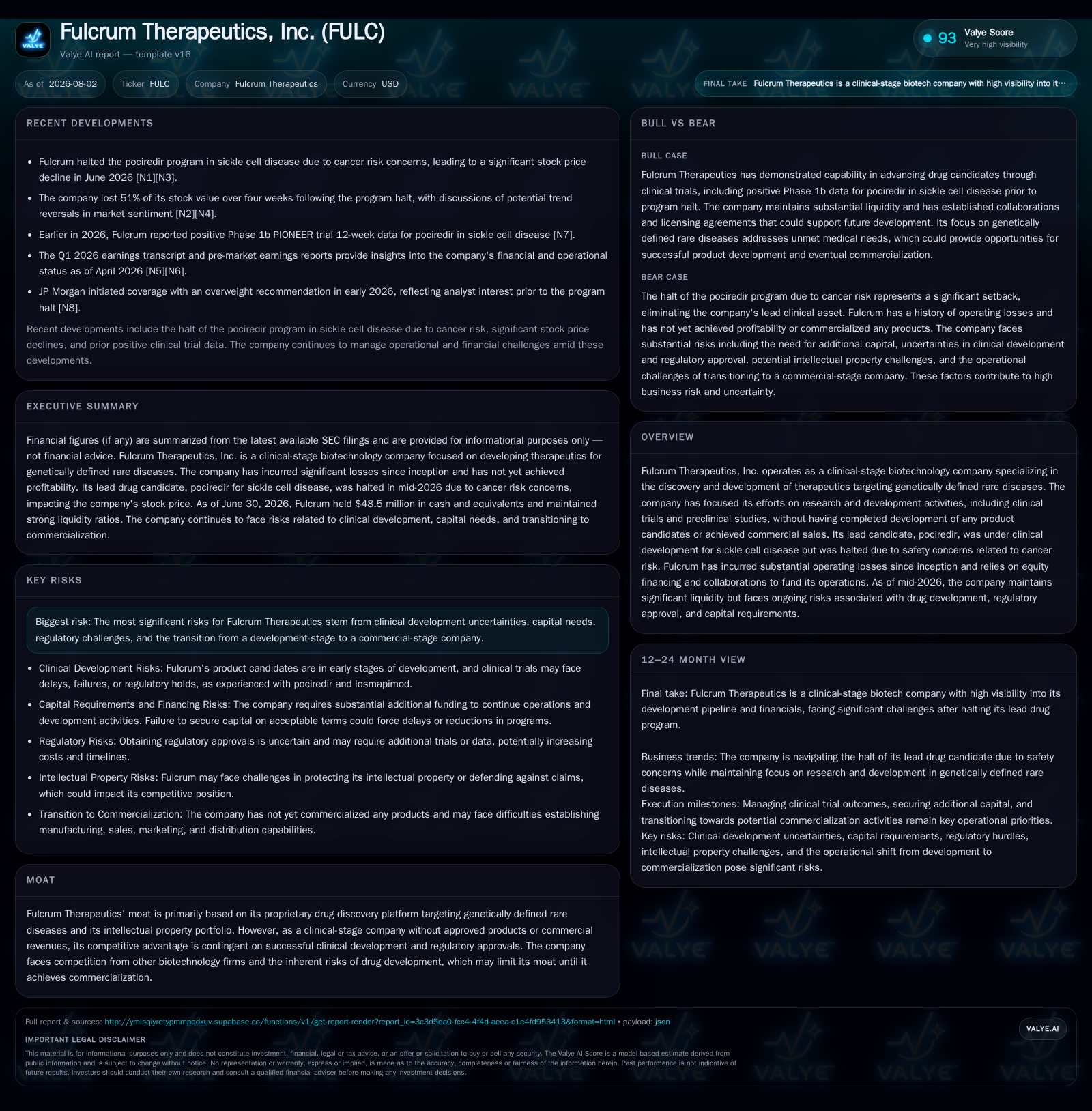
Fulcrum Therapeutics, a clinical-stage biotechnology company focused on genetically defined rare diseases, reported a major operational shift in mid-2026 following safety-related discontinuation of its lead candidate pociredir. The company enacted an 85% workforce reduction to preserve capital and initiated a strategic review process to explore potential transactions. Despite substantial ongoing operating losses and an absence of approved products, Fulcrum maintains significant liquidity as it seeks to recalibrate its pipeline and long-term strategy. This transition underscores typical biotech sector risks tied to clinical trial outcomes, regulatory hurdles, and capital intensity prior to commercialization.
Recent Operating Update
Fulcrum Therapeutics' latest quarterly report filed July 30, 2026, confirms significant operational changes following the discontinuation of its lead drug candidate pociredir for sickle cell disease (SCD) due to safety concerns involving increased cancer risk [S2][S4]. This setback is material given that pociredir was central to Fulcrum's pipeline strategy focused on genetically defined rare diseases. In direct response, the company implemented an extensive restructuring plan during Q2 2026 that cut approximately 85% of its workforce from 57 full-time employees down to only 9. The restructuring aims primarily at preserving cash reserves during uncertain near-term clinical developments [S4].
Concurrently, Fulcrum initiated a strategic review led by independent advisors Leerink Partners LLC to explore potential transactions that might include mergers, acquisitions, asset sales, or licensing agreements [S4][S6]. This process remains open-ended without a set timetable or guaranteed outcomes but signals management’s acknowledgment of the need for fundamental recalibration of strategy given the clinical challenges faced
Business Model Overview
As a clinical-stage biotechnology company without any approved products or commercial revenues to date, Fulcrum generates value mainly through the discovery and development of novel therapeutics targeting rare genetic disorders. Its operations are predominantly invested in research and development activities including preclinical studies and multiple phases of clinical trials aimed at proving safety and efficacy before regulatory submissions [S1]. The company's monetization model involves funding via equity issuances raised in public markets along with upfront payments and milestone-based revenue from licensing or collaboration agreements; however, milestone income is contingent on successful product advancement.
Revenue mechanics derive principally from upfront license fees and potential milestone achievements upon progress through clinical stages or regulatory approvals. Long-term revenues would depend on product commercialization either directly or via partnerships/licensing. Margins before commercialization are negative due to heavy R&D expenditures associated with long-cycle drug discovery programs.
Fulcrum’s proprietary drug discovery platform focuses on genetically defined rare diseases—a niche indicating potential scientific differentiation but also facing inherent uncertainties typical for early-stage biotech firms reliant on binary clinical outcomes. Its intellectual property portfolio underpins its competitive position but remains unproven until significant product candidates successfully traverse approval stages.
Industry Structure and Competitive Positioning
Fulcrum operates within the biotechnology sector specializing in rare disease therapeutics—an area characterized by specialized science, small patient populations, lengthy development cycles, rigorous regulatory scrutiny, and high capital intensity. The industry’s value chain places such companies predominantly in early-stage discovery through clinical development phases. Late-stage commercialization often requires partnerships with larger pharmaceutical firms due to scale and market access challenges.
Key competitors include other clinical-stage biotechs targeting rare genetic disorders with competing platforms or molecules seeking regulatory approval. While Fulcrum’s focus on genetically defined diseases could offer differentiation akin to peers like Sarepta Therapeutics or Blueprint Medicines that leverage precision medicine approaches, its lack of approved products limits competitive leverage.
The company's moat is thus largely dependent on proprietary discovery technology combined with intellectual property rights. However, this moat is fragile until demonstrable clinical success mitigates inherent biotech risks related to efficacy failures or unforeseen safety liabilities—a critical vulnerability highlighted by the halt in pociredir development.
Growth Drivers
Future growth prospects hinge heavily on several structural factors: successful advancement of current or new product candidates through clinical trial phases; securing regulatory approvals; expanding the pipeline via internal discovery or external licensing; strategic partnerships bringing both validation and financial support; and leveraging advances in genetic/molecular biology enabling targeted therapies for underserved rare disease populations.
Given increased attention from payors and regulators towards rare diseases with high unmet needs, Fulcrum’s platform addresses a growing therapeutic segment supported by favorable healthcare policies globally. Additionally, scientific advances improve chances of discovering impactful drug candidates that fulfill specific genetic mutation profiles.
Operationally important KPIs include number of active clinical trials (now reduced post-pociredir), R&D spending efficiency relative to peer benchmarks, cash runway sustaining development activities amid restructuring-induced cost reductions, as well as potential milestone payments linked to collaboration agreements if new pipeline assets materialize.
Risks and Constraints
Fulcrum faces prominent risks typical of early-stage biotech companies but accentuated by recent setbacks:
- Clinical development uncertainty is front and center after safety-related termination of pociredir—underscoring binary phase-transition risk impacting valuation and investor confidence [S2][S4].
- Capital requirements remain substantial; although cash reserves are solid short term (cash approx. $48.5 million as of June end), the reduced workforce indicates constrained burn capacity absent additional financing or transaction proceeds [F1][S4].
- Regulatory complexity around genetically targeted therapies may prolong timelines or require expensive additional studies.
- Intellectual property litigation risks linger amid competitive patent landscapes common in biotech innovation fields [S12][S26].
- Transitioning from clinical-stage without commercial products necessitates continued reliance on equity markets or partnership deals vulnerable to market conditions.
- Compliance burdens increase due to evolving laws around data privacy (e.g., GDPR) and emerging AI technologies used in R&D workflows potentially adding operational overheads [S15][S19].
- Market acceptance hurdles persist around pricing/reimbursement even if approvals are achieved given payor scrutiny on novel therapies’ cost-effectiveness [S14].
What To Watch Next
Upcoming milestones critical for monitoring include:
- Outcomes from ongoing strategic review could yield announcements about partnerships, asset sales or organizational restructurings pivotal for Fulcrum's survival trajectory.
- Any new pipeline additions internally discovered or acquired/licensed externally could signal reorientation towards broader therapeutic targets beyond SCD.
- Regulatory developments concerning existing candidates or new IND submissions will indicate progression capability despite recent headwinds.
- Quarterly financial updates will reveal burn rate post-restructuring relative to cash reserves informing runway estimation.
- Updates regarding intellectual property portfolio expansions or defense efforts may affect competitive positioning.
- Further insider transactions might provide insights into management confidence amidst volatility [N1]
Financial Profile Discussion
Fulcrum Therapeutics’ financial position reflects the profile expected for a clinical-stage biotech undergoing significant transition post-clinical setback. As of June 30, 2026, the company held approximately $48.5 million in cash and cash equivalents paired against current liabilities near $10 million resulting in an exceptionally strong current ratio exceeding 31x—largely driven by low liabilities rather than operating income generation capabilities [F1]. This liquidity provides limited cushion primarily aimed at supporting minimal ongoing operations after an aggressive workforce reduction.
In summary, while Fulcrum’s financial reserves allow temporary operational runway post-restructuring, sustainability depends on successful execution of strategic alternatives or securing partnership/licensing avenues alleviating sole equity financing reliance inherent before generating product-derived revenues.
This analysis synthesizes publicly available SEC filings as recent as July 30, 2026 ([S2], [S3], [F1]) alongside contemporary industry context without projecting investment research views. Readers should interpret forward-looking elements cautiously recognizing underlying biotech sector volatility amplified by clinical trial discontinuations typical at this development juncture.
Disclaimer: This is research-only, informational analysis and not investment advice. It may include AI-generated interpretation and general industry context. Always verify important details using primary sources.

Comments