
Flex Ltd.’s Diversified EMS Model Energized by Cloud Infrastructure Spin-Off and Robust Liquidity
Flex's latest quarterly update underscores strategic repositioning through a planned spin-off and operational momentum driven by AI infrastructure growth.
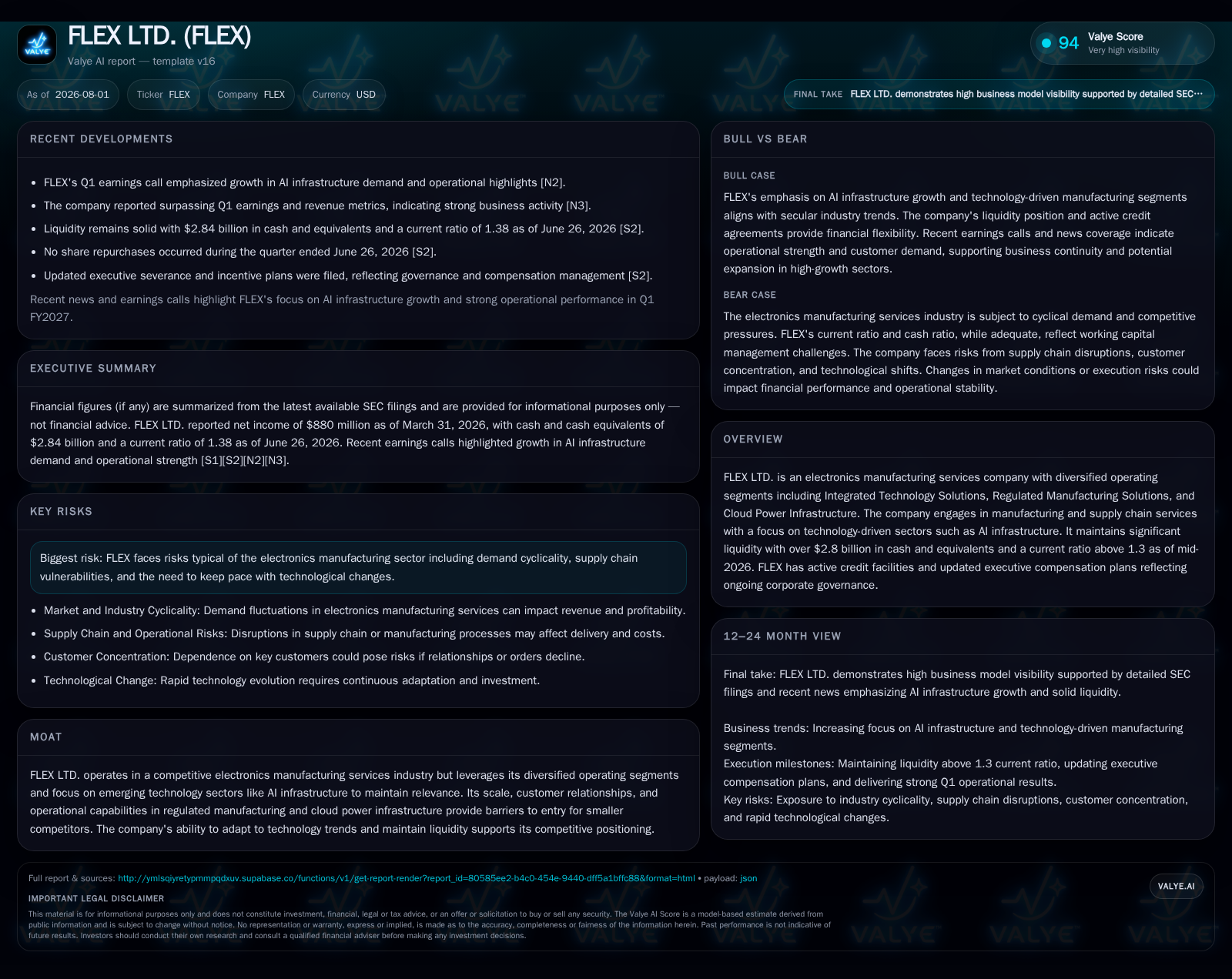
Flex Ltd.'s Q1 fiscal 2027 results highlight strong demand in its cloud power infrastructure segment, supporting a scheduled spin-off expected to unlock value and sharpen strategic focus. The company’s integrated EMS model, spanning Integrated Technology Solutions, Regulated Manufacturing Solutions, and Cloud Power Infrastructure segments, benefits from diversified exposure to technology-driven markets. Robust liquidity with over $2.8 billion in cash and a solid current ratio supports capital-intensive operations amid ongoing supply chain complexity. Risks remain related to cyclicality and regulatory compliance, but leadership appointments tied to the spin-off provide clarity on execution milestones.
First Quarter Snapshot: Operational Highlights Signal Strategic Focus Shift
Flex Ltd.'s first quarter of fiscal 2027 reveals operational momentum largely driven by elevated demand in its Cloud Power Infrastructure (CPI) segment, a reflection of the industry-wide acceleration in AI infrastructure deployments that require specialized contract manufacturing expertise [S2][N1]. The company reported improved order intake supporting an optimistic outlook for capacity utilization rates tied directly to build-to-order contracts from original equipment manufacturers (OEMs). This uptick validates Flex's positioning within high-growth EMS verticals that underpin modern data center demands.
Concomitantly, an 8-K filing disclosed leadership appointments specifically linked to the planned spin-off of the CPI business into an independent entity [S3]. The move aligns with Flex’s board strategy to unlock shareholder value through increased strategic focus and operational agility. These executives will lead their respective companies post-separation, subject to board and regulatory approvals. As such, Flex's near-term operating environment is shaped by both sustaining growth drivers in AI/cloud infrastructure and orchestrating complex corporate restructuring.
Segmented Business Model Drives Diversification and Customization
Flex's EMS operations span three core segments: Integrated Technology Solutions (ITS), Regulated Manufacturing Solutions (RMS), and Cloud Power Infrastructure (CPI), each serving distinct but complementary customer needs with specialized product offerings [S1][S7]. ITS focuses on technology-driven end markets including communications and lifestyle products with rapid innovation cycles necessitating agile design-for-manufacturability (DFM) processes combined with rigorous quality control. RMS caters to highly regulated sectors such as healthcare devices, automotive electronics, and industrial automation—areas marked by stringent compliance requirements that create higher switching costs for customers.
The CPI segment underpins mission-critical digital infrastructures supporting high-density AI data centers via integrated compute systems, power delivery, and advanced thermal management solutions [S1][S18]. This segment's turnkey systems-level scope—from server racks to facility-level electrical infrastructure—reflects its complex engineering demands unmatched by many peers. Flex’s competitive moat arises from these levers alongside specialization in regulated manufacturing markets where compliance burdens deter less sophisticated players.
By integrating design-for-manufacturability within their contract manufacturing workflows, Flex offers OEMs not just assembly but tailored turnkey solutions that combine engineering input with supply chain management. This breadth mirrors peer strategies at companies like Jabil or Sanmina but distinguishes Flex through greater depth in regulated manufacturing and emerging cloud infrastructure applications [S1]. The company’s systematic investments in automation and scalable production technologies further enhance existing operating margin profiles while preserving quality control—a critical KPI especially in medical device manufacturing segments.
Growth Catalysts Anchored in AI Infrastructure and Cloud Power Demand
AI infrastructure growth acts as a powerful structural tailwind for Flex’s CPI segment. As OEMs increasingly outsource the manufacture of power-dense digital infrastructure due to capital intensity considerations, Flex stands poised to capture expanding wallet share supported by longer average contract lengths typical in this domain [N1][S1].
Moreover, adoption of advanced liquid cooling technologies facilitates higher rack densities indispensable for next-generation AI workloads—a demand driver uniquely met through Flex’s integrated engineering-supply chain model [S7]. These growth vectors are complemented by rising customization requirements across ITS and RMS segments where product complexity compels customers toward partners capable of supply chain resiliency combined with regulatory compliance expertise.
Key KPIs such as order intake expansion, book-to-bill ratios above unity signaling future revenue queuing, and improving capacity utilization rates suggest that Flex is effectively translating macro trend momentum into tangible operating leverage.
Risks Rooted in Supply Chain Complexity and Cyclicality
Despite positive macro trends, Flex faces persistent risks reflective of the EMS sector’s structural characteristics [S2]. Cyclicality remains a significant headwind given OEM spending volatility; sudden shifts in demand can materially impact inventory turnover rates and margin stability. Ongoing global geopolitical tensions continue to exacerbate component sourcing challenges—a bottleneck effect particularly acute for cutting-edge semiconductors integral to AI hardware.
Regulatory complexities weigh heavily on the RMS segment due to its healthcare and automotive exposure requiring continuous adherence to evolving safety standards which inflate compliance costs. Additionally, labor shortages may threaten manufacturing yields or elevate defect rates if workforce quality erosion occurs amid competitive talent markets.
Maintaining on-time delivery rates—a key customer satisfaction metric—in the face of these risks will be critical evidence points determining Flex’s resilience. Currency fluctuations impacting international operations add another layer of risk.
Milestones Ahead: Spin-Off Execution and Capacity Expansion Targets
The announced leadership appointments formalize governance structures for the pending separation of the CPI business scheduled for early calendar 2027 pending customary approvals including board consent and Singapore High Court clearance [S3][S19]. Successful execution will separate high-growth cloud power infrastructure from ITS/RMS allowing each entity sharper strategic focus tailored capital allocation.
Investors should track key milestones such as formal shareholder votes, SEC compliance filings pertaining to tax-free treatment assurances, and operational efficiency targets guiding pre-spin cost management. The company’s current assets of $18.2 billion and current liabilities of $13.2 billion imply a current ratio of approximately 1.38, indicating adequate short-term financial flexibility amid capital-intensive operations [F1]
Notably, there were no share repurchases during the last quarter signaling disciplined capital allocation prioritizing organic growth investments over payouts given prevailing cyclical uncertainties [S2]. Revised executive compensation plans introduced augment governance alignment towards balanced risk-reward incentives supporting both spin-offs’ value realization objectives [S2].
This analysis synthesizes information from Flex Ltd.’s recent SEC filings including the Q1 FY27 10-Q release dated July 31, 2026 [S2], an accompanying 8-K announcement on July 29 regarding spin-off plans [S3], as well as broader annual disclosures outlining segment strategy [S1][S7] supported by current financial snapshot data from companyfacts [F1] and pertinent market commentary [N1]. It reflects a nuanced interpretation focused on operational performance drivers linked explicitly to business model segmentation amid macrosector dynamics rather than providing investment guidance or forecasts.
Disclaimer: This is research-only, informational analysis and not investment advice. It may include AI-generated interpretation and general industry context. Always verify important details using primary sources.

Comments