
A.O. Smith Advances Water Heating Growth via Distribution Power and Regulatory Adaption
Q2 2026 results reflect balanced pricing strategies, warranty cost pressures, and geographic dynamics shaping A.O. Smith’s replacement-driven water heating business.
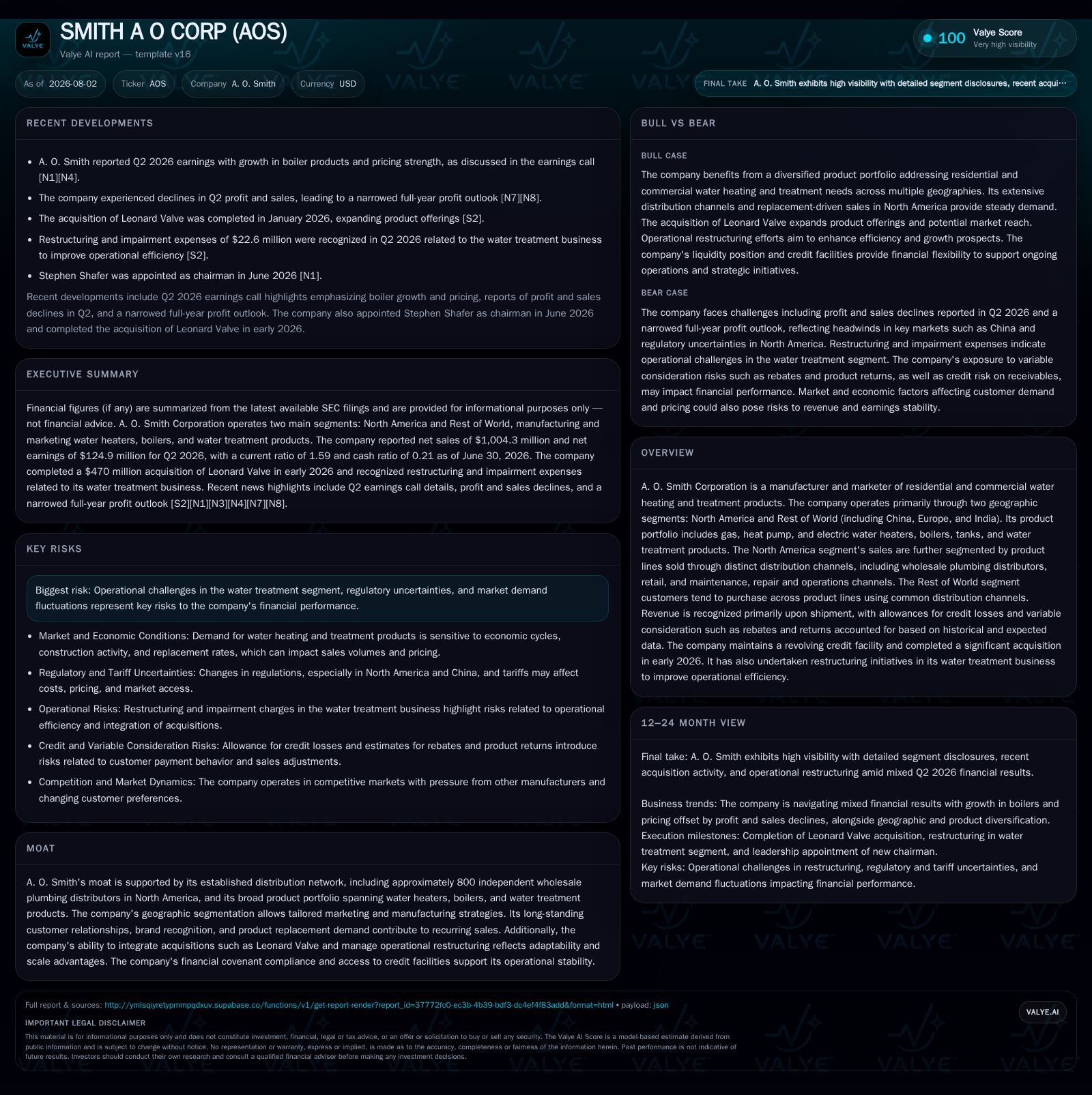
In Q2 2026, A.O. Smith navigated a complex mix of softer residential volumes offset by price increases and robust boiler sales, while warranty liabilities edged higher reflecting product quality and installed base aging factors. The company’s wide wholesale plumbing distributor network underpins stable recurring revenues, particularly in North America, where differentiated regional regulations influence product design and pricing. Growth initiatives focus on heat pump water heaters and expansion in emerging markets despite continued headwinds in China. Raw material inflation remains a margin pressure, managed through derivative hedging strategies. Financially, the firm maintains solid liquidity with net cash positioning and covenant compliance supporting operating stability.
Q2 Operating Shifts Reflect Pricing Discipline and Warranty Cost Trends
A.O. Smith's latest quarterly filing highlights a nuanced operating landscape where modest volume softness in its core North America residential water heater segment was largely offset by measured price increases ranging between four to seven percent implemented at the end of Q2 2026 [S23]. This pricing resilience is critical given ongoing input cost inflation impacting steel and other commodities. Commercial boilers saw robust volume gains—21% growth in Q2—driven by pre-buy behaviors ahead of anticipated regulation shifts and price hikes [S23]. The interplay between stable unit shipments alongside ASP gains supports revenue durability despite a slightly weaker market backdrop.
Distribution Channel Strategy Fuels Competitive Moat in Replacement Markets
A.O. Smith's moat continues to leverage its comprehensive distribution network dominated by roughly 800 independent wholesale plumbing distributors across North America [S1], a foundation that underpins strong recurring revenue streams particularly from replacement demand, which historically drives majority unit movements in residential markets due to equipment lifecycle turnover. This channel dominance grants the company not only pricing influence but also valuable shelf space control versus retail or maintenance, repair and operations (MRO) channels that typically command different margin profiles [S1][N1].
The company's segmentation approach further sharpens channel focus: North America sales split distinctly by product lines sold through wholesale distributors, retail outlets, and MRO channels—each with unique buying dynamics—while Rest of World customers generally purchase across product lines within common distribution frameworks [S19]. This multi-channel approach bolsters A.O. Smith’s competitive positioning relative to peers such as Rheem Manufacturing Company and Bradford White Corporation who compete heavily in residential/commercial water heaters but may lack comparable global distribution breadth or diversified aftermarket parts revenue streams.
Geographic Segmentation Shapes Manufacturing and Sales Tailwinds
Geographic segmentation remains central to A.O. Smith’s strategy, materially influencing manufacturing footprint decisions that emphasize regional proximity to markets while managing supply chain risks [S1]. North America remains the largest revenue contributor with steady demand tempered by predicted low single-digit declines in residential industry volume owing to softer new construction starts [S23]. Regulatory headwinds impact timing: notably, enforcement by the U.S. Department of Energy (DOE) for new commercial gas water heater energy efficiency requirements was delayed by up to one year from October 2026, providing both relief and uncertainty on replacement timing [N1][S23].
In contrast, the Rest of World segment faced marked challenges with China third-party sales down approximately 28% in local currency terms amid continuing market softness including cessation of certain incentives [S23]. Europe and India provide partial dampening of this weakness but remain far smaller contributors overall. The company’s manufacturing localization in these regions mitigates tariffs impacts but cannot fully shield from macroeconomic volatility or regulatory complexity.
Growth Path Supported by Energy Efficiency Innovation and Emerging Markets Expansion
A key growth driver is rising penetration of heat pump water heaters—a technology segment aligned with tightening environmental regulations favoring high-efficiency electric solutions over fossil-fuel dependent units [S1][N1]. Government incentives in various jurisdictions bolster consumer uptake of these products offering better margins compared to traditional gas units while sustaining relevance amid evolving energy policies.
Moreover, strategic acquisitions such as Leonard Valve expand A.O. Smith’s footprint beyond core water heating into complementary plumbing controls markets, enhancing cross-selling opportunities though adding near-term acquisition-related transaction expenses reflected partially in adjusted EPS guidance reduction [S16][N1]. Continued dealer network expansion focused on water treatment products supports sustainable revenue growth through recurring aftermarket parts sales—a more stable income source less sensitive to new construction cycles.
Risk Factors Center on Raw Material Inflation and Regulatory Compliance
Input cost pressures persist as a salient risk; steel prices and other raw materials remain volatile globally, threatening gross margin compression despite price adjustments [S2][N1]. The company actively uses derivative instruments like commodity futures contracts to manage raw material price exposures along with foreign currency hedges targeting regions heavily influenced by exchange rate fluctuations such as India and China [S2].
Regulatory compliance complexity also poses operational risk; apart from uncertain timing around DOE enforcement action delays impacting demand patterns, evolving international trade policies could introduce tariff changes creating cost challenges or supply interruptions [S1][N1]. Additionally, the company faces ongoing tax audits across multiple jurisdictions adding potential financial volatility tied to unrecognized tax benefits totaling $13 million as of June 30, which could affect effective tax rates if realized [S2].
Key Milestones and What to Monitor Ahead for Performance Validation
Looking forward into H2 2026 and beyond, critical performance indicators will include unit shipment trends particularly within the replacement-heavy residential North America market segment weighted against new construction softness [N1]. Monitoring order backlog shifts tied to boiler pre-buy programs offers insight into sustained commercial strength while early indicators from heat pump adoption curves will test innovation-driven growth assumptions.
Additionally, management commentary underscores cautious optimism around China market recovery timelines alongside integration progress for acquisitions like Leonard Valve which will contribute incrementally to top-line diversification [N3][S23]. Smith maintains solid liquidity with cash & equivalents at $181 million against current liabilities totaling approximately $872 million resulting in a healthy current ratio near 1.59—a positive indicator for short-term obligations coverage [F1]. Total debt stood near $155 million based on best available estimates from year-end but given cash levels implies negative net debt positioning around -$26 million effectively signaling low leverage risk factoring in recent debt taken on for acquisition financing [F1].
This analysis draws solely upon currently filed SEC disclosures augmented with reputable earnings call insights without speculative forecast or investment conclusion statements.
Disclaimer: This is research-only, informational analysis and not investment advice. It may include AI-generated interpretation and general industry context. Always verify important details using primary sources.

Comments