
Liberty Broadband's Strategic Transition Hinges on Charter Acquisition and Equity Method Investment Dynamics
Liberty Broadband operates as a controlling equity investor in Charter Communications, navigating a pending merger while managing liquidity and capital structure risks.
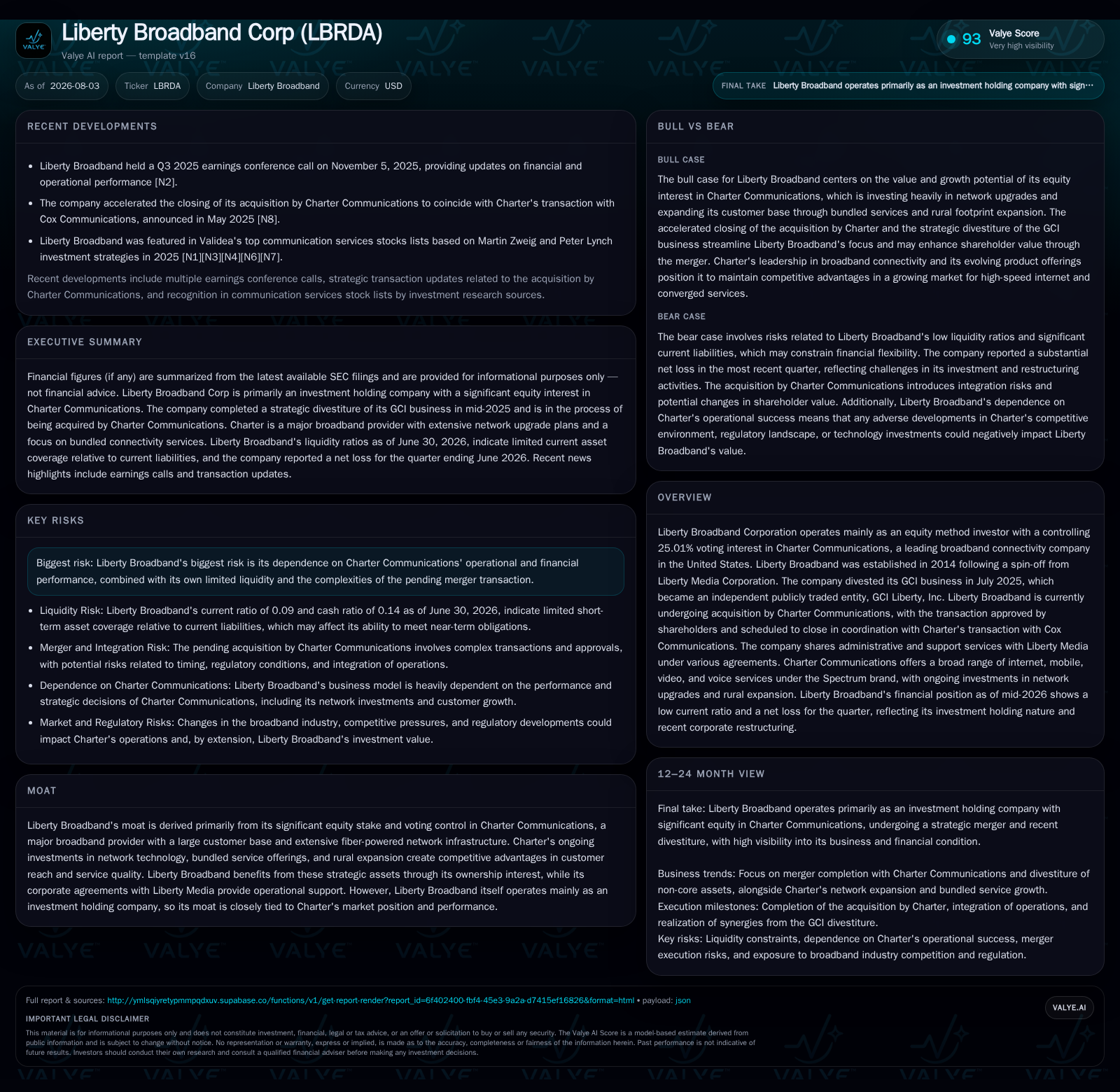
Liberty Broadband Corporation primarily functions as an investment holding company with a 25.01% voting stake in Charter Communications, which drives its financial performance through equity method investment income. Following the divestiture of its GCI business in mid-2025, Liberty Broadband is preparing for acquisition by Charter, contingent on broader transactions involving Cox Communications. The company’s near-term operating updates highlight ongoing share repurchases and loan arrangements with Charter to support liquidity amid merger-related limitations. Its moat is tethered to Charter's broadband market position, and risks center on merger complexities, cash constraints, and dependency on Charter’s results.
Recent Operating Update
Liberty Broadband Corporation's latest filing dated July 29, 2026, confirms the company's ongoing status as an equity-method investor holding a controlling 25.01% voting interest in Charter Communications—the primary driver of its operating results [S2], [S1]. Notably, following the divestiture of its GCI business in July 2025—a strategic move that separated prior diversified broadband holdings—Liberty Broadband's focus sharpened exclusively on broadband investments anchored through Charter ownership [S1].
Central to recent developments is the approved pending acquisition of Liberty Broadband by Charter Communications, scheduled to close simultaneous with Charter's acquisition transactions involving Cox Communications [S1], [S3]. This coordination suggests a strategic consolidation posture aiming to scale the combined entity's market presence in U.S. broadband connectivity.
Key operational mechanics include a monthly share repurchase program coordinated between Liberty Broadband and Charter mandating repurchases of at least $100 million of Charter common stock held by Liberty Broadband or loans from Charter if repurchases fall short due to voting caps or other conditions. This structure effectively monetizes legacy equity holdings into manageable cash flows while maintaining ownership thresholds critical for governance control requirements pre-merger [S1], [S26].
Additionally, financing arrangements signed in May 2026 introduced term loans from Charter to Liberty Broadband totaling approximately $359 million initially. These loans bear floating interest linked to Term SOFR plus a spread and serve dual purposes: supporting debt refinancing efforts—including repayment of prior margin loans—and maintaining interim liquidity amid merger-related restrictions on capital movements [S16]. These steps illustrate agile liquidity management but also expose the company to rising interest rate risks.
Business Model
Liberty Broadband operates purely as an investment holding company without direct broadband operations or consumer service offerings. Its revenues originate predominantly from equity earnings recorded via the equity method reflecting Charter's net income attributable to Liberty’s ownership stake [S1]. Additional financial inflows include dividends declared by Charter, proceeds from share repurchases conducted by Charter under contractual agreements designed for orderly monetization of Liberty's stake, and occasional loan facilities extended by Charter specifically timed around corporate transactions.
The company's cost base is limited mainly to general administrative expenses provided under service agreements with related entities like Liberty Media Corporation. These inter-company contracts cover legal, tax, accounting, IT support, cybersecurity functions, and investor relations activities with negotiated reimbursements mitigating direct operating expense volatility [S1]. Such arrangements signal operational efficiency common among telecom-focused investment vehicles that seek lean corporate overhead.
With no operational revenue streams independent of its portfolio investments, Liberty Broadband’s financial success closely tracks the capital appreciation potential of its charter holdings and periodic liquidity events structured through repurchases and dividends.
Industry Structure and Competitive Position
As a holding entity within the broader telecommunications ecosystem, Liberty Broadband occupies a capital allocation layer directly above actual broadband network operators such as its primary portfolio company, Charter Communications. Whereas providers like Comcast and Cox engage directly with end customers through bundled internet/video/voice services under consumer brands (e.g., Spectrum for Charter), investment companies like Liberty concentrate ownership influence without operational responsibilities.
This positioning exposes Liberty Broadband's valuation and cash flow profile almost entirely to the competitive dynamics shaping U.S. broadband providers—scale advantages driven by extensive fiber optic network infrastructure upgrades; spectrum allocation; pricing power over premium bundled service offerings; rural broadband expansion policies incentivized by federal programs; and regulation impacting pricing flexibility or market entry barriers.
Within this context, Liberty holds a durable moat primarily through voting power control at Charter amounting to 25.01%. Coupled with active participation in shareholder agreements enabling controlled divestitures via share repurchases or mandated financing from Charter during transitional periods bolsters political leverage over executive actions at its core operating investee.
Industry peers vary widely: some investment companies such as GCI Liberty act similarly in focused portfolios spun off from diversified media conglomerates; others include telecom infrastructure funds specializing purely in fiber or wireless assets without direct operator stakes; meanwhile publicly traded network operators confront direct customer competition risks absent protective governance layers seen at holding firms like Liberty Broadband.
Growth Drivers
Though Liberty Broadband itself does not generate organic growth metrics directly (like subscriber additions or ARPU increases), it benefits passively from multiple growth vectors realized by its investee:
- Network Expansion: Ongoing capital expenditures by Charter to upgrade fiber infrastructure increase customer reach and service quality.
- Bundled Services Demand: Rising consumer preference for high-speed internet combined with video and mobile offerings fuels higher revenue per user achievable by operators.
- Regulatory Incentives: Government programs aimed at rural broadband penetration create new markets potentially captured by spectrum-based providers like Charter.
- Consolidation Synergies: The planned transaction involving Cox Communications alongside the merger blending Liberty into Charter could strengthen scale economies reducing operational costs per subscriber across expanded geographies.
- Share Repurchase Programs: Mechanisms converting portfolio shares into liquidity inject shareholder value realization cycles benefiting investment holding valuations indirectly.
Monitoring these investee-level KPIs within public disclosures from Charter will serve as leading indicators for downstream impacts on Liberty Broadband’s reported earnings through equity income recognition.
Risks and Watchpoints
Liberty Broadband faces several material risks predominantly arising from its structural dependence on a single major investee—Charter Communications:
- Operational Concentration Risk: Any deterioration in Charter’s competitive positioning due to intensified pricing wars with Comcast or regulatory changes limiting content bundling could reduce earnings passed through as equity income.
- Liquidity Constraints: The company exhibits a very low current ratio (~0.09) given roughly $43 million cash against over $880 million current liabilities as of June 30, 2026; this mandates reliance on contractual liquidity provisions via share repurchases or loans from Charter that are subject to availability conditions within merger agreements [F1], [S2].
- Debt Leverage Exposure: With total debt approximating $1.22 billion net of cash around $43 million resulting in net debt near $1.18 billion, servicing costs depend partly on floating rate borrowings exposing finance charges to interest rate volatility not fully hedged despite relatively low coupon exchangeable debentures outstanding [F1], [S20].
- Merger Execution Risk: Closing timing aligned with another major transaction (Cox) adds complexity; failure to consummate could lead to covenant breaches or revaluations impacting investor returns.
- Governance Conflicts: Overlapping director/officer roles across affiliated entities including Liberty Media introduce potential conflicts requiring careful arms-length governance oversight referenced explicitly within risk disclosures [S1].
- Tax and Accounting Risks: Treatment of net operating losses or deferred tax assets can be adversely impacted by ownership changes tied closely to merger activity affecting future taxable income reductions availability.
Close tracking of official regulatory filings ahead of scheduled conference calls announced for early August 2026 will provide further clarity into execution status along with supplemental Q&A sessions addressing shareholder concerns about integration plans [S3], [S8].
Financial Profile Discussion
Disclaimer: This is research-only, informational analysis and not investment advice. It may include AI-generated interpretation and general industry context. Always verify important details using primary sources.

Comments